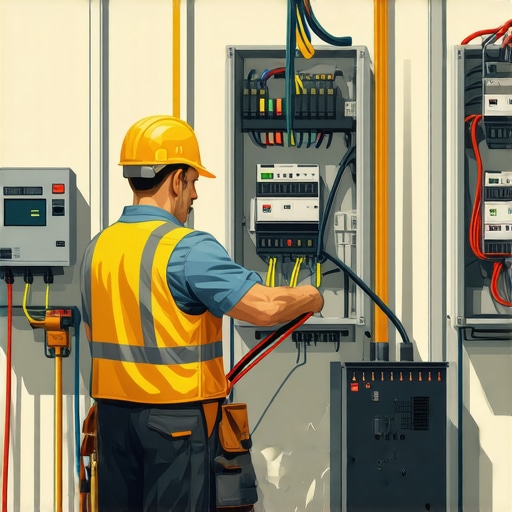
The Smell of Burning Phenolic and the Old Timer’s Lesson
You smell it before you see it. That sickly-sweet, fishy odor of a 1970s-era circuit breaker cooking itself from the inside out. My journeyman used to smack my hand if I stripped a wire with a knife. ‘You nick the copper, you create a hot spot,’ he’d scream. He was right. That tiny notch in the conductor reduces the cross-sectional area, increasing resistance at that specific point. In a workshop where you’re running a table saw and a dust collector simultaneously, that hot spot isn’t just a theory; it’s an ignition source. Most people walking into 2026 think their garage is ready for a high-performance shop because they added a power strip. They’re wrong. They are building a fire trap, one loose terminal at a time.
Mistake 1: The Load Center Upgrade Neglect
The heart of your workshop is the load center, and if you’re working with a mid-century home, you’re likely sitting on a ticking clock. I’ve seen homeowners try to run three phase power services for industrial lathes off an old 100-amp Federal Pacific panel. Those ‘Stab-Lok’ breakers are notorious; they jam and refuse to trip even when the bus bar is melting. A proper load center upgrade isn’t just about adding more spaces for breakers; it’s about the physics of the bus bar itself. When you draw heavy current, the interaction between the breaker clip and the bus bar creates micro-vibrations. If there’s any corrosion—especially in coastal areas where salt air acts as a catalyst—you get arcing. That arcing creates carbon tracking, which is basically a highway for fire.
“Aluminum wire connections can overheat and cause a fire without tripping the circuit breaker.” – CPSC Safety Alert 516
In 2026, with the prevalence of high-draw tools and even the occasional camper electrical panel being tapped into the main house, you cannot skip the calculation. You need certified journeyman services to perform a legitimate demand load calculation before you ever pull a single ‘Home Run’ of Romex. If you ignore this, you’ll be making those holiday emergency calls when your main lug glows cherry red while you’re trying to finish a project on Christmas Eve.
Mistake 2: The Bonding Jumper and the Ghost in the Machine
The most misunderstood concept in the trade is the difference between grounding and bonding. I’ve walked into shops where the DIYer used the neutral as a ground—a ‘bootleg ground.’ It works until it doesn’t. The moment that neutral connection fails upstream, every metal casing on your tools becomes live. This is why bonding jumper services are non-negotiable. You are creating a low-impedance path back to the source to ensure the breaker actually trips during a fault. In a workshop, where you have metal conduit, workbenches, and heavy machinery, everything must be bonded. When I use my ‘Wiggy’ (solenoid voltmeter) and see a phantom voltage between the neutral and the ground, I know someone skipped the bonding. It’s the difference between a minor spark and a fatal shock. If you’re planning a PA system installation for your shop or studio, that improper bonding will also manifest as a 60-cycle hum that no amount of filtering can fix. You have to respect the return path. I’ve seen guys use ‘monkey shit’ (duct seal) to try and hide poor fittings, but you can’t hide physics.
Mistake 3: Underestimating the Lighting Install and Voltage Drop
People think lighting install is just about seeing your work. In a workshop, it’s a safety feature. But here’s the catch: voltage drop. If you run 200 feet of #14 wire for your lights and tools, by the time the current reaches the end of the line, the voltage has sagged. Your motors run hotter, and your LED drivers flicker and die prematurely. For 2026 setups, you should be looking at dedicated circuits for your lighting to avoid the ‘strobe effect’ when a heavy motor starts up. This is similar to how electricians tackle troubleshooting for lighting installations in commercial settings. When the voltage drops, the amperage must rise to do the same amount of work. Heat follows the square of the current. You do the math. I’ve taken my ‘Dikes’ (diagonal cutters) to more ‘renovated’ shops than I can count because the owner used undersized wire that was literally charred under the insulation. If your lights dim when the compressor kicks on, your system is screaming for help. You might even need specialized lighting installations made easy through proper circuit branching rather than daisy-chaining off a single 15-amp breaker.
Mistake 4: Skipping Permit Pulling Services for the ‘Handyman Special’
Everyone hates the inspector until the house burns down and the insurance company denies the claim because there’s no record of permit pulling services. In 2026, insurance adjusters are getting smarter; they look for non-UL listed equipment and unpermitted ‘Rough-ins.’ Whether it’s a simple outlet switch repair or a complex PA system installation, the permit is your paper trail of safety. I once found a live junction box buried behind pegboard in a ‘pro’ workshop. I found it with my ‘Tick Tracer’ (non-contact voltage tester) glowing red through the wood. The owner had used a ‘Widow Maker’—a double-male cord—to backfeed a subpanel. It’s not just illegal; it’s homicidal.
“The authority having jurisdiction shall have the responsibility for making interpretations of the rules, for deciding on the approval of equipment and materials.” – NFPA 70: National Electrical Code (NEC)
If you are adding an EV circuit to your shop, ensure you are ensuring safe and efficient EV charging station setup at home by following the code to the letter. Don’t be the guy who thinks he knows better than a century of forensic fire data. Get the permit, do the ‘Trim-out’ correctly, and torque every lug to the manufacturer’s specifications. Only then can you sleep at night without one eye open, watching for the orange glow of a failing connection.