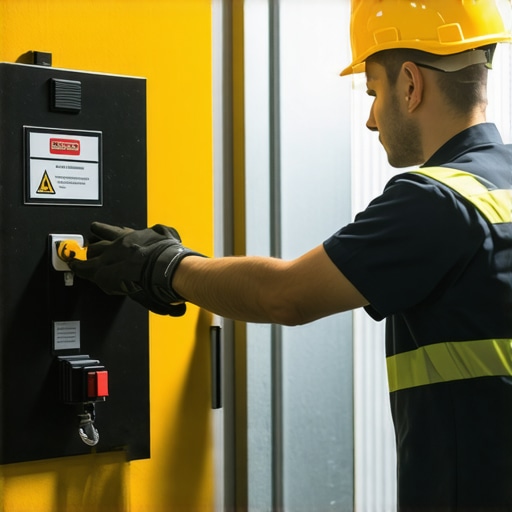
The Autopsy of a Near-Fatal Arc Flash
The smell hits you before the visual does—the sharp, metallic tang of ozone and the sickening scent of vaporized copper. I was called into a warehouse lighting retrofit project last month where a ‘qualified’ tech had skipped the final step of a lockout tagout (LOTO) procedure. He thought the circuit was dead because the switch was off. He didn’t account for a faulty capacitor in a legacy high-intensity discharge ballast. When his dikes cut the line, the stored energy released in a blinding flash that melted his pliers and pitted the concrete floor. This wasn’t a failure of equipment; it was a failure of discipline. Old Man Miller, my first journeyman back in ’89, had a pair of scarred Klein dikes that he used more as a disciplinary tool than a wire cutter. If he saw me using a utility knife to score the jacket on a home run, he’d rap my knuckles hard enough to bruise. ‘You nick that copper, you’re not just making a weak point, kid,’ he’d bark through a cloud of cigar smoke. ‘You’re creating a bottleneck for electrons, and that bottleneck generates heat. Heat causes the metal to expand, which loosens the terminal, which causes an arc, which burns the damn building down while you’re home eating dinner.’ He was obsessed with the physics of resistance long before it became a line item in a forensic report. As we move into 2026, the complexity of industrial sites—from retail store wiring to massive warehouse lighting retrofit projects—demands a level of forensic precision that goes beyond just throwing a padlock on a hasp.
“Aluminum wire connections can overheat and cause a fire without tripping the circuit breaker.” – CPSC Safety Alert 516
Rule 1: Forensic Preparation and Energy Mapping
In 2026, you don’t just walk up to a panel and start flipping breakers. Modern industrial sites are interconnected webs of primary power, UPS backups, and solar offsets. Before a single 24 hour emergency electrician touches a screwdriver, every energy source must be mapped. This includes pneumatic, hydraulic, and mechanical energy. In a warehouse lighting retrofit, for instance, you’re often dealing with multi-tap transformers that can backfeed if you aren’t careful. You need to identify every potential ‘hot’ point. This is the rough-in stage of safety. If your energy map is flawed, your lockout is a lie. This is especially critical during a fuse box to breaker conversion, where decades of ‘creative’ wiring by previous handymen might have bypassed standard isolation points. You have to assume every wire is a widow maker until proven otherwise.
Rule 2: The Physical Isolation of Legacy Infrastructure
We are seeing a massive surge in 60 amp panel upgrade requests because modern industrial and residential loads are crushing old infrastructure. The rule for 2026 is absolute physical isolation. In old systems, particularly those requiring a fuse box to breaker conversion, the mechanical components of the switchgear are often pitted or corroded. A handle might move to the ‘off’ position, but the internal blades can remain welded shut due to past arcing. This is where a ‘Tick Tracer’ is useless. You need a real solenoid tester—a ‘Wiggy’—to put a load on the circuit and verify zero potential. For boat lift wiring, where salt air corrosion creates conductive paths across insulators (salt bridging), physical isolation must also include checking for stray current from the water itself. We use ‘Monkey Shit’ (duct seal) to prevent that humid, salt-laden air from migrating through the conduit, but it doesn’t replace a solid LOTO protocol.
“Employees shall be trained to know that the circuit parts to which they might be exposed are de-energized.” – OSHA 1910.333(b)(2)
Rule 3: Digital Verification and Smart Lockout Tags
By 2026, OSHA compliance wiring will increasingly involve smart breakers and IoT-integrated lockout devices. However, the rule remains: hardware trumps software. Even if your tablet says the retail store wiring is de-energized, you still hang a physical tag and a heavy-duty lock. During a chandelier installation in a high-end commercial space, I’ve seen digital dimming systems ‘ghost’ power back onto a neutral wire through induction. The LOTO rule for the new era is digital verification followed by physical confirmation. If you’re doing track lighting services, the bus bar itself must be grounded after isolation to bleed off any induced voltage from parallel high-voltage lines. This prevents the ‘ghost voltage’ that often scares the hell out of apprentices during a trim-out.
Rule 4: Managing Stored Energy and Cold Creep
Stored energy isn’t just in capacitors; it’s in the thermal memory of the metal. Component zooming into the lugs of a 60 amp panel upgrade reveals a phenomenon called ‘Cold Creep.’ Aluminum conductors expand and contract at different rates than copper or steel terminals. Over time, this loosens the connection, creating a high-resistance junction. Even when locked out, these components can remain dangerously hot to the touch for several minutes. Rule four for 2026 industrial safety is the mandatory cooling and discharge period. Before you begin any up lighting services or warehouse lighting retrofit, you must ensure all capacitive loads are bled to ground. Never trust a system just because the light is off. If you’re called in as a 24 hour emergency electrician, you’re usually walking into a site where something has already failed; assume the stored energy is looking for a way out, and you don’t want to be that path.
Rule 5: The ‘Try-Out’ and Final Verification
The most skipped step in the LOTO process is the most vital: the ‘Try-Out.’ After you’ve locked it, tagged it, and tested it with your Wiggy, you must attempt to restart the equipment. This ensures that the isolation is actually on the circuit you intend to work on. I’ve seen cases in retail store wiring where the panel labels were off by one, and the electrician was working on a live 277V circuit while his lock was on the coffee machine circuit next door. This is why how electricians tackle troubleshooting for lighting installations always starts with verification of the specific load. For boat lift wiring, this means trying the motor manual override. For a warehouse, it means checking the contactors. If the machine stays dead, you’re safe to proceed. If it moves even a fraction of an inch, you stop and start the forensic trace over. Electricity isn’t a hobby; it’s a lethal force that requires 100% accuracy, 100% of the time. If you have any doubt about your facility’s compliance, you need to contact us before someone gets hurt.