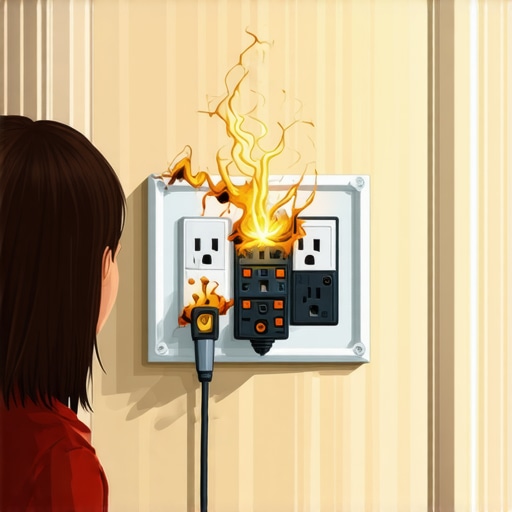
The Autopsy of a Silent Killer: Why Your Outlets are Screaming for Help
I’ve spent thirty-five years smelling what most homeowners ignore until the fire trucks arrive. I’ve crawled through attics where the dust is so thick it feels like breathing a wool sweater, and I’ve seen more ‘handyman specials’ than I care to count. When you walk into a house and catch that faint, metallic tang of ozone—it’s not a ‘new house smell.’ It’s the smell of oxygen being ionized by a localized lightning bolt inside your wall. By 2026, many homes are still operating on infrastructure designed for an era before 1,500-watt air fryers and electric vehicle chargers were the norm. If your outlets are showing signs of fatigue, you aren’t just looking at a cosmetic nuisance; you’re looking at a forensic evidence trail leading toward a structural fire.
The Flipper Special: A Forensic Discovery
I walked into a ‘fully renovated’ kitchen last month where the flipper had buried three live junction boxes behind a designer marble backsplash. I found them with my tracer because the homeowner complained of a ‘pulsing’ warmth near the toaster. When I finally broke through that expensive stone, I found cloth-insulated wires that had been spliced with nothing but masking tape. The copper was black with oxidation, and the heat had turned the surrounding wood studs into charcoal. This wasn’t just a mistake; it was a death trap hidden behind high-end finishes. Whether you are dealing with cloth insulated wiring replacement or a 1970s aluminum nightmare, the physics of failure remain the same: resistance creates heat, and heat creates fire.
“Aluminum wire connections can overheat and cause a fire without tripping the circuit breaker.” – CPSC Safety Alert 516
1. The Discoloration of the Faceplate: The Physics of Resistance
When you see a brownish tint around the slots of an outlet, that isn’t dirt. It’s carbonization. This happens due to a phenomenon called high-resistance heating. Think of electricity like water flowing through a pipe. If you suddenly narrow that pipe, the pressure builds. In a circuit, if a wire is loose under a screw terminal or if the internal brass contacts have lost their ‘spring’ tension, the current has to jump a tiny air gap. This is a micro-arc. This arc generates temperatures exceeding 1,000 degrees Fahrenheit. Over time, this thermal cycling causes Cold Creep—where the metal expands and contracts until the connection is so loose that the heat becomes a runaway train. If your outlet is warm to the touch, you need an after hours electrical repair immediately. Don’t wait for the smoke.
2. The ‘Wiggy’ Doesn’t Lie: Flickering and Voltage Drops
If you plug in a vacuum and the lights dim, or if your PA system installation is humming with 60-cycle interference, your home is telling you the ‘Home Run’—the main line from the panel—is struggling. This is often a sign that your old fuse box is overwhelmed. A fuse box to breaker conversion is no longer optional in 2026; it is a baseline safety requirement. Fuses are binary; they either work or they blow. But breakers can fail too, especially the old Federal Pacific or Zinsco brands that are notorious for ‘jamming.’ When these pivots seize due to corrosion or age, the breaker won’t trip even if the wire is melting. We see this often in restaurant kitchen electrical setups where high-draw appliances are constantly cycling. You need a meter socket replacement and a modern panel to handle these loads safely.
3. The Smell of Fish and Ozone
If you smell something fishy in a room where there’s no seafood, you’re smelling burning plastic and urea-formaldehyde resin. This is the scent of a device in the middle of a catastrophic failure. I’ve seen sign lighting installation projects where the ballast was literally melting into the mounting bracket, emitting that exact stench. It is the chemical signature of an electrical fire in its infancy. In older homes, this is often exacerbated by cloth insulated wiring replacement needs. The old rubber-and-cloth wrap becomes brittle with age, flaking off like dead skin and leaving the raw copper exposed to the elements or, worse, the metal conduit. Once that insulation is gone, a ‘Tick Tracer’ will light up like a Christmas tree just by touching the wall.
“Arc-fault circuit interrupters (AFCIs) are necessary to provide protection against the effects of arcing faults that may pose a risk of fire.” – NFPA 70: National Electrical Code
4. Loose Plugs and Mechanical Fatigue
If you plug your phone charger in and it falls out, the internal ‘wiping’ contacts of that outlet are shot. Inside every quality outlet are brass alloy leaves designed to grip the plug blades. After thousands of cycles, the metal loses its memory. This lack of tension creates—you guessed it—resistance. For seniors, this is especially dangerous as they might struggle to ensure a firm connection. We often provide senior discount services specifically to go through older homes and ‘rough-in’ new, high-tension commercial-grade outlets. This is even more critical for a pool pump electrical circuit, where vibration and moisture-laden air can accelerate the degradation of those metal contacts through galvanic reaction.
5. The Buzzing Sound (The Widow Maker)
A quiet hum might be normal for a transformer, but a ‘sizzle’ or ‘crack’ coming from a switch is a Widow Maker. That sound is the physical vibration of electrons jumping through the air. Arcing is essentially a continuous series of mini-explosions. If you hear this when you flip a switch, the internal spring mechanism is likely fractured. This is a common failure point in generator transfer switch installations that weren’t torqued to spec. When we do a sign lighting installation, we use a torque screwdriver to ensure every lug is at the exact inch-pounds required by the manufacturer. If a handyman just ‘hand-tightened’ it until it felt snug, it’s going to fail. We see this in restaurant kitchen electrical repairs all the time; the constant heat of the kitchen expands the terminals until they start singing that deadly song.
Upgrading for the Future: More Than Just a Switch
Fixing an outlet isn’t just about swapping a $2 piece of plastic. It’s about evaluating the entire system. Are you ensuring safe and efficient EV charging station setup at home? If you are adding a Level 2 charger but still have 1950s cloth wiring, you are asking for a disaster. Modern life requires modern protection. This includes troubleshooting for lighting installations to ensure that new LED drivers aren’t being fried by voltage spikes from a failing neutral. Whether you are doing a step-by-step electrician guide for a DIY project or calling in a pro for a meter socket replacement, the goal is the same: eliminate resistance. If you’re seeing these signs, it’s time to contact us before the forensic inspector is the one writing the report on your house. Don’t let a ‘Handyman Special’ be the last thing that happens to your electrical system. Torque it down, wire it right, and sleep at night.