
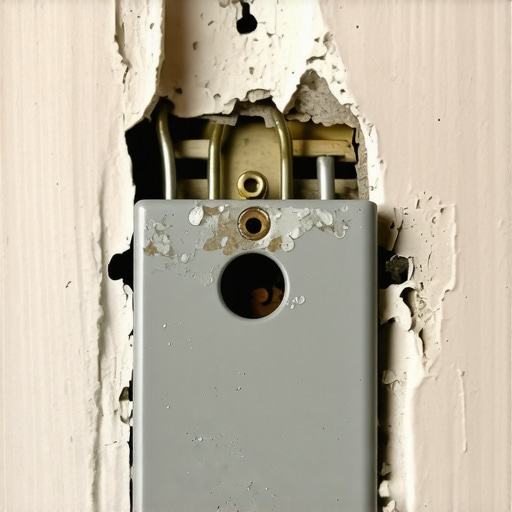
The Ghost in the Walls: A Mid-Century Legacy
You step into a charming 1968 ranch-style home, the kind with solid bones and original hardwoods. But as a forensic inspector who has spent three decades staring at the aftermath of electrical catastrophes, I don’t look at the floors. I look at the outlets. If those walls were closed up between 1965 and 1973, there is a high probability they are housing a ticking clock made of solid-conductor aluminum. This isn’t just an ‘old house’ quirk; it is a fundamental metallurgical mismatch that has kept the insurance industry and fire marshals awake for half a century.
The Old Timer’s Lesson on Metallurgy
My journeyman used to smack my hand if I stripped a wire with a knife. ‘You nick the copper, you create a hot spot,’ he’d scream. He was right. With copper, a nick is a 10% reduction in surface area. With aluminum, a nick is a death sentence. Aluminum is brittle. It’s soft. If you score that conductor while prepping for a rough-in, the mechanical stress of thermal expansion will snap that wire right at the terminal. I’ve seen home run circuits where the wire was held together by nothing but the charred remains of the insulation and a prayer. This is why we don’t just ‘fix’ aluminum; we remediate it with forensic precision.
“Aluminum wire connections can overheat and cause a fire without tripping the circuit breaker.” – CPSC Safety Alert 516
The Physics of Failure: Cold Creep and Oxidation
Why did the industry pivot to aluminum? It was cheap during the Vietnam War copper shortage. But the physics didn’t care about the budget. Aluminum has a significantly higher coefficient of thermal expansion than copper. Every time you turn on a space heater or a hair dryer, the wire heats up and expands. When you turn it off, it contracts. In the trade, we call this ‘Cold Creep.’ Because the aluminum expands more than the steel or brass screws on your standard 1970s-era receptacles, it literally squeezes itself out from under the terminal. Over hundreds of heating and cooling cycles, the connection becomes loose. A loose connection creates resistance. Resistance creates heat. Heat creates more oxidation.
Speaking of oxidation: when copper oxidizes, the green patina is still conductive. When aluminum oxidizes, it forms a white crust of aluminum oxide—an incredible electrical insulator. Now you have a high-load current trying to push through a layer of insulation at the terminal. That’s when the ‘fishy smell’ starts. That’s when the plastic on the outlet starts to brown and warp. By the time you notice the flickering lights, the tick tracer is already screaming at a wire that’s reaching 300 degrees Fahrenheit behind the drywall.
The Infrastructure Trap: From Panels to Peripherals
In neighborhoods built during this era, the aluminum problem is often compounded by the panels used. You’ll frequently find Federal Pacific or Zinsco panels—brands that are notorious for breakers that refuse to trip even during a dead short. If you have aluminum branch circuits feeding into a jammed breaker, you don’t have a safety system; you have a blast furnace. This is why we often recommend AFCI breaker services as a secondary layer of protection. An Arc-Fault Circuit Interrupter is designed to detect the specific signature of an arcing loose connection—the kind aluminum is famous for—and kill the power before the framing studs ignite.
We see homeowners trying to modernize these houses without addressing the core. You want a sauna heater installation or a high-draw EV charging station setup at home? You cannot simply tap into a 1970s aluminum circuit. The amperage requirements of modern life will melt that old wiring in a week. Even something as simple as troubleshooting for lighting installations in an aluminum-wired home requires specialized knowledge. You can’t just use standard wire nuts. If I catch a ‘handyman’ using a standard tan wire nut to twist copper and aluminum together, I’ll pull him off the job myself. That’s a galvanic corrosion nightmare waiting to happen.
The Remediation: Doing It Right
There are only three ways to handle this safely. First, a total rewire. This is the gold standard, often involving knob and tube removal if the house is even older, or a full pull of new copper Romex. It’s expensive, but it’s the only way to sleep with 100% certainty. Second, the COPALUM crimp. This requires a specialized hydraulic tool and a certification most guys don’t have. It cold-welds a copper pigtail to the aluminum wire. Third, and most common for residential fixes, is the AlumiConn connector. Unlike the ‘purple wire nuts’ which have a history of failure, AlumiConn uses lug-style screws to apply specific torque to the connection, separating the metals and preventing the creep.
“The most common cause of fire in aluminum-wired homes is at the points of connection—outlets, switches, and junction boxes.” – NFPA 70 Research Report
We often get calls for 24 hour emergency electrician services because someone’s ‘wall started buzzing.’ When we arrive with our Wiggy and thermal cameras, we usually find a junction box that’s been buried behind plaster—a total Code violation. For those looking to upgrade their aesthetics, like adding tree mounted lights or a warehouse lighting retrofit for a home studio, the foundation must be copper. If your neighborhood was built between ’65 and ’73, don’t wait for the smell of ozone. Get a virtual consultation wiring review or take advantage of free electrical estimates to see what’s actually happening behind your switch plates. We even offer weekend electrician services because these problems don’t wait for Monday morning.
The Modern Load Challenge
Today’s homes are filled with non-linear loads—computers, LED drivers, and variable speed motors. These introduce harmonics into the system. In an old aluminum-wired home, these harmonics can cause additional heating on the neutral wire. This is why we sometimes integrate harmonic filter services when doing a panel heavy-up. We aren’t just looking to make the lights turn on; we are looking to ensure the impedance of your entire system is low enough to handle the 21st century. Whether it’s a simple trim-out or a complex service upgrade, the physics of aluminum cannot be ignored. Torque your lugs, use your dielectric grease, and for God’s sake, stop using those push-in ‘stab’ terminals on the back of cheap outlets. They are a death trap in a copper house and a guaranteed fire in an aluminum one.