
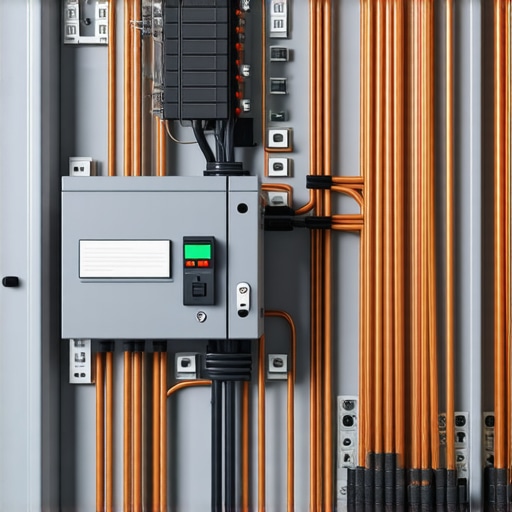
The Invisible Load: Why Your 100-Amp Panel is Whining
You hear it before you see it—that high-pitched, metallic hum coming from the utility closet every time the HVAC kicks on while the dryer is spinning. That’s the sound of a 100-amp service gasping for air. Back in the day, my first journeyman used to look at those old glass-fuse boxes and say, ‘Electricity is a lazy beast; it’ll take the easiest path to ground, even if that path is through your ribcage.’ He was a ray of sunshine, but he was right. Today, we aren’t just running three light bulbs and a radio. We’re plugging in Tesla chargers, high-end workshop electrical setup gear, and structured wiring panels that demand more juice than a 1950s suburb. When you ask a 100-amp main breaker to handle a modern load, you aren’t just pushing your luck; you’re inviting a thermal event to dinner.
“The service disconnecting means shall have a rating not less than the load to be carried.” – NEC Article 230.79
Upgrading to a 200-amp service isn’t about luxury; it’s about infrastructure integrity. When I pull a tick tracer out of my pocket and see it screaming red near a service mast that’s been baked by forty summers, I know we’re looking at a 24 hour emergency electrician call waiting to happen. The upgrade process is a forensic reconstruction of your home’s lifeline. It starts with the load calculation—not a guess, but a mathematical reality based on square footage and dedicated appliance circuits.
The Anatomy of the Heavy-Up: More Than Just a Box
When we talk about a ‘heavy-up,’ most homeowners think I’m just swapping a grey box on the wall. If only it were that simple. We are talking about the entire path from the utility’s lateral to your home run hits. A successful 200-amp upgrade involves the service mast, the meter socket, and the grounding electrode system. If your mast is still 1-1/4 inch thin-wall conduit, it’s going in the scrap bin. We’re bumping that to 2-inch RMC (Rigid Metal Conduit) to handle the beefier 2/0 copper or 4/0 aluminum entrance cables. I’ve seen guys try to pull 200-amp wire through 100-amp pipe; it’s like trying to shove a firehose through a straw. The friction strips the insulation, and suddenly you’ve got a ‘widow maker’ live pipe. This is why lighting installations made easy won’t save you if the backbone of your system is rotting.
The Physics of Resistance: Why Connections Fail
Let’s talk about Cold Creep. This is the forensic reason why your old panel is a fire hazard. When electricity flows, the wire heats up and expands. When it stops, it cools and contracts. Over thirty years, that cycle loosens the lugs on the bus bar. Once a connection is loose, resistance goes up. Higher resistance creates more heat. It’s a death spiral. I’ve opened panels where the main lug was so scorched it looked like it had been hit by a blowtorch. You can’t just tighten those; the metal is fatigued. You need a full swap. This is especially critical when you’re ensuring safe and efficient EV charging station setup at home, where the continuous draw can last for eight hours straight. If that connection isn’t torqued to spec with a calibrated wrench, it’s a ticking bomb.
“Aluminum wire connections can overheat and cause a fire without tripping the circuit breaker.” – CPSC Safety Alert 516
During a trim-out, I make sure every neutral and ground is isolated according to current NEC code updates. In an old 100-amp setup, you often find ‘bootleg grounds’—some handyman tying the neutral to the ground screw because he didn’t want to run a real wire. That’s a recipe for energized appliance frames. When we do a 200-amp upgrade, we drive two new eight-foot copper-clad ground rods, spaced six feet apart, and bond them back to the panel. We also ensure your smoke detector installation is integrated and hardwired with battery backups, as required by modern code during any major electrical modification.
Expanding the Ecosystem: Workshops, Lighting, and Data
Once you have the headroom of a 200-amp panel, the house can actually breathe. You can finally build out that workshop electrical setup with a dedicated 60-amp sub-panel for the table saw and dust collector without dimming the lights in the kitchen. This is also the prime time to look at your exterior. We often integrate deck lighting services or tree mounted lights during the service upgrade because the exterior walls are already being accessed for the new meter socket. I always recommend ethernet wiring services at this stage too; if we’re running a new home run for a circuit, we might as well pull Cat6 for a structured wiring panel to get your data off the congested Wi-Fi airwaves.
The Role of Microgrids and Maintenance
We are moving toward a world of microgrid integration. Your 200-amp panel is the gateway for solar arrays and battery backups. If you’re still on a 100-amp Zinsco or Federal Pacific panel, you can’t even begin to talk about renewables. Those old panels are ‘no-trip’ wonders—they’ll let the bus bar melt into a puddle of slag before they trip the breaker. That’s why annual maintenance contracts are becoming the standard for smart homeowners. A pro comes in once a year with a thermal camera to check for hot spots and uses a Wiggy or a high-end multimeter to verify voltage drops. If you’re having issues after an install, checking ev charger troubleshooting expert tips can help, but nothing beats a physical inspection of the lugs.
The Inspector’s Checklist: Getting the Green Sticker
To pass a 200-amp service inspection, you need more than just a neat box. You need ‘Monkey Shit’—that’s duct seal—in the conduit to prevent condensation from traveling from the cold outdoors into your warm panel. You need clear labeling; ‘Lights’ isn’t a label, ‘South Bedroom Receptacles’ is a label. You need AFCI (Arc-Fault Circuit Interrupter) protection on almost every living space circuit per the latest NEC code updates. These breakers are smart; they can distinguish between the normal arc of a vacuum cleaner motor and the dangerous arc of a nail driven through a Romex wire in the wall. If you’re curious about how we handle these complexities, look at how electricians tackle troubleshooting for lighting installations to see the level of detail required.
Don’t let a ‘handyman’ with a pair of dikes and a roll of electrical tape touch your service entrance. This is the heart of your home. If it’s not done right, the best-case scenario is a flickering bulb. The worst case? I’m visiting your house with a fire investigator. Treat the upgrade with the respect it deserves, and you’ll sleep a lot better when the lightning starts rolling in.