
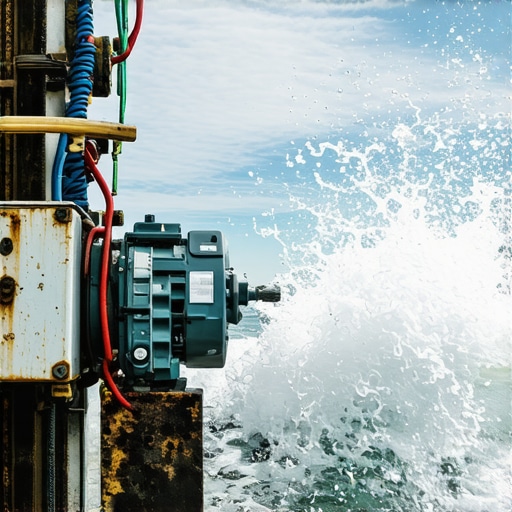
The Invisible Killer in Your Backyard: Why Boat Lift Wiring Fails
I’ve spent thirty-five years pulling wire through some of the most unforgiving environments on the planet, but nothing makes my skin crawl like a coastal boat dock. People treat their docks like an extension of their living room, but they forget one fundamental law of physics: salt water and electricity are a lethal combination. My journeyman used to smack my hand if I stripped a wire with a knife. ‘You nick the copper, you create a hot spot,’ he’d scream. ‘In a house, maybe you get a flickering light. On a dock, that hot spot meets salt spray and you’ve got a localized heater that won’t stop until the motor is toast or someone gets hit.’ He was right. Most ‘handyman’ boat lift installs I see are essentially underwater electric chairs waiting for a circuit to complete.
The Forensic Autopsy of a Coastal Connection
When we talk about boat lift wiring, we aren’t just talking about connecting a motor to a switch. We are talking about managing a chemical war. In coastal environments, the air itself is a conductor. Salt air corrosion isn’t just ‘rust’; it’s a Galvanic Reaction that happens at the molecular level. When you have two dissimilar metals—like a zinc-coated screw and a copper conductor—the salt water acts as an electrolyte. This causes ‘Cold Creep’ and oxidation layers to form. Eventually, the resistance at that connection spikes. High resistance equals high heat. I’ve opened junction boxes where the terminal block had melted into a puddle of black goo, yet the breaker never tripped because the current draw didn’t exceed 20 amps. It just sat there, cooking at 400 degrees, inches away from dry pressure-treated wood.
“Aluminum wire connections can overheat and cause a fire without tripping the circuit breaker.” – CPSC Safety Alert 516
While most modern lifts use copper, the principle remains the same for marine-grade connections. If the installer didn’t use dielectric grease or failed to torque the lugs to the exact inch-pound specification, you are living on borrowed time. This is why we see so much storm damage electrical repair in coastal areas. It’s not just the wind; it’s the surge forcing salt water into every crevice of the conduit. If your dock took a hit during the last season, you need to check for ‘Salt Bridges.’ This is when salt residue forms a conductive path between the phases or to the ground. You won’t see it with the naked eye, but your Wiggy or a high-quality multimeter will show a voltage leak that’s just waiting to find a path through your body to the water.
The Three Warning Signs of a ‘Handyman Special’
First, look at the conduit. If I see Romex anywhere near a dock, I stop the inspection right there. Romex is for interior walls, not boat lifts. A proper Rough-in for a marine environment requires liquid-tight flexible conduit or Schedule 80 PVC. If you see exposed wires or residential-grade ‘Monkey Shit’ (duct seal) used as a primary water barrier, you’re looking at a hack job. Second, check the GFCI. A Ground Fault Circuit Interrupter is your only line of defense against Electric Shock Drowning (ESD). If your lift is tripping the GFCI, do not—under any circumstances—bypass it. I’ve seen people swap a GFCI for a standard breaker because they were tired of ‘nuisance tripping.’ That ‘nuisance’ is the device telling you that current is leaking into the water. Third, the grounding system. A proper dock needs a Home Run ground back to the main service panel, not just a ground rod pounded into the muck. Muck is a terrible conductor. You need a low-impedance path to clear a fault.
“Wiring for boat lifts shall be installed in accordance with Article 682, which covers electrical installations on or adjacent to natural and artificial bodies of water.” – National Electrical Code (NEC)
The Physics of Voltage Drop and Motor Burnout
One thing people forget when they’re doing retail store wiring or even tiny home wiring is the length of the run. But on a dock, your lift might be 200 feet from the house. Ohm’s Law tells us that voltage drops over distance. If your motor is rated for 230V but it’s only receiving 205V because the wire gauge is too thin, the motor will pull more amperage to compensate. This extra amperage creates heat in the windings, melting the varnish and eventually shorting out the motor. This is why a proper load calculation is vital. We also see this issue with battery backup wiring and microgrid integration for remote docks; if the source isn’t stable, the equipment dies. For our older neighbors, we often provide senior discount services to perform these safety audits, because identifying a ‘tick tracer’ hit on a dock frame before someone gets in the water is the most important work we do.
Modern Solutions: From Ethernet to Flood Safety
In today’s world, docks are getting more complex. I’m seeing more ethernet wiring services for dock cameras and fence line lighting to keep the perimeter secure. Every one of these low-voltage lines is a potential path for a lightning strike or a power surge to enter your main home system. This is why flood water electrical safety is no longer just for the basement. If your dock sub-panel isn’t mounted above the 100-year flood line, you’re asking for a total system failure. If you are concerned about your current setup, it is worth reaching out to an expert to verify your grounding and bonding. Whether you are setting up an EV charger at home or just trying to keep your boat in the air, the rules of electricity don’t change. You respect the load, you respect the environment, and you never, ever take a shortcut with water.
Final Check: Don’t Let Your Dock Become a Widow Maker
Before you hit the ‘Up’ switch this weekend, do a quick visual forensic check. Grab your dikes and trim back any zip ties that are cutting into the insulation. Look for the ‘Widow Maker’—that glowing red light on a cheap surge protector that says ‘Ground Open.’ If you see it, kill the breaker. Electricity isn’t a hobby, and the water doesn’t forgive mistakes. If you’ve recently had work done, or if you’ve moved into a new place with an existing lift, treat it with suspicion until a master electrician has put a Wiggy on it. Sleep better knowing your connections are torqued, your conduit is sealed, and your family is safe from a bad wiring job that was just waiting for a rainy day.