
The Scent of a Failing Service: Why Your Insurance Carrier is Terrified
You probably didn’t think twice about that grey metal box in the garage until the renewal notice arrived from your insurance company. Now, they are demanding a 100-amp or 200-amp service upgrade, or they are threatening to drop your coverage entirely. They aren’t just being difficult; they are looking at the math of house fires. I have spent three decades watching what happens when old-school infrastructure meets modern electrical demands, and it is rarely pretty. My old journeyman, a man who could spot a loose neutral from across a room, used to smack my hand if I even thought about using a utility knife to strip insulation. ‘You nick that copper, you create a microscopic bottleneck,’ he’d growl while checking my work with his Wiggy. ‘That bottleneck becomes a hot spot, and that hot spot becomes a 911 call.’ He was right. Those tiny imperfections are exactly what infrared thermography scans pick up today, revealing the invisible heat building up inside your walls because of outdated service equipment.
The Physics of the ‘Cold Creep’ and Why Your 60-Amp Panel is a Liability
Many older homes were built when the biggest electrical load was a toaster and a few incandescent bulbs. A 60-amp service was plenty. But today, we have high-draw appliances, chandelier installation projects that add significant wattage, and electric vehicles. When you pull 50 amps through a 60-amp main lug for hours on end, you trigger a phenomenon called thermal cycling. As the metal heats up, it expands. When you turn the oven off, it contracts. In older panels, especially those using aluminum branch wiring or poorly torqued copper, this leads to ‘cold creep.’ The wire literally crawls out from under the terminal screw. This creates a high-resistance gap.
“Aluminum wire connections can overheat and cause a fire without tripping the circuit breaker.” – CPSC Safety Alert 516
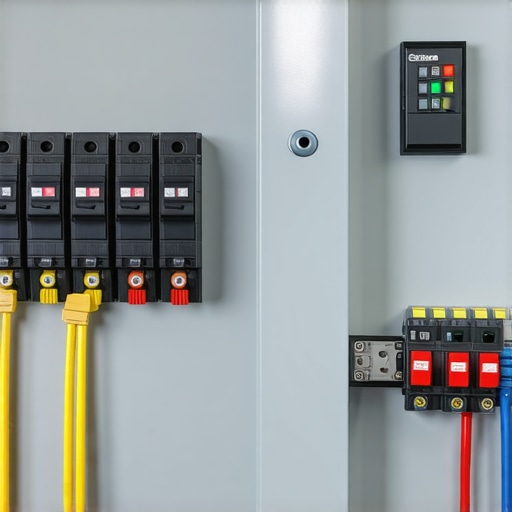
This is why insurance companies shudder at the sight of certain mid-century panels. They know that a load center upgrade isn’t just about convenience; it is about preventing the bus bar from turning into a heating element that eventually melts the plastic housing and ignites the surrounding drywall. If you are noticing flickering when the AC kicks on, you need a power quality analysis immediately to see just how much stress your system is under.
The Forensic Reality of Brand Shaming: Federal Pacific and Zinsco
If your home still has a Federal Pacific Electric (FPE) Stab-Lok panel or a Zinsco board, your insurance company might not even give you the option to keep it. In the forensic world, we call these ‘no-trip’ breakers. A breaker has one job: to trip when the current exceeds the wire’s rating. FPE breakers are notorious for jamming. The internal pivots become seized over decades of inactivity. You could have a dead short in a bedroom, and that breaker will sit there, frozen, while the Romex in the wall turns into a glowing filament.
“The NEC requires that overcurrent protective devices be capable of opening under load without injury to itself or causing a hazard.” – NFPA 70: National Electrical Code
When these devices fail that basic mandate, you are no longer living in a home; you are living in a tinderbox. This is why electrical inspections often lead to a recommendation for a total panel swap. We use thermal imaging inspections to show homeowners the ‘purple’ plumes of heat radiating from breakers that appear perfectly fine to the naked eye. It’s hard to argue with a heat map that shows a breaker sitting at 180 degrees Fahrenheit while just idling.
Modern Demands: EV Chargers and the 100-Amp Minimum
Even if your panel is safe, it might simply be exhausted. Adding a portable generator hookup or an EV charging station can push an old 100-amp service to its absolute limit. If you are looking at ensuring safe and efficient EV charging station setup at home, you have to understand the continuous load. An EV charger pulls a heavy current for 6 to 10 hours straight. This is very different from a vacuum cleaner that runs for ten minutes. This sustained draw uncovers every weakness in your service mast, your meter can, and your main lugs. We often find ‘monkey shit’—that’s the duct seal we use to keep moisture out—melted away because the service entrance conductors were running so hot. If you’re experiencing issues, you might need to look into ev charger troubleshooting expert tips to fix common issues, but often the ‘fix’ is simply that your house needs more juice. A load center upgrade to 200 amps provides the headroom needed so your breakers aren’t constantly operating at their thermal trip threshold.
The Inspection Process: From Rough-in to Trim-out
When we come out for same day service appointments to evaluate a service, we don’t just look at the stickers. We use a tick tracer to check for phantom voltages and pull the dead front off the panel to look for signs of arcing. We’re looking for that telltale ‘fishy’ smell of burning phenolic resin. If we see evidence of water ingress—rust trails on the bottom of the breakers—that’s an immediate red flag. Moisture turns the copper bus bars into a mess of green oxidation, increasing resistance and heat. Whether it is access control wiring for a gated driveway or simple parking lot lighting for a commercial client, the principles of grounding and bonding remain the same. If your ground rod is loose or your ‘widow maker’ (an ungrounded circuit) is live, your insurance risk profile skyrockets. Following a step-by-step electrician guide for any new install is critical, but it all starts with the heart of the home: the service panel. If the heart is weak, it doesn’t matter how pretty the lighting installations are. For those struggling with existing setups, seeing how electricians tackle troubleshooting for lighting installations can reveal just how often the root cause is actually at the main panel.
Why You Can’t Afford to Wait
The cost of a service upgrade is high, but the cost of a fire or a denied insurance claim is higher. When we do a rough-in for a new service, we aren’t just pulling wires; we are resetting the clock on your home’s safety for the next 40 years. We ensure every home run is properly labeled and every terminal is torqued to the specific inch-pounds required by the manufacturer. No more ‘handyman specials’ where wires are wrapped backwards around screws or double-tapped into a single breaker. Once we finish the trim-out, you can sleep knowing that if a fault occurs, the system will actually do its job and shut down. Don’t wait for the ‘tick-tick-tick’ of a sparking bus bar to call us. You can contact us for a comprehensive forensic inspection before your insurance company sends that cancellation notice. Maintenance is also key for those who have already upgraded, so check out top ev charger maintenance tips for optimal performance to keep your new system running cool. Electricity is a tool, but only if it stays inside the copper where it belongs. When it starts leaking out as heat, your home is just fuel waiting for a spark.