
The Forgotten Arteries of the Mid-Century Home
Most homeowners look at their electrical panel and see the lifeblood of their house, but they ignore the tangled, brittle web of tan and grey wires snaking through the crawlspace. I’m talking about those old POTS (Plain Old Telephone Service) lines. To the untrained eye, they’re harmless low-voltage leftovers. To a Master Electrician who has spent 35 years sniffing out hot spots, they are a literal fuse waiting for a match. When I started my apprenticeship, my journeyman used to smack my hand if I stripped a wire with a knife. ‘You nick the copper, you create a hot spot,’ he’d scream. He was right. Those tiny nicks lead to resistance, and resistance leads to heat. Now, imagine forty years of those nicks, combined with the insulation-eating heat of a summer attic and the structural vibrations of a house settling. You aren’t just looking at an old phone line; you’re looking at a structural liability.
“Section 800.133 of the National Electrical Code (NEC) specifies that communications conductors shall be separated by at least 2 inches from conductors of any electric light, power, Class 1, non-power-limited fire alarm, or medium-power network-powered broadband communications circuits.” — NFPA 70: National Electrical Code
In mid-century homes, specifically those built between 1960 and 1980, we see a lethal combination of factors. This was the era of the 60 amp panel upgrade necessity and, unfortunately, the era of aluminum branch wiring. While we were running aluminum to save a buck, we were also stapling telephone lines right alongside them. Aluminum is notorious for a phenomenon called Cold Creep. Because aluminum expands and contracts at a different rate than the brass screws on your outlets, the connections loosen over time. This creates an arc. When that arc happens near an old, dried-out phone line with cracked PVC insulation, the low-voltage wire becomes the path of least resistance for high-voltage stray current. It’s not just about a fuzzy dial tone anymore; it’s about a 120-volt surge riding a 24-gauge wire that was never meant to handle more than a milliamp.
The Forensic Breakdown: Why Insulation Fails
Let’s talk physics. The insulation on those old wires wasn’t designed for the long haul. Over decades, the plasticizers leach out of the jacket, leaving behind a brittle shell that can be snapped like a dry twig. In the trade, we use a Tick Tracer to find live circuits, and it’s terrifying how often those tracers light up when touched to an ‘unplugged’ phone line. This is often due to induction. If an old phone line is bundled tightly with a modern Romex run for office lighting upgrades, the electromagnetic field from the high-voltage line can induce a current in the parallel phone wire. This is why CAT6 cabling services are so critical today; modern data lines are twisted and shielded to prevent this exact type of EMI (Electromagnetic Interference).
When we perform temporary power services or set up sign lighting installation, we see the mess left behind by ‘weekend warriors.’ They see a hole in the top plate and think, ‘Hey, I can run my new driveway sensor lights wire through there.’ They jam a high-voltage line right against an old phone wire, creating a friction point. Every time the wind blows the house or the HVAC kicks on, those wires rub. Eventually, you get a ‘Widow Maker’ scenario where the phone line becomes energized at line voltage. I’ve seen it happen where a homeowner went to plug in a telephone in the kitchen and got thrown across the room because the line was shorted to a 20-amp appliance circuit in the wall.
“Aluminum wire connections can overheat and cause a fire without tripping the circuit breaker.” — CPSC Safety Alert 516
The Modern Integration Crisis
Modern homes are power-hungry. We are installing EV charger troubleshooting protocols and ensuring safe and efficient EV charging station setup at home, which pulls massive amounts of current. This high-load environment stresses every inch of the home’s infrastructure. If you’re still running on a 60-amp service, you’re already redlining your system. Adding high-draw appliances makes any existing ‘ghost’ wiring, like those old phone lines, even more dangerous. They can act as a bridge for surges. If lightning hits a nearby pole, it doesn’t just hit the power lines; it hits the old copper phone lines still connected to the house. Without proper swimming pool bonding or a robust whole-home grounding system, that surge is going straight into your sensitive electronics via the phone jacks you forgot existed.
When we do trenching electrical conduit for new external projects, we often find old direct-burial phone lines tangled with the roots of trees. These lines are often saturated with moisture. If these lines are still connected to your internal wiring, they are essentially ‘wicks’ that pull moisture and electrolytic corrosion back into your house. This is why we recommend same day service appointments the moment you smell that ‘fishy’ scent of burning plastic. It’s usually not the device you can see; it’s the junction box buried in the wall where an old phone line is arcing against a loose neutral.
Practical Steps for Forensic Remediation
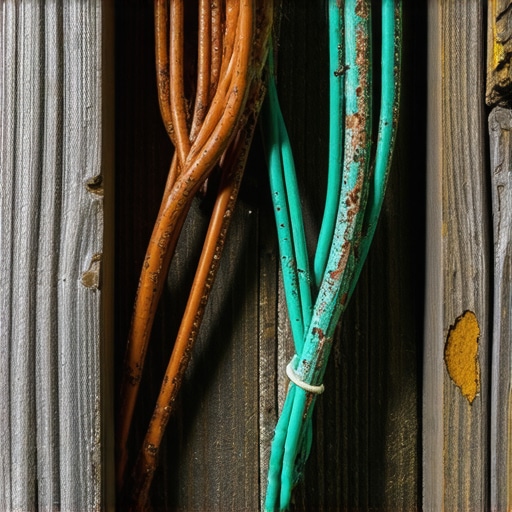
If you’re upgrading your home, don’t just cut the wires and push them back into the wall. That’s a handyman’s trick that leads to forensic inspectors like me taking photos of your charred studs later. You need to trace those lines back to the ‘Home Run’ — the main point of entry. Use a Wiggy or a high-quality multimeter to ensure there is no induced voltage before you start snipping with your Dikes. If you are planning lighting installations made easy a step-by-step electrician guide approach, make sure you aren’t sharing holes in the framing between low-voltage and high-voltage lines. The image above shows exactly what happens when induction and age meet. The jacket is scorched because it was too close to a high-draw circuit.
We also see issues during weekend electrician services calls where people complain about their internet speeds. Nine times out of ten, they are trying to run DSL or even fiber-to-the-home through old internal phone jacks. The interference from the unshielded old wires is a nightmare. This is why CAT6 cabling services are an investment in both speed and safety. By removing the old copper and replacing it with shielded, twisted-pair cabling, you eliminate the bridge that allows high-voltage surges to enter your data network. For more on how we handle these complex installs, you can read about how electricians tackle troubleshooting for lighting installations.
Conclusion: Don’t Let the Past Burn Down the Future
Electricity isn’t a hobby, and it isn’t something you can ‘set and forget.’ Those old phone lines are a relic of a different era, one where we didn’t have 50-inch TVs, EV chargers, and high-speed data needs. If you are noticing flickering or if you haven’t had your panel inspected since the Nixon administration, it’s time to act. Don’t wait for the smell of ozone. Whether it is ensuring safe and efficient EV charging station setup at home or simply cleaning up the ‘monkey shit’ and old wires in your attic, professional intervention is what lets you sleep at night. If you’re concerned about the state of your wiring, contact us today before a small problem becomes a forensic investigation.