
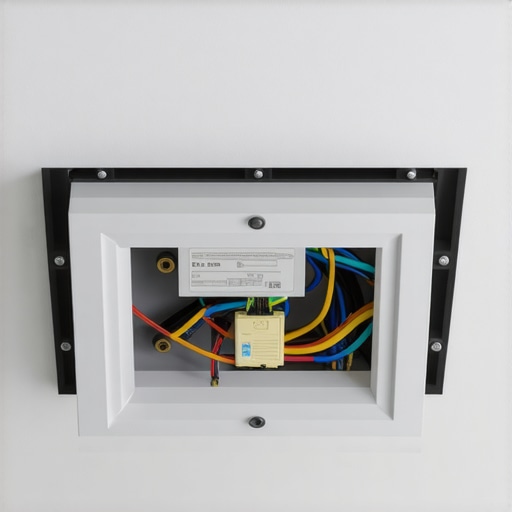
The Ghost in the Walls: Why Your Fan is a Silent Threat
I’ve spent 35 years pulling charred remains of Romex out of stud bays, and if there is one thing that keeps me up at night, it’s the arrogance of the ‘standard’ residential wiring job. People think a bathroom exhaust fan is a minor appliance, a little plastic box that sucks out steam. They treat it like a nightlight. But as a forensic inspector, I see the truth: that fan is an inductive load motor sitting in a high-humidity environment, often connected to a circuit that is already screaming for mercy under the load of hair dryers and curling irons. My journeyman used to smack my hand if I stripped a wire with a knife. ‘You nick the copper, you create a hot spot,’ he’d scream. He was right. That tiny nick reduces the cross-sectional area of the conductor, increasing resistance. In a bathroom, where moisture is a constant, that resistance leads to heat, and heat leads to the fire department visiting your house at 3 AM. If you aren’t pulling a home run for that fan, you’re just waiting for the failure to find you.
“At least one 20-ampere branch circuit shall be provided to supply bathroom receptacle outlet(s). Such circuits shall have no other outlets.” – NEC 210.11(C)(3)
The Forensic Autopsy of a Failed Motor
When I perform electrical inspections after a ‘suspicious’ attic fire, the fan is usually the culprit. Let’s talk about the physics of why this happens. Most bathroom fans use shaded-pole motors. They are cheap, low-torque, and rely on a sleeve bearing that is lubricated by a thin film of oil. Over time, steam carries aerosolized hairspray and dust into those bearings. The ‘monkey shit’ or duct seal used to transition the vent pipe often fails, allowing moisture to drip back onto the motor housing. The motor starts to labor. This is where ‘Component Zooming’ matters: as the motor struggles, the slip increases, and the counter-electromotive force (back EMF) drops. This causes the windings to draw more current. If that fan is sharing a circuit with your smart lighting installation, the voltage drop can be subtle but devastating. The insulation on the windings—usually a thin layer of enamel—reaches its thermal breakdown point. Once that enamel carbonizes, you get a turn-to-turn short. The motor doesn’t just stop; it becomes a heating element.
Voltage Drop and the ‘Handyman Special’
I’ve seen ‘pros’ tap into a bathroom fan from the nearest outlet because it was easier than running a new line to the panel. In a 1970s mid-century home, you likely have a Federal Pacific or Zinsco panel. These are the ‘widow makers’ of the industry. These breakers are notorious for ‘jamming’—they won’t trip even when the wire is glowing. If your fan is on a shared circuit and your spouse plugs in a 1500-watt hair dryer, the total draw can spike. On a dedicated circuit, the fan is isolated. On a shared circuit, you’re pushing the limits of the 12-gauge or (heaven forbid) 14-gauge copper. If you have aluminum wiring from the mid-century era, you’re dealing with Cold Creep. The aluminum expands and contracts at a different rate than the steel screws on the fan’s terminal block. Every time you flip that switch, the connection loosens just a hair. Eventually, an oxidation layer forms, resistance skyrockets, and you get an arc. I’ve used my ‘Wiggy’ to test these circuits and seen voltage fluctuations that would make an industrial engineer weep. This isn’t just about convenience; it’s about the integrity of the branch circuit.
Why Your Whole House Fan Wiring Isn’t the Same
People ask me if they can just treat a bathroom fan like whole house fan wiring. The answer is a hard no. A whole house fan is a massive beast, but it’s usually in a dry environment. The bathroom fan is a different animal because of the galvanic reaction potential. When moisture bridges the gap between the hot and neutral terminals on a cheap fan, you get a ‘salt bridge.’ This creates a high-resistance path that doesn’t always trip a standard breaker but generates enough heat to ignite the dust accumulation in the housing. This is why we insist on permit pulling services. A real inspector wants to see that you’ve run a dedicated line with an Arc-Fault Circuit Interrupter (AFCI). AFCI breakers are designed to detect the signature of that ‘hissing’ arc before the wood framing catches fire.
“Aluminum wire connections can overheat and cause a fire without tripping the circuit breaker.” – CPSC Safety Alert 516
The Industrial Logic Applied to Your Home
In the world of industrial motor controls or retail store wiring, we would never dream of putting a motor on a lighting circuit. We use dedicated contactors and overcurrent protection sized specifically for the motor’s FLA (Full Load Amps). Why should your home be any different? Your home is your most expensive asset, yet people try to save $200 by skipping a dedicated circuit. If you’re looking at a camper electrical panel, you see how every inch of wire is scrutinized because space is tight and heat is the enemy. Your bathroom ceiling is no different. We offer a priority service membership because we want to catch these issues during a routine check before you need a same day service appointment for a house that smells like ozone and burnt plastic.
The Solution: Home Runs and Proper Torque
When we do a storm damage electrical repair, the first thing I check is the grounding system and the dedicated circuits. If you want to sleep at night, you need a dedicated 20-amp circuit for your bathroom. This means a ‘home run’—a single, unbroken length of Romex from the breaker panel directly to the bathroom. No splices in buried junction boxes, no tapping off the vanity light. We use a torque screwdriver to ensure every terminal is tightened to the manufacturer’s exact specifications, preventing the micro-arcing that leads to catastrophic failure. Whether it’s EV charger troubleshooting or a simple fan install, the physics of electricity don’t change. Resistance is the enemy. Don’t let a $30 fan destroy a $500,000 home because you didn’t want to pull a new wire. Get a professional who understands that electricity isn’t a hobby—it’s a force of nature that wants to return to the ground, and it will burn through anything in its way to get there.