
The Scent of a Short: When Your Kitchen Starts Talking Back
You’re standing in your dream kitchen, admiring the quartz countertops and the soft-close cabinets, but there’s a faint, sickly-sweet smell of rotting fish lingering near the microwave. That isn’t yesterday’s lunch. That’s trimethylamine, the chemical released when the phenolic resin in an old outlet starts to liquefy under high-resistance heating. Most homeowners ignore it until the wall starts to smoke, but a Master Electrician knows that smell is the sound of a countdown. If you are planning a renovation, you aren’t just choosing tile; you are deciding whether your house survives the next decade. Modern kitchens are power-hungry beasts, and plugging 2024 appliances into 1950s infrastructure is like trying to run a fire hose through a soda straw. If you don’t respect the physics of electricity, it will find a way to make you respect it.
The Forensic Anatomy of the ‘Flipper Special’
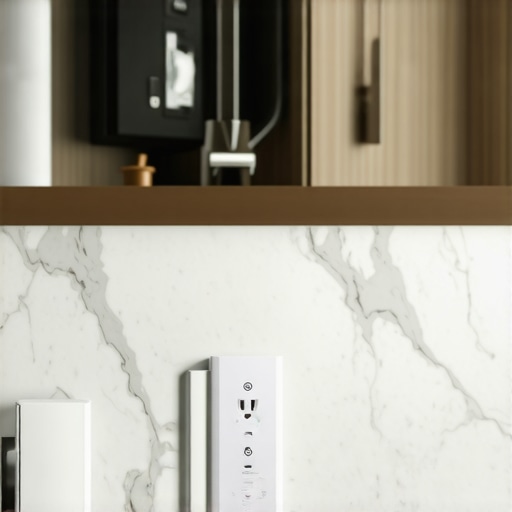
I walked into a ‘fully renovated’ kitchen last year where the flipper had buried three live junction boxes behind a custom marble backsplash. The homeowner complained of a flickering recessed lighting installation, but my Tick Tracer started screaming the moment I got near the stove. I had to use a circuit tracer to map the chaos. What I found was a nightmare: Romex spliced to old silver-braid wire with no wire nuts, just electrical tape that had turned into a gummy, conductive mess. This is why electrical inspections are not optional. A flipper wants it to look pretty for the open house; a bonded insured electrical professional wants to make sure you don’t die in your sleep. When we do a rough-in, we are looking for ‘cold creep’ in old aluminum lines and ensuring the home run—that’s the direct line back to the panel—is sized for the actual load. Without proper lockout tagout training and a deep understanding of the National Electrical Code (NEC), you’re just playing with fire—literally.
“The purpose of this Code is the practical safeguarding of persons and property from hazards arising from the use of electricity.” – National Electrical Code (NEC) Article 90.1
Component Zooming: The Physics of Resistance and Heat
Let’s talk about why your old 14-gauge wire can’t handle your new gourmet range. It comes down to Ohm’s Law and the thermal expansion of copper. When you pull 15 amps through a wire rated for 12, the copper molecules start to vibrate violently. This generates heat. That heat causes the wire to expand, and when you turn the appliance off, it contracts. Over time, this cycle loosens the terminal screws on your receptacles. A loose connection creates an air gap, and electricity loves to jump gaps. That’s an arc. An arc is hotter than the surface of the sun. If you haven’t invested in load center upgrades to include Arc-Fault Circuit Interrupter (AFCI) breakers, that arc will continue until the wood studs behind your drywall ignite. This is why the latest NEC requires AFCIs in almost every room of the house, especially during a kitchen remodel. We don’t just swap outlets; we analyze the entire system’s integrity.
The Critical Role of Grounding and Bonding
In the trade, we often find ‘bootleg grounds’ where a hack connects the neutral screw to the ground screw to fool a three-prong tester. It’s a widow maker move. In a kitchen, where you have water and electricity in close proximity, grounding is your only lifeline. A smart lighting installation or a new dishwasher requires a solid path to earth. We use Dikes to snip away the old, brittle insulation and ensure every ceiling fan installation or appliance is properly bonded. Bonding ensures that if a hot wire touches the metal casing of your toaster, the current goes back to the panel and trips the breaker instantly, rather than waiting for you to touch it and become the path to ground. If you’re considering hot tub wiring services or adding heavy-duty appliances, your grounding electrode system must be up to par, often requiring new 8-foot copper rods driven into the earth.
“Aluminum wire connections can overheat and cause a fire without tripping the circuit breaker.” – CPSC Safety Alert 516
Modern Standards: GFCI, AFCI, and Small Appliance Branch Circuits
The NEC isn’t a suggestion; it’s a forensic record of every house fire that ever happened. Currently, code requires at least two 20-amp ‘Small Appliance Branch Circuits’ in a kitchen. You can’t just pig-tail off the dining room light anymore. We also have to consider the ‘6-foot rule’ for GFCIs near sinks. But it goes deeper. Every recessed lighting installation today should be integrated into a system that handles the harmonic distortion caused by LED drivers. If you’re doing a warehouse lighting retrofit or even a high-end home kitchen, the smart lighting installation needs to be shielded from interference. Check out our lighting installations guide to see how we manage these complexities during the trim-out phase.
Load Center Upgrades: The Heart of the Renovation
If your panel still says ‘Federal Pacific’ or ‘Zinsco’ on the door, you don’t have a circuit breaker; you have a glorified bus bar that won’t trip even if the wires are melting. A load center upgrade is the first step in any kitchen project. We look for signs of bus bar corrosion and ‘pitting’ where the breakers snap on. If the contact point is compromised, it creates resistance, which creates heat. For those moving toward a more sustainable home, including underground wiring services for exterior needs, you need a panel that can handle the surge. We often find that older 100-amp services are pushed to the limit by modern induction cooktops and steam ovens. Upgrading to 200-amp service provides the headroom needed for safety and future expansion. For those troubleshooting existing setups, our guide on lighting troubleshooting explains the diagnostic process we use to find these hidden failures.
The Final Torque: Why Professionalism Matters
I don’t leave a job until I’ve hit every terminal with a torque screwdriver. Most ‘handymen’ just crank it until it feels tight, but over-tightening can crush the copper and create a hot spot just as easily as a loose connection. This is the difference between a ‘renovation’ and a ‘restoration.’ When you hire for bonded insured electrical work, you are paying for the 35 years of experience that tells me exactly where a wire is likely to fail behind a wall. We use Monkey Shit (duct seal) to plug conduits and prevent moisture from migrating into your load center. We ensure your underground wiring services are buried at the correct depth with warning tape to prevent the next guy from hitting it with a shovel. Electricity is the most dangerous thing in your home. Treat it with the respect it deserves, or it will bite you. For help with your next project, you can contact our team of master technicians. We don’t do ‘pretty’ if it isn’t safe first.