
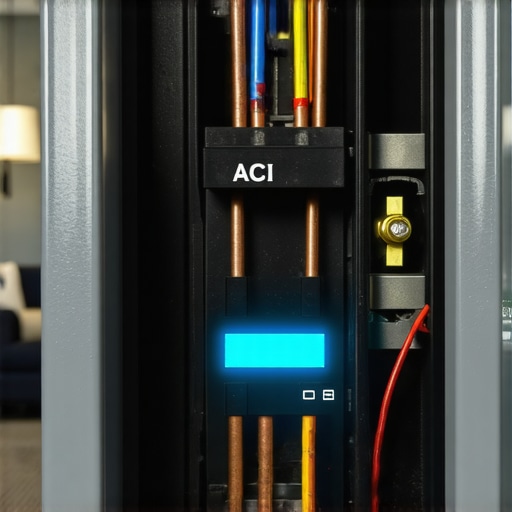
The Invisible Threat Within the Walls
I remember my old foreman, a guy who had been pulling wire since the Eisenhower administration. He used to smack my hand if I stripped a wire with a knife instead of the proper tool. ‘You nick that copper, you create a hot spot,’ he’d scream over the sound of a hammer drill. ‘That nick is a funeral waiting to happen.’ He wasn’t being dramatic; he understood the physics of resistance long before digital breakers were even a concept. Most homeowners think a circuit breaker is an infallible sentry, but a standard thermal-magnetic breaker is surprisingly blind. It’s designed to trip when you overload a circuit with too many hair dryers or when a direct short sends a massive surge of current back to the panel. It doesn’t see the tiny, white-hot needle of electricity jumping across a frayed lamp cord or a loose terminal behind your recessed lighting installation. That, my friends, is an arc fault, and it’s the leading cause of residential fires that insurance claim electrical work inspectors like me have to document far too often.
The Anatomy of an Arc: Why Heat Isn’t Enough
To understand why an Arc-Fault Circuit Interrupter (AFCI) is necessary, you have to understand the forensic reality of a failing wire. When a wire is damaged—maybe a nail hit it during a DIY project or the insulation has turned brittle from fifty years of heat—the electricity doesn’t always just stop. Instead, it can jump the gap. This is ionization. The air between the two points becomes a conductor, creating a plasma discharge that can reach temperatures over 10,000 degrees Fahrenheit. This isn’t a sustained ‘short’ that pulls enough amps to trip a 20-amp breaker. It’s a series of micro-bursts, a flickering blue flame that carbonizes everything it touches. Once that Romex jacket or the wood stud turns to carbon, it becomes a better conductor, fueling the fire further. This is what we call a ‘carbonized path.’ A standard breaker won’t trip because the current flow might only be 5 or 10 amps—well within the ‘safe’ range of the breaker—but it’s enough heat to ignite the dust in your walls.
“Aluminum wire connections can overheat and cause a fire without tripping the circuit breaker.” – CPSC Safety Alert 516
How the AFCI Thinks: AI Fault Detection in Your Panel
While a standard breaker relies on a bi-metallic strip that bends when it gets hot, an AFCI uses AI fault detection logic—or at least, a very sophisticated digital signal processor. It is constantly ‘listening’ to the electrical signature of your home. It looks for the specific harmonic ‘noise’ of an arc. Real electrical loads, like a vacuum cleaner motor or a smart lighting installation, have predictable waveforms. An arc is chaotic. It has a ‘shouldering’ effect in the sine wave that the AFCI recognizes instantly. When the processor sees that signature, it trips the main disconnect services for that branch circuit in milliseconds. This is critical for certified journeyman services because we know that by the time a homeowner smells ozone, the damage is already structural. We often see these issues during a rough-in where a wire was pinched, but the symptoms don’t show up until years later during the trim-out or when the house settles.
The Mid-Century Time Bomb: Aluminum and Aging Insulation
If your home was built between 1960 and 1980, you might be sitting on a powder keg of ‘cold creep.’ This is the physical phenomenon where aluminum wiring expands and contracts at a different rate than the brass terminals on your outlets. Over time, the connection becomes loose. A loose connection creates resistance; resistance creates heat; heat creates oxidation. That layer of aluminum oxide is an insulator, which sounds good but is actually deadly—it forces the electricity to ‘arc’ across the gap to maintain the circuit. This is why main disconnect services upgrades often require a full panel transition to AFCI protection. In older coastal homes, this is even worse. Salt air acts as a catalyst, bridging the gap between phases in boat lift wiring or outdoor parking lot lighting. I’ve opened meter cans where the bus bar was so corroded it looked like green moss, yet the lights were still on. That’s a widow maker waiting for a technician to touch it with a tick tracer.
“The AFCI shall be installed in a readily accessible location… to protect the entire branch circuit.” – National Electrical Code (NEC) Section 210.12
Infrastructure Context: From Grounding Rods to Portable Generators
A proper grounding electrode install is the foundation of any safe system, but it won’t stop an arc fault. Grounding provides a path for lightning or high-voltage surges, but the AFCI is the specialized tool for internal circuit integrity. When we perform a lighting installation troubleshooting, we often find that ‘nuisance tripping’ isn’t the breaker’s fault—it’s the breaker doing its job. It’s detecting a smart lighting installation where the neutral was shared or a portable generator hookup that wasn’t bonded correctly. In the world of high-demand appliances, especially when ensuring safe and efficient EV charging station setup, the integrity of every terminal is paramount. I’ve seen dikes used to cut wires too short, forcing a tight bend that eventually cracks the copper. That crack is where the arc begins. Whether it’s parking lot lighting or a simple bedroom outlet, if the torque isn’t right, the fire risk is real. Don’t trust a handyman with a screwdriver; trust a pro who uses a torque wrench to ensure every lug is set to the manufacturer’s inch-pound specifications. If you are worried about your current system, contact us for a forensic inspection before the ‘fishy smell’ starts coming from your walls.