
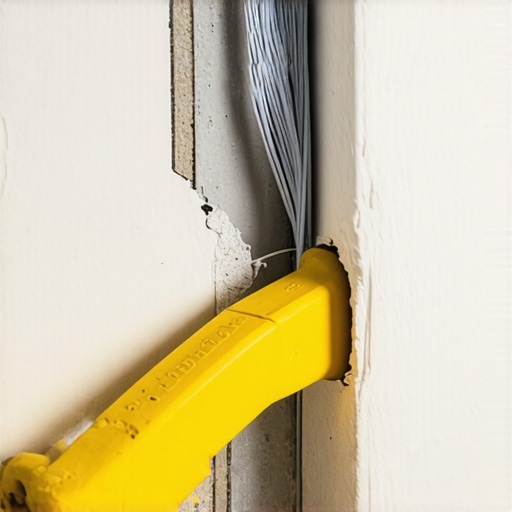
The Autopsy: Why Your Fiber Pull Failed Before You Even Plugged It In
I once walked onto a job site where a homeowner tried to ‘save money’ by pulling fiber for his home office through a 1940s balloon-frame wall. The scent of burnt insulation from his old ungrounded circuits was bad enough, but the real crime was the pile of shattered glass fiber sitting in the bottom of a junction box. He’d tried to pull a 90-degree bend through a tight top plate without a pulley or a decent lubricant. The forensic breakdown was clear: he treated 125-micron glass like it was a heavy-duty extension cord. My journeyman used to smack my hand if I didn’t use a proper lead when pulling. ‘You snag that jacket on a rough-cut 2×4, and you’ve just built a very expensive heater for the mice,’ he’d growl. He wasn’t just being a crank; he knew about friction, the structural integrity of a glass core, and the absolute unforgiving nature of refractive index shifts caused by tensile stress.
The Physics of the Failure: Micro-Bends and Cold Creep
When you’re dealing with home rewiring services or upgrading an ancient structure, you aren’t just moving copper; you’re navigating a minefield of debris. In old homes built between 1900 and 1950, you’re dealing with lathe and plaster that acts like a cheese grater on cable jackets. If you pull too hard, you don’t just stretch the jacket—you induce what we call macro-bending. This isn’t a theoretical concern. In the world of high-speed data, a micro-fracture in the core acts as a mirror, reflecting your signal back to the source instead of letting it reach the ONT.
“Fiber optic cables are susceptible to damage from excessive pulling tension and sharp bends, which can lead to signal loss or total cable failure.” – CPSC Safety Alert (Fiber Safety Guidelines)
This is why your choice of tools isn’t just about convenience; it’s about preventing a ‘dark fiber’ scenario before the trim-out even begins.
The Master’s Toolkit: More Than Just a Fish Tape
If you’re doing a fire alarm system install or trying to navigate tiny home wiring, space is your primary enemy. You can’t just shove a Wiggy in there and hope for the best. You need a specialized arsenal. First, throw away those cheap plastic tapes. You need a high-grade Fiberglass Glow Rod. These aren’t just for visibility; they have the right amount of ‘memory’ to stay straight in a wall cavity but enough flex to get around a rough-in obstacle. When I’m doing a virtual consultation wiring session, the first thing I tell people is to look at their overhead service drop. If you’re pulling near main power lines, your tool must be non-conductive. A steel fish tape is a Widow Maker in a crowded service panel. Use a non-conductive nylon or fiberglass tape instead. For the heavy lifting, especially in parking lot lighting or long pathway lighting install runs, you need a vacuum-powered pull-string system. You use a shop-vac to suck a ‘mouse’ (a small foam plug) through the conduit, dragging a lightweight jet-line behind it. This prevents the friction-burn you get when high-speed pull-strings saw through PVC elbows.
Navigating the Obstacles: Storm Damage and Permit Pulling
After a storm damage electrical repair, you often find wall cavities filled with damp insulation or shifted structural members. This is where ‘Monkey Shit’ (duct seal) and high-performance lubricants come into play. You don’t use dish soap; you use a polymer-based lubricant that reduces the coefficient of friction to near zero without degrading the cable jacket. When you’re managing permit pulling services for a client, the inspector isn’t just looking at the ceiling fan installation; they’re looking for fire-stopping.
“All openings through fire-resistant-rated walls, partitions, floors, or ceilings for electrical equipment shall be fire-stopped using approved methods.” – NEC Article 300.21
This means every time you pull fiber through a top plate, you need to seal that hole with intumescent caulk. If you leave a chimney for fire to travel up, you’ve failed your job and endangered the family. Whether you’re doing a simple pathway lighting install or a complex data overhaul, remember: the goal isn’t just connectivity. The goal is a system that won’t require a forensic inspector to visit with a clipboard and a grim expression because your ‘quick pull’ turned into a structural fire. Just like [lighting installations made easy] requires a steady hand, pulling fiber requires a respect for the glass. If you’re unsure about the load-bearing capacity of your service, always check your overhead service drop and consult the pros for [ensuring safe and efficient EV charging station setup at home] to see how we handle high-amperage versus low-voltage data runs.