
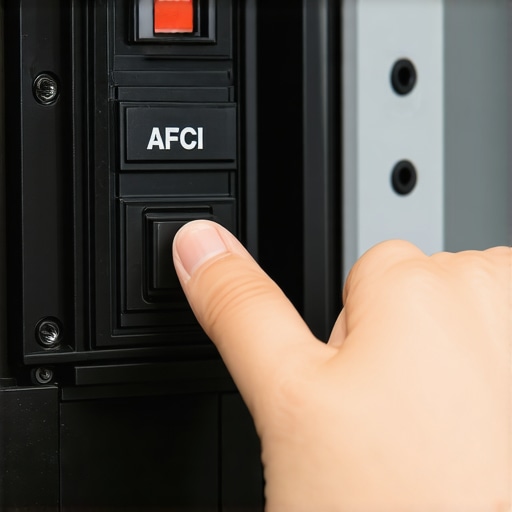
The Ghost in the Copper: Why Your AFCI is Screaming
It starts with a click. Not the satisfying thud of a heavy-duty contactor, but a sharp, plastic snap that leaves you in the dark. You head to the panel, flip the handle, and it immediately kicks back. You’re dealing with an Arc-Fault Circuit Interrupter (AFCI), and right now, you’re probably convinced it’s broken. Most homeowners assume the hardware is the problem, but as someone who has spent 35 years tracking down electrons that have gone rogue, I can tell you: the breaker is usually the only thing standing between you and a 2,000-degree plasma fire. Testing for a defective breaker requires more than just a tick tracer and a prayer; it requires a forensic understanding of how these microprocessors interpret the language of electricity.
The Flipper Special: A Lesson in Hidden Dangers
I remember walking into a kitchen that had just undergone a high-end ‘renovation’ for a data closet organization and lighting update. The flipper had installed beautiful quartz backsplashes and recessed LED cans. But the AFCI protecting the living room circuit wouldn’t stay engaged for more than twenty minutes. The homeowner thought they needed a simple circuit breaker replacement. I pulled out my tracer and started sniffing behind that pretty backsplash. I found a live junction box, buried behind three inches of stone, where the wires were stripped with a dull knife and held together by cheap tape rather than wire nuts. The arcing was so localized it hadn’t tripped a standard breaker yet, but the AFCI’s logic board saw the signature waveform of a fire in the making. That ‘defective’ breaker saved that family’s life before they even finished moving in.
“The arc-fault circuit interrupter is a device intended to provide protection from the effects of arc faults by recognizing characteristics unique to arcing and by functioning to de-energize the circuit when an arc fault is detected.” – National Electrical Code (NEC) Section 210.12
Component Zooming: The Physics of the Trip
To understand if the breaker is defective, you have to understand Cold Creep and thermal expansion. Inside that AFCI is a bimetallic strip for overloads, a magnetic solenoid for short circuits, and a sophisticated microprocessor for arc detection. An arc isn’t just a spark; it’s the ionization of air as current jumps a gap. This creates a specific ‘noise’ on the sine wave. If you’re living in a mid-century home, you likely have old Romex or even cloth-insulated wire that has become brittle. When that insulation cracks, the air gap becomes a playground for arcs. If you suspect the breaker is the issue, you’re looking for a failure in the logic board, not just a mechanical jam. This is where a power quality analysis becomes essential. If the voltage coming into your home is fluctuating, it can trick the AFCI into thinking it sees an arc fault. This isn’t a defect in the breaker; it’s a symptom of a larger grid or battery backup wiring issue.
The Diagnostic Protocol: Is It the Load or the Lug?
Before you commit to a lighting installation or a total rewire, follow this forensic autopsy of your circuit. First, perform a ‘Load Shedding’ test. Unplug every single device on the circuit—lamps, chargers, even that fancy chandelier installation you just finished. If the breaker still trips with zero load, the problem is in the ‘home run‘—the wire between the panel and the first outlet—or the breaker itself. This is where you grab your Wiggy or a high-quality multimeter. Check the torque on the breaker’s lug. A loose connection at the panel creates Ohmic heating, which can cause the thermal element to trip prematurely. We see this often in coastal areas where salt air speeds up galvanic reaction, though it’s just as common in older 1970s panels where aluminum wiring has undergone significant Cold Creep, loosening the terminal screws over decades.
“Aluminum wire connections can overheat and cause a fire without tripping the circuit breaker.” – CPSC Safety Alert 516
The Widow Maker: Shared Neutrals and AFCI Failure
One of the most common reasons an AFCI appears ‘defective’ is the presence of a shared neutral, often called a ‘Widow Maker’ by old-timers. In older home rewiring services, electricians would often share a neutral wire between two different circuits to save on copper. A standard breaker doesn’t care about this. An AFCI, however, monitors the balance between the hot and neutral wires. If it sees current returning on a neutral that didn’t leave through its specific hot wire, it trips. This isn’t a broken breaker; it’s an improperly wired house. If you’re struggling with this during a virtual consultation wiring session, remember that diagnosing this requires mapping the entire circuit layout. It’s tedious, it’s frustrating, and it’s why we charge the big bucks. If your AFCI is tripping every time you turn on a specific light, you might need to look at troubleshooting for lighting installations to see if a neutral has been bootlegged somewhere in the ceiling box.
When to Call for a Professional Evacuation
Sometimes, the breaker really is just a piece of junk. Brands from the 80s like Federal Pacific or Zinsco are notorious for ‘welding’ their contacts shut, but modern AFCIs can occasionally suffer from ‘nuisance tripping’ due to firmware bugs or internal component failure. If you’ve cleared the loads and verified the wiring integrity with a megohmmeter, and the breaker still won’t hold, it’s time for a replacement. Do not just swap it for a standard breaker to ‘fix’ the annoyance. That’s like cutting the wire to your smoke detector because the burnt toast is loud. Whether you’re dealing with dock electrical services or parking lot lighting, the code exists for a reason. If you’re unsure, many firms offer free electrical estimates to help identify if the issue is a $50 breaker or a $5,000 fire hazard. Electricity isn’t a hobby; it’s a force of nature that wants to return to the ground through the easiest path possible—don’t let that path be you or your home. Always ensure your connections are torqued to the manufacturer’s specs; a tight wire is a happy wire. [{“@context”:”https://schema.org/”,”@type”:”HowTo”,”name”:”How to Test an AFCI Breaker”,”step”:[{“@type”:”HowToStep”,”text”:”Unplug all devices from the affected circuit to eliminate load-based arcing.”},{“@type”:”HowToStep”,”text”:”Reset the breaker by flipping it fully to the OFF position, then to ON.”},{“@type”:”HowToStep”,”text”:”If it trips immediately with no load, check the panel lugs for proper torque and signs of heat damage.”},{“@type”:”HowToStep”,”text”:”Identify shared neutrals by checking if the circuit’s neutral is tied to another circuit’s return path.”},{“@type”:”HowToStep”,”text”:”Replace the breaker only after verifying the branch circuit wiring is not compromised.”}]}]