
The Hidden Time Bomb in Your Walls
If you live in a home built between 1960 and 1980, you aren’t just sitting on a piece of real estate; you’re sitting on a metallurgical experiment that hasn’t finished yet. As a forensic inspector, I’ve spent decades pulling back the dead-front covers of service panels only to find the slow-motion wreckage of mid-century engineering. The smell of ozone and the sight of charred Bakelite aren’t just technical failures; they’re the calling cards of a house trying to set itself on fire. Selecting the right Arc-Fault Circuit Interrupter (AFCI) isn’t about following a trend—it’s about stopping a disaster before the first spark jumps. I remember walking into a ‘fully renovated’ ranch where the flipper had installed a shiny new backsplash. My tracer was screaming. I ended up cutting a hole in the brand-new drywall to find three buried junction boxes, the wires held together by nothing but friction and luck. The wire nuts had literally melted into a single glob of plastic because of the heat generated by aluminum wiring repair done poorly. These are the traps people buy every day. Electricity isn’t a hobby, and it certainly isn’t ‘forgiving.’ When we talk about AFCI breakers, we are talking about the difference between a minor electrical hiccup and a three-alarm fire. Unlike a standard breaker that only trips when you overload the circuit by plugging in too many space heaters, an AFCI is a micro-processing computer that listens to the wire. It detects the specific electronic signature of an arc—that jagged, high-frequency snap of current jumping a gap—and kills the power before the heat can ignite the surrounding dust or insulation.
“Aluminum wire connections can overheat and cause a fire without tripping the circuit breaker.” – CPSC Safety Alert 516
The Physics of Failure: Why Your Old Panel is Screwing You
To understand which AFCI you need, you have to understand the specific enemy you’re fighting. In mid-century homes, the enemy is often ‘Cold Creep.’ This isn’t a horror movie character; it’s the physics of aluminum. Aluminum expands and contracts at a different rate than the copper and brass terminals in your panel. Every time you turn on a light, the wire heats up and expands. When you turn it off, it cools and shrinks. Over 40 years, that wire literally ‘creeps’ out from under the screw. This creates a microscopic gap. Current then has to jump that gap, creating a series arc. This arc can reach temperatures of 10,000 degrees Fahrenheit—hotter than the surface of the sun. This is where how electricians tackle troubleshooting for lighting installations becomes a matter of life and death. If you have cloth insulated wiring replacement needs, the stakes are even higher. That old rag-wrapped wire becomes extremely brittle. One flex and the insulation flakes off like a dry scab, leaving bare conductor exposed to the grounded metal of the box. This is why the National Electrical Code (NEC) has been aggressively updating its requirements. Modern NEC code updates now require AFCI protection for almost every room in a dwelling. If you’re working on a camper electrical panel or a sophisticated data center power setup, the principles remain the same: you must match the breaker to the bus bar or face the consequences of high-resistance heat.
Component Zooming: The Anatomy of a Breaker
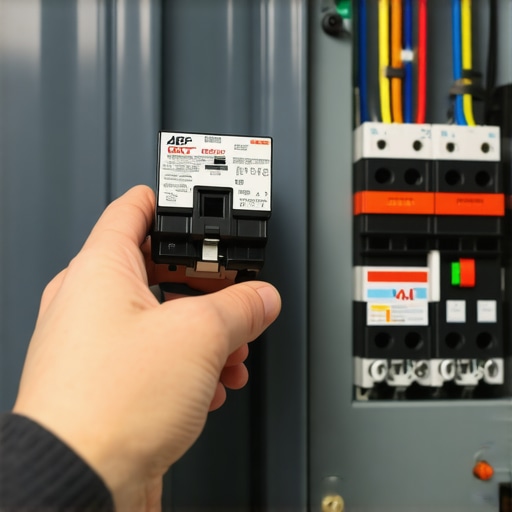
When you go to buy a breaker, don’t just look at the amperage. You need to look at the ‘trip-free’ mechanism and the bus bar connection type. A breaker is a mechanical device that relies on a bi-metal strip. When too much current flows, the strip heats up and bends, releasing a spring-loaded trigger. But an AFCI adds a layer of silicon-controlled rectifiers (SCRs) and a logic board. This board monitors the 120Hz sine wave of your home’s power. If it sees a signature that looks like an arc—a ‘staccato’ pattern in the current—it triggers the solenoid to drop the handle. This is why you cannot put a Square D breaker in an Eaton panel, even if it ‘seems to fit.’ The tension on the bus bar clip is calibrated to a thousandth of an inch. If that clip is loose, you’ve just created the very arc you were trying to prevent. I’ve seen ‘handymen’ use a file to make a breaker fit a different brand’s bus bar. That’s a ‘Widow Maker’ move. In the trade, we use a ‘Wiggy’ or a ‘Tick Tracer’ to verify our circuits, but no tool can fix a mismatched breaker. You need to identify if your panel is a ‘Plug-on-Neutral’ (PoN) or a ‘Pigtail’ type. PoN panels have a dedicated neutral bar that the breaker snaps directly onto, eliminating the messy white wire. If your panel is older, you’ll be stuck with pigtails, which means you’ll be shoving a lot of extra Romex into an already crowded gutter.
“Arc-fault circuit-interrupters shall be installed in a readily accessible location.” – NEC Section 210.12
The Brand Graveyard: Federal Pacific and Zinsco
Before you even think about AFCIs, look at the name on your panel. If it says Federal Pacific Electric (FPE) or Zinsco, stop. Do not pass go. These panels are the pariahs of the electrical world. FPE Stab-Lok breakers are notorious for ‘jamming.’ In testing, up to 60% of them failed to trip during an overcurrent event. They don’t just fail; they weld themselves to the bus bar. If you have one of these, an AFCI retrofit isn’t the answer—a full panel changeout is. Insurance companies are increasingly dropping coverage for homes with these brands because they are verified fire hazards. I’ve seen Zinsco bus bars that looked like they’d been hit by a blowtorch because of the poor contact between the breaker and the rail. For these systems, we often look into main disconnect services to completely isolate the house while we rip out the old guts. If you’re moving toward a microgrid integration or adding an EV charger, you cannot build on a rotten foundation. Ensuring a safe and efficient EV charging station setup at home requires a panel that can actually handle the continuous load without melting the bus bar. I’ve had to use augmented reality troubleshooting tools lately just to map out the thermal signatures in these old systems before we even start the demo. It’s the only way to see the heat before it becomes a flame.
How to Select Your Match
1. **Identify the Manufacturer:** Look for the label on the inside of the door. Square D (QO or Homeline), Eaton (BR or CH), Siemens, or GE. You must stay within the brand family.
2. **Check the Bus Bar:** Is it a pigtail system or Plug-on-Neutral? If you have a silver-colored bar running parallel to the breakers with no wires attached to it, you likely have PoN.
3. **Determine the Circuit Type:** Is it a 15-amp or 20-amp circuit? Match the wire gauge. If you have 14-gauge Romex, use a 15-amp breaker. Never, ever put a 20-amp breaker on 14-gauge wire unless you want to turn your walls into a toaster oven.
4. **Consider Dual-Function:** Many modern codes require both AFCI and GFCI (Ground Fault) protection. Dual-function breakers do both, protecting against arcs and shocks. This is standard now for lighting installations made easy when you’re working in kitchens or laundry rooms. 5. **Don’t Forget the Smoke Detectors:** During your upgrade, ensure you have a proper smoke detector installation on a dedicated or protected circuit. AFCIs can sometimes nuisance-trip with old motors, but modern ‘Smart’ AFCIs have better filtering to prevent this. If your vacuum trips the breaker, the breaker might actually be telling you the vacuum’s motor brushes are arcing—which is exactly what it’s supposed to do.
The Final Torque
Electricity is lazy. It’s always looking for the easiest path to ground, and it doesn’t care if that path goes through your studs or your skin. When you’re installing these breakers, use a torque screwdriver. Most people ‘hand-tighten’ and think it’s fine. It’s not. A loose terminal is a high-resistance point. High resistance creates heat. Heat creates carbon tracking. Carbon tracking leads to a fire. I’ve seen guys ‘Rough-in’ a whole house and then rush the ‘Trim-out,’ leaving the home runs loose in the panel. That’s how you end up needing contact us for an emergency service call at 3 AM. If you’re tackling spa grounding services or setting up a heavy-duty shop, every connection must be torqued to the manufacturer’s spec, usually printed right on the side of the breaker. Don’t be the guy who thinks he has ‘calibrated elbows.’ Use the tool. Sleep at night knowing that your AFCI isn’t just a plastic box with a switch, but a silent sentry that’s faster and smarter than a fire. And if you’re dealing with an EV setup, check out top EV charger maintenance tips for optimal performance to make sure your new AFCI doesn’t trip every time you plug in your car. If you experience constant tripping, it’s time for EV charger troubleshooting expert tips to find the leak. This isn’t just about ‘code compliance’; it’s about the forensic reality that a house is only as safe as its weakest connection.
{“@context”:”https://schema.org/”,”@type”:”HowTo”,”name”:”How to Select the Right AFCI Breaker”,”description”:”A guide to choosing the correct Arc-Fault Circuit Interrupter based on panel brand and wiring type.”,”step”:[{“@type”:”HowToStep”,”text”:”Identify the panel manufacturer and model from the door label.”},{“@type”:”HowToStep”,”text”:”Determine if the panel supports Plug-on-Neutral or requires pigtail breakers.”},{“@type”:”HowToStep”,”text”:”Match the breaker amperage to the existing wire gauge (15A for 14AWG, 20A for 12AWG).”},{“@type”:”HowToStep”,”text”:”Install and torque the connections to the manufacturer’s specified inch-pounds.”}]}