
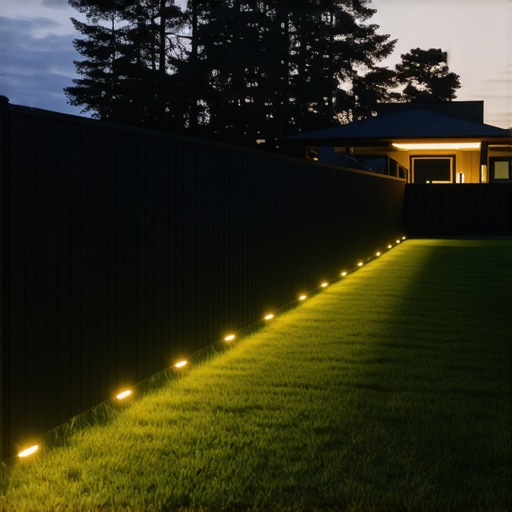
I can still smell the acrid, metallic tang of vaporized PVC. It is a scent that lingers in the back of your throat for days after you pull a failed direct-burial cable out of the mud. I was standing in a backyard last Tuesday, looking at a fence line that was supposed to be a ‘security feature.’ Instead, it was a liability. The homeowner had tried to run 120-volt Romex in a shallow trench, barely three inches deep, tucked right under the bottom rail of the cedar fence. A stray lawnmower blade or even a deep-seated shovel would have turned that perimeter into a lethal electrified cage. My journeyman used to smack my hand if I stripped a wire with a knife. ‘You nick the copper, you create a hot spot,’ he’d scream. He was right. Every nick is a point of resistance, and resistance is just another word for heat. When you are talking about perimeter lighting for home security, if you do not understand the physics of what is happening under the soil and inside your panel, you are not building a defense; you are building a fuse.
The Mid-Century Infrastructure Trap
Most of the homes I inspect for security upgrades were built between 1960 and 1980. This was the era of the ‘Federal Pacific’ and ‘Zinsco’ panels—names that make any forensic inspector’s skin crawl. These panels are the ultimate ‘Time Bomb.’ The breakers in an old FPE panel are notorious for jamming. They look like they are off, but internally, the bus bar is fused. When you decide to add low voltage lighting or a 400 amp service entrance to handle your modern lifestyle, you are often plugging into a system that is literally incapable of protecting itself. If you have aluminum wiring from this era, you are dealing with ‘Cold Creep.’ Aluminum expands and contracts at a much higher rate than copper. Over decades, this thermal cycling loosens the screws on your outlets and breakers. A loose connection creates an oxidation layer. That layer acts like a resistor, generating heat that eventually chars the insulation until it arcs.
“Aluminum wire connections can overheat and cause a fire without tripping the circuit breaker.” – CPSC Safety Alert 516
Before you even think about hanging a single fixture, we need to talk about your service. If you are adding a level 2 EV charger or a complex home automation setup alongside your security lighting, your old 100-amp panel is going to scream. We often have to perform a full electrical panel upgrade just to ensure the home doesn’t become a statistic while you’re trying to light up your driveway.
The Forensic Breakdown of Perimeter Lighting
Security lighting is about more than visibility; it is about psychological deterrents and technical reliability. When we do a rough-in for a fence line system, we have to account for voltage drop. This is where most DIYers fail. If you run 200 feet of 14-gauge wire to the back of a property to power LED floods, the resistance of the wire itself eats the voltage. By the time the current reaches the last light, the voltage has dropped from 12V to maybe 9V. This causes the internal drivers of the LEDs to work harder, generating heat and leading to premature failure. We use a Wiggy to check the potential at the end of the line—not just a cheap digital meter that can be fooled by phantom voltage. For a real security perimeter, you want low voltage lighting (12V-24V) because it is safer for outdoor environments where moisture is a constant. However, the transformer needs a dedicated home run back to a circuit protected by a surge protector installation. Without a whole-house surge protector, a single lightning strike nearby will fry your security cameras, your structured wiring panels, and every expensive LED on your fence. You can find more details on how we handle these complexities in our guide to how electricians tackle troubleshooting for lighting installations.
Physics of the Perimeter: Corrosion and the Widow Maker
The biggest enemy of your security lighting isn’t a burglar; it is galvanic corrosion. When you bury wires, you are putting them into a chemical bath. If you use the wrong connectors, moisture will wick up the strands of the copper, turning it green and brittle—a process we call ‘wicking.’ I always use ‘Monkey Shit’ (duct seal) to plug the ends of conduits. This prevents warm, moist air from the house from migrating down the pipe and condensing in the outdoor junction boxes. Without it, your boxes will rot from the inside out. I’ve seen ‘Widow Maker’ setups where a homeowner used a non-GFCI protected circuit for their fence lights. One nick in the insulation and the entire wet fence becomes energized. This is why code violation corrections are the first thing we look for during a forensic inspection. We use a tick tracer to sniff out energized surfaces before we even touch a fence. If you are planning a more extensive project, like ensuring safe and efficient EV charging station setup at home, the same rules of grounding and bonding apply. Your perimeter lighting and your charger are both part of a single ecosystem that demands a solid ground.
“All outdoor 15- and 20-ampere, 125-volt receptacles must be GFCI protected to prevent ground-fault currents from causing injury.” – National Electrical Code (NEC) Article 210.8
Infrastructure for the Modern Fortress
Building a secure home today requires more than a few lights. We are talking about structured wiring panels that act as the brain of the house, managing cameras, motion sensors, and automated gates. If your home still has a ‘spaghetti mess’ of wires in the basement, you need a cleanup. During the trim-out phase, we organize these systems to ensure they don’t interfere with your high-voltage lines. If you are worried about the cost, many homeowners are now looking into financing electrical upgrades to spread out the investment of a 400 amp service entrance and a total rewire. This isn’t just about security; it’s about capacity. When you add a level 2 EV charger, you are essentially adding the load of a second house to your panel. You need to ensure your system can handle the draw without tripping the main or melting a bus bar. If you run into issues with your charging setup, you might need ev charger troubleshooting to diagnose if the problem is the car, the charger, or your home’s aging infrastructure. Proper top ev charger maintenance tips always include checking the torque on the lugs, because just like that fence lighting, a loose connection is a fire waiting to happen.
The Final Torque: Sleeping at Night
When I finish a job, I don’t just flip the switch and walk away. I go through with a torque wrench and verify every single set screw in the panel. I’ve seen factory-tightened lugs that were half a turn loose. In the world of high-amperage draws, that half-turn is the difference between a cool panel and a cherry-red lug. Whether you are doing a simple pendant light hanging in the foyer or a massive perimeter lighting project, the physics don’t change. Electricity wants to return to its source, and it will take any path—including you or your house’s framing—to get there. By following a lighting installations made easy approach that prioritizes code compliance over aesthetics, you ensure that your security lighting actually provides security, rather than a new set of hazards. Don’t let a ‘handyman’ with a pair of dikes and some electrical tape touch your home’s perimeter. Get an inspector who knows the smell of a looming disaster before it starts. “