
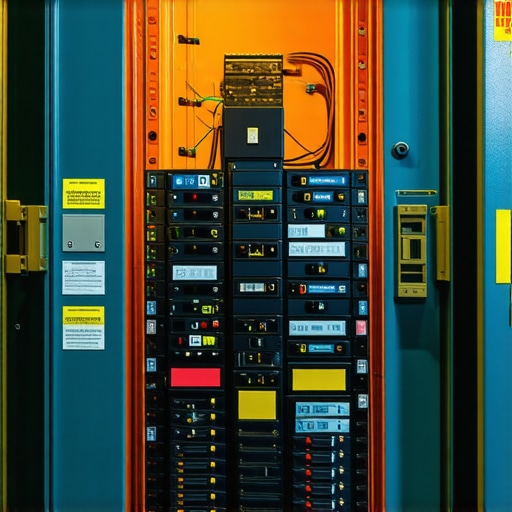
The Ghost in the Gear: Why Your Panel is Screaming Without Making a Sound
The air in a commercial mechanical room should smell like dust, old grease, and perhaps a faint hint of ozone if a heavy motor just cycled. But when you walk into a facility and catch that unmistakable, sickly-sweet scent of melting PVC insulation, your stomach drops. It’s the smell of money burning and a building’s heartbeat skipping. For 35 years, I’ve been chasing these ghosts. Most people think electricity is binary—it’s either on or it’s off. As a forensic inspector, I know the dangerous truth lies in the middle. There is a state of ‘failing’ that looks perfectly normal to the naked eye until the moment the bus bar liquefies and the lights go dark.
I remember walking into a ‘fully renovated’ medical office suite last year where the previous contractor had played fast and loose with the home run circuits. They had buried three live junction boxes behind a double layer of fire-rated drywall in the server room to avoid the cost of proper conduit runs. I didn’t find them with a sledgehammer; I found them with my thermal imaging camera. Through the lens, the wall looked like it had a glowing red arterial bleed. Those hidden connections were arcing, vibrating at 60Hz, and slowly charring the 2×4 studs. If we hadn’t caught it, that ‘renovated’ office would have been a pile of ash by morning. This is why thermal imaging inspections aren’t a luxury; they are an autopsy on a living system.
“Each bolting or compression connection shall be made with a pressure-type connector… Connections that depend on solder shall not be used.” – National Electrical Code (NEC) Section 110.14
The Physics of Failure: Why Resistance is the Enemy
To understand what a thermal imaging inspection reveals, you have to understand the physics of resistance. In a perfect world, your electrical system is a frictionless highway for electrons. But in the real world, every connection—every lug, every breaker clip, every splice—is a potential bottleneck. When a connection becomes loose due to vibration or improper torque, the surface area available for current flow decreases. This increases resistance. According to Joule’s First Law, the heat produced is proportional to the square of the current multiplied by the resistance (P=I²R). If you double the resistance, you double the heat. If you double the load—say, by adding a heavy-duty holiday light installation or a new server rack—you quadruple the heat. This is where certified journeyman services become critical. A ‘handyman’ might tighten a lug until it feels snug, but a Master Electrician uses a calibrated torque wrench because we know about Cold Creep. Aluminum and even copper will physically deform under pressure over time. If that connection isn’t torqued to the exact inch-pound specification, it will loosen, oxidize, and begin a slow-motion meltdown.
Component Zooming: The Anatomy of a Glowing Lug
Let’s look closer at the point of failure. When we perform thermal imaging inspections, we are looking for a ‘Delta T’—a temperature difference between phases. If Phase A is 90 degrees and Phase B is 145 degrees, we have a problem. The heat isn’t just ‘warmth’; it’s a symptom of molecular degradation. As the copper heats up, it expands. When the load drops, it cools and contracts. This thermal cycling eventually breaks the microscopic ‘cold welds’ of a tight connection. Once oxygen gets between the contact surfaces, an oxide layer forms. Copper oxide is a terrible conductor. Now the electricity has to ‘jump’ across that oxide layer, creating micro-arcs. These arcs generate temperatures exceeding 1,000 degrees Fahrenheit, which is more than enough to compromise the temper of the metal and melt the breaker’s internal trip mechanism. By the time you see the smoke, the breaker has already failed to do its one job: protect the wire.
The Perimeter Threat: Lighting and Outdoor Infrastructure
Your commercial electrical system doesn’t stop at the walls. We often see major failures originating in outdoor branch circuits. A bollard light installation or driveway sensor lights are constantly battling the elements. In coastal areas, salt air is the ultimate saboteur, bridging the gap between hot and neutral and causing ‘tracking.’ If your up lighting services weren’t installed with proper monkey shit (duct seal) in the conduit ends, moisture migrates right back into the main distribution panel. We’ve seen after hours electrical repair calls where the entire bottom of a 400-amp panel was rotted out because of a single unsealed conduit from a parking lot light. When we do a thermal scan, we often find these ‘leaks’ manifesting as heat at the breaker, even when the load is low. If you’re seeing flickering in your driveway sensor lights, don’t just swap the bulb. You likely have a high-resistance ground fault that’s cooking your wires in the ground.
“Aluminum wire connections can overheat and cause a fire without tripping the circuit breaker.” – CPSC Safety Alert 516
Beyond the Scan: Maintenance as a Survival Strategy
Thermal imaging is the diagnostic tool, but the cure is disciplined maintenance. This is why a priority service membership is the most valuable tool in a facility manager’s belt. It’s the difference between a planned GFCI outlet installation and an emergency after hours electrical repair that costs triple the rate. When we find a hot spot, we don’t just ‘tighten it up.’ We pull the component, inspect the bus bar for pitting, clean the surfaces with an abrasive pad, apply an antioxidant compound if we’re dealing with aluminum-to-copper transitions, and re-torque to spec. If the damage is too far gone, we talk about financing electrical upgrades. Modernizing an old Federal Pacific or Zinsco commercial panel isn’t about aesthetics; it’s about getting rid of components that have a documented history of failing to trip during an overcurrent event. You can read more about technical troubleshooting in our lighting installation guide.
The Real Cost of Ignoring the Heat
I’ve seen business owners balk at the cost of a panel upgrade or a comprehensive thermal scan, only to lose $50,000 in refrigerated inventory or a week of production when a main lug finally gives up the ghost. Electricity is a relentless force. It doesn’t care about your budget or your deadlines. It follows the path of least resistance, and if that path is through your building’s structure because a wire failed, it will take it. Whether you are planning a massive lighting installation or simply trying to ensure your current system can handle the load of a modern office, you need more than a tick tracer and a prayer. You need a forensic look at the thermal health of your infrastructure. Don’t wait for the smell of ozone. By then, the damage is done. Get a certified journeyman to put a thermal lens on your system today. Your peace of mind—and your insurance policy—depends on it.