
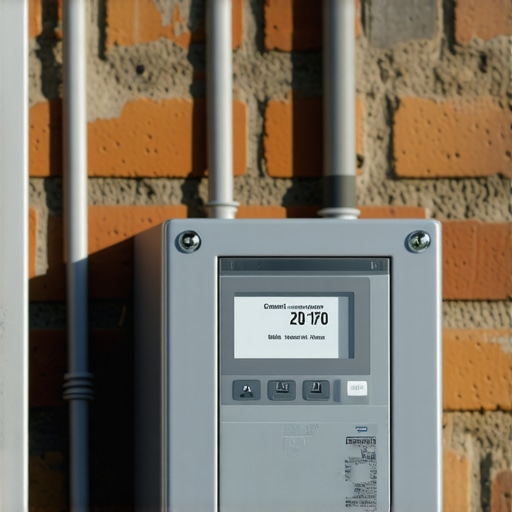
The Sound of Impending Failure: Why Your Smart Meter is Buzzing
If you are standing near your electrical service entrance and hear a low-frequency vibration—a sound that feels like a swarm of angry bees trapped behind glass—don’t tell yourself it’s just the grid doing its job. That humming is the sound of resistance, and in my 35 years of carrying a Wiggy and a pair of dikes, I’ve learned that resistance is just another word for a slow-motion house fire. Most homeowners think a smart meter is a silent computer. It should be. When it starts singing, you’re listening to the physics of failure. I walked into a ‘fully renovated’ ranch last month where the flipper had slapped a brand-new digital smart meter onto a 1970s meter socket that was held together by monkey shit and prayer. I pulled out my tick tracer and the thing screamed before I even touched the enclosure. The flipper had buried a live junction box behind the new siding right next to the service mast, and the heat from the bad connection had actually started to melt the Romex insulation inside the wall. It’s a miracle the place hadn’t gone up during the rough-in phase. To understand why your meter is humming, we have to look at the forensics of the home run and the mechanical interface between the utility and your panel.
The Physics of Magnetostriction and Arcing
Electricity isn’t just invisible magic; it’s a physical force that exerts pressure. The humming you hear is often caused by a phenomenon called magnetostriction. Inside the meter and the panel, magnetic fields caused by alternating current (AC) cause ferromagnetic materials to expand and contract at twice the frequency of the current. In a perfect world, everything is torqued down and silent. But when you have aluminum wiring or a 1960s-era socket, those vibrations become a jackhammer. Over time, this mechanical stress leads to ‘Cold Creep.’ Aluminum is notorious for this; it expands and contracts at a different rate than the brass or copper lugs, eventually backing the screws out. Once that connection is loose, you get micro-arcing. You won’t see it, but you’ll hear it. It’s a high-frequency vibration that eats away at the metal, creating an oxidation layer that is highly resistive. More resistance equals more heat. More heat equals more humming. Eventually, the jaw of the meter socket loses its spring tension, and that’s when you’re looking at a widow maker scenario where the meter could literally blow off the wall under a heavy load like an EV charger or a restaurant kitchen electrical system.
“Aluminum wire connections can overheat and cause a fire without tripping the circuit breaker.” – CPSC Safety Alert 516
The Danger of the Mid-Century Infrastructure
If your home was built between 1960 and 1980, you are likely sitting on a structural vulnerability. This was the era of the fuse box to breaker conversion boom, where many contractors took shortcuts. They would leave the old, undersized service entrance cable and just swap the internal guts. If you still have a Federal Pacific or Zinsco panel paired with a humming smart meter, you aren’t just looking at a repair; you’re looking at an emergency. These panels are famous for ‘jamming.’ The breakers won’t trip even when the bus bar is melting. When the utility company installs a smart meter, they often don’t check the integrity of the lugs inside the can. They just plug the new meter into the old jaws. If those jaws are corroded, you get a ‘hot socket.’ I’ve seen meter cans where the heat was so intense it charred the wooden siding behind the box. This is why permit pulling services are vital; a real inspector would catch the mismatch between modern utility demands and 50-year-old hardware. If you’re seeing flickering lights along with the noise, you need to check how electricians tackle troubleshooting for lighting installations to see if the problem is localized or systemic at the service entrance.
Why Modern Loads are Killing Old Connections
We are asking 1970s infrastructure to do 2024 work. When you add an attic fan installation, a suite of new smoke detector installation units, and an EV station, you are pushing the amperage limits of your old service. A 100-amp service from 1975 was designed for a toaster and a color TV, not a 48-amp continuous draw for a Tesla. This is why ensuring safe and efficient EV charging station setup at home is so critical. If the connection at the meter is even slightly compromised, the sustained draw of an EV charger will cook it. I’ve performed drone light inspections on commercial buildings where the thermal imaging showed the meter was 200 degrees Fahrenheit while the surrounding conduit was only 85. That temperature delta is a neon sign saying ‘fix me before I explode.’ In residential settings, we often see this during the trim-out of a basement finish. The homeowner adds 10 new circuits, but they never check the trenching electrical conduit or the main lugs for signs of pitting.
“All electrical equipment shall be installed in a neat and workmanlike manner.” – NEC Article 110.12
Forensic Steps: What to Do When the Buzzing Starts
First, don’t go poking a screwdriver into the meter can. That’s a widow maker move. You have 240 volts of unfused power coming straight from the transformer. If you slip, there is no breaker to save you. Instead, look for visual cues. Is there a brownish discoloration on the meter glass? Is the smell of ozone (like a burnt copy machine) present? If so, you need temporary power services while a pro performs an aluminum wiring repair or a full service upgrade. We are seeing more augmented reality troubleshooting tools being used to overlay circuit maps, but nothing beats an old-timer with a thermal camera and a torque wrench. If the noise is coming from the meter, call the utility, but be prepared for them to tell you it’s your responsibility from the lugs inward. That’s when you need a master electrician to pull the meter and inspect the jaws. If they look like they’ve been through a war zone—pitted, blackened, or lost their ‘spring’—the whole can needs to go. While you’re at it, check your top EV charger maintenance tips to ensure your heavy-draw appliances aren’t exacerbating the vibration at the service entrance. Don’t let a $500 repair turn into a $50,000 fire claim. If you need a forensic evaluation of your system, contact us immediately. Peace of mind is worth more than the cost of a panel swap. “