
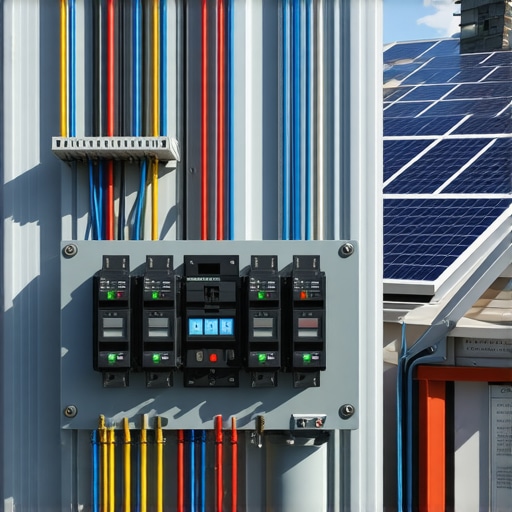
The Sensory Warning: When Copper Starts to Scream
Before you ever see a spark, you hear it. It’s a low-frequency hum, a vibration in the drywall that tells a seasoned sparky that the electrons are fighting for their lives. I’ve spent 35 years in the trade, and I can tell you that electricity doesn’t care about your green energy goals; it only cares about the path of least resistance. My old journeyman used to say, ‘If you don’t respect the load, the load will find a way to disrespect your house.’ He once made me sit in a crawlspace for three hours with a Wiggy just to prove that a neutral wire was carrying ghost voltage from a neighbor’s bad transformer. That lesson—that every connection is a potential point of failure—is the only way to approach connecting solar panels to an aging electrical infrastructure. If you’re thinking about slapping a 40-amp solar breaker into a panel that’s already struggling with knob and tube removal leftovers, you’re not building a power plant; you’re building a slow-motion fuse.
The Load Calculation: Why Ohm’s Law Isn’t a Suggestion
We need to talk about the 120% Rule (NEC 705.12). Most homeowners think a 200-amp panel can handle 200 amps of whatever they want. Wrong. In a standard load-side connection, you are feeding power from two sources: the utility grid and your solar inverter. This means the busbar—that hunk of tin-plated copper holding all your breakers—is getting hit from both ends. If you have a 200-amp main breaker and a 200-amp rated busbar, the NEC only allows you to back-feed an additional 40 amps of solar (200 x 1.2 = 240, minus the 200-amp main). If you exceed this, you risk the ‘Physics of the Hot Spot.’ The busbar begins to undergo thermal expansion and contraction, a process known as Cold Creep. Over time, this loosens the tension on the breaker clips, increasing resistance and creating a thermal runaway. Before you know it, that lighting install in the kitchen starts flickering because the main bus is warping under the heat. This is why main disconnect services are vital; you need a way to kill the feed before the panel becomes a puddle of slag.
“Aluminum wire connections can overheat and cause a fire without tripping the circuit breaker.” – CPSC Safety Alert 516
The Forensic Breakdown: Aluminum Wiring and Solar Stress
If your home was built between 1965 and 1973, you likely have a hidden enemy: aluminum branch wiring. Connecting a high-output solar system to a house with uncorrected aluminum is a recipe for disaster. Aluminum has a much higher coefficient of thermal expansion than copper. When the solar system ramps up at noon, the current flow increases, the wire expands, and it pushes against the steel terminal screws. When the sun goes down, it contracts. This creates a microscopic gap that fills with aluminum oxide—a fantastic insulator. Now, you have high resistance in a high-current circuit. This is why aluminum wiring repair using AlumiConn or Copalum connectors is a prerequisite for solar. You can’t just ‘twist and tape’ here. I’ve seen storm damage electrical repair calls where the wind didn’t knock the power out; the solar feedback simply finished off a terminal that was already failing due to oxidation. You need to ensure the rough-in phase of your solar project includes a full forensic audit of your existing terminations.
The 1920s Trap: Knob & Tube Meets Modern Photovoltaics
In older metropolitan areas, we deal with the ghost of electricity past: Knob and Tube (K&T). This system was designed for a few lightbulbs and a radio, not for the massive continuous loads of modern living or the back-feed of a 10kW solar array. K&T is an open-air system; it relies on the space between the wires and the wood joists to dissipate heat. When people blow insulation into their attics, they’re essentially putting a parky on a toaster. Adding solar to a K&T-heavy home is a non-starter. You need a total knob and tube removal strategy before you even look at a solar quote. Attempting to tie a modern inverter into an ungrounded system is asking for a Widow Maker scenario where the entire chassis of your appliances could become energized. This is also a critical time to look into rebate assistance programs that cover both energy generation and the necessary safety upgrades to your core infrastructure.
“The sum of the ampere ratings of overcurrent devices in circuits supplying power to a busbar or conductor shall not exceed 120 percent of the rating of the busbar or conductor.” – National Electrical Code (NEC) 705.12(B)(2)
The Process: From Heavy-Ups to Monkey Shit
To safely integrate solar, we often perform a ‘Heavy-Up.’ This isn’t just about a bigger box; it’s about main disconnect services, new grounding rods, and often, garage wiring services to house the inverter and battery storage. When we run the conduit from the roof to the panel, we don’t just ‘poke it through.’ We use Monkey Shit (duct seal) to ensure no moisture migrates into the sensitive electronics of the main breaker. We use a Tick Tracer to verify every circuit before we flip the switch. If you’re also planning on ensuring-safe-and-efficient-ev-charging-station-setup-at-home, your load calculation becomes even more precarious. A solar array and an EV charger running simultaneously can melt a sub-standard panel in hours. I always recommend a dedicated sub-panel for these ‘High-Impact’ loads, ensuring the architectural lighting and hot tub wiring services don’t end up competing for the same limited amperage on a tired busbar.
Closing the Circuit: Sleep Better Through Better Torque
At the end of the day, a solar installation is only as good as the torque on the lugs. If I catch a helper using dikes to strip wire or failing to use a calibrated torque wrench on the main feed, they’re off the job. Electricity is a relentless force, and solar is a constant, high-amperage stressor. Whether you are dealing with access control wiring for security or a massive lighting install, the rules of heat and resistance never change. If your panel is a relic of the mid-century, or if you suspect your wiring isn’t up to the task, contact us for a forensic inspection. Don’t wait for the smell of ozone to tell you there’s a problem. Check out our tips on ensuring safe and efficient EV charging station setup at home to see how we manage these heavy loads correctly. Your home should be a sanctuary, not a statistics point in an NFPA fire report. Get it torqued, get it grounded, and get it right.