
The Invisible Tingle: Why Your Faucet is Biting Back
You’re standing in your kitchen, barefoot on a damp tile floor, and you reach for the chrome faucet. There it is—a sharp, buzzing prickle that travels up your arm. Most homeowners dismiss it as a static shock or a quirky plumbing issue. I call it a forensic warning from a dying electrical system. As an inspector who has spent three decades tracing electrons through rotting crawlspaces and over-fused panels, I know that ‘tingle’ is actually stray voltage looking for a path to ground. If that path happens to be your heart instead of a copper rod in the dirt, your house becomes a crime scene. When you feel that buzz, it is time to call a 24 hour emergency electrician before the ‘tingle’ turns into a tragedy.
The Old Timer’s Lesson: The Cost of a Nicked Wire
My journeyman back in the late 80s was a man who lived by the code and died by the torque wrench. He used to smack my hand with a pair of dikes if he saw me stripping Romex with a pocket knife instead of a proper pair of strippers. ‘You nick that copper, you create a hot spot, kid,’ he’d growl. ‘The electrons get bottlenecked, the heat builds up, and the insulation carbonizes. You’re building a slow-motion bomb.’ He was right. That microscopic nick in the conductor increases resistance, leading to thermal expansion and contraction that eventually looses the terminal. In old homes built between 1900 and 1950, these ‘hot spots’ are often buried behind plaster walls where no one sees the smoke until it’s too late. This is why a service entrance upgrade isn’t just about more power; it’s about replacing the brittle, compromised infrastructure that’s currently leaking voltage into your structural components.
The Forensic Breakdown: Why Voltage Strays
Stray voltage occurs when electricity finds an unintended path back to the transformer. In a perfect world, current travels through the ‘hot’ wire and returns via the neutral. But in the real world of aging homes, neutral connections fail. When that ‘Home Run’ back to the panel loses its integrity due to oxidation or a loose lug, the electricity gets desperate. It hitches a ride on your gas lines, your water pipes, or your cable TV shielding. This is where bonding jumper services become critical. If your electrical system isn’t properly bonded to your plumbing, those pipes become energized. I’ve seen cases where a lack of a simple bonding jumper at the water meter caused enough stray voltage to kill a dog in a backyard. We don’t just ‘check’ wires; we perform a forensic audit of the entire grounding electrode system. [image_placeholder_1]
“Aluminum wire connections can overheat and cause a fire without tripping the circuit breaker.” – CPSC Safety Alert 516
The Component Zoom: Physics of the Neutral Failure
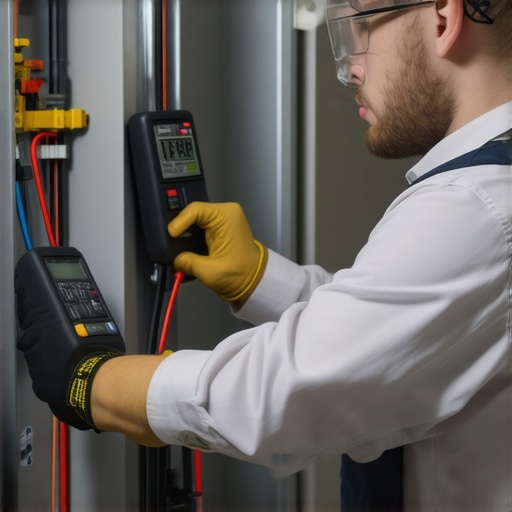
Let’s talk about the physics of why your lights flicker when the microwave kicks on. This is often a sign of a ‘floating neutral.’ When the neutral connection in your service entrance or at the utility weatherhead starts to corrode—a process accelerated by the ‘Monkey Shit’ (duct seal) drying out and letting moisture in—the voltage on your two legs of power becomes unbalanced. One side of your house might see 140 volts while the other drops to 100. This wreaks havoc on sensitive electronics in your structured wiring panels and can literally fry the control boards in your HVAC system. A professional safety audit uses a ‘Wiggy’ (a solenoid voltage tester) to put a load on the circuit; unlike a cheap ‘Tick Tracer’ that just glows near a wire, a Wiggy tells us if the voltage has the ‘guts’ to actually do damage. If we find these imbalances, an immediate subpanel installation or a full panel replacement is often the only code-compliant path forward.
The Invisible Enemy: Underground Wiring and Corrosion
If your home relies on underground wiring services, the risks are literally buried. Direct-buried cables from the 70s are notorious for insulation breakdown. Soil chemistry can eat through the outer jacket, allowing current to leak into the earth. This ‘stray voltage’ can surface in your lawn or around your pool deck. I’ve conducted audits where deck lighting services were installed by a ‘handyman’ who didn’t use UF-rated cable or proper conduit. The result? A wet deck that was carrying 40 volts of potential. We use specialized tracers to locate these faults without digging up your entire yard, but the fix usually involves a total bypass of the compromised line. Protecting these circuits with AFCI breaker services is non-negotiable in modern code, as these breakers can detect the specific signature of an underground arc before the ground catches fire.
“All electrical equipment shall be installed and used in accordance with the instructions included in the listing or labeling.” – NEC 110.3(B)
Modern Solutions for a Safe Home
We live in an era where our homes demand more than just a couple of 15-amp fuses. Between high-draw appliances and the need for ensuring safe and efficient EV charging station setup at home, your electrical heart—the main panel—is under constant stress. During a safety audit, we don’t just look for current problems; we look for future failures. We check the torque on every lug, inspect the ‘rough-in’ quality of previous additions, and ensure your smoke detector installation is integrated into a hardwired system with battery backups. If you’re unsure where to start, many firms now offer virtual consultation wiring reviews to walk you through a basic visual inspection before a master electrician arrives on-site. Don’t let a ‘fishy’ smell or a warm switch plate go ignored. If you are experiencing weird issues with your lamps or fixtures, you can learn more about how electricians tackle troubleshooting for lighting installations to see the complexity involved in modern circuitry. Electricity is a faithful servant but a murderous master. Torque your lugs, bond your pipes, and sleep soundly knowing your home isn’t a time bomb.