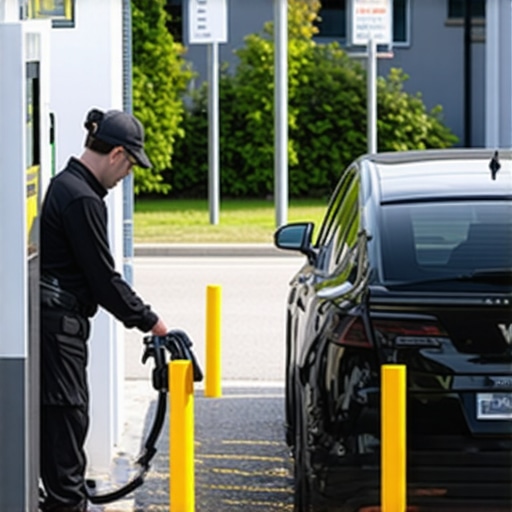
The Nuisance Trip: A Warning Shot Across the Bow
You wake up, grab your coffee, and walk out to the garage only to find your electric vehicle hasn’t gained a single mile of range overnight. You look at the wall connector and see a pulsing red ring or a dead screen. You walk over to the main service panel, and there it is: the 50-amp double-pole breaker is sitting in the tripped position. Most homeowners just flip it back and go about their day. They don’t realize that breaker just saved their lives, and flipping it back without knowing why it tripped is like putting a piece of tape over the ‘Check Engine’ light and flooring it on the interstate. When we talk about Reliable EV Charger Troubleshooting & Installation, we aren’t just talking about making the car go; we are talking about preventing your home’s electrical system from turning into a Roman candle.
The Journeyman’s Lesson: The Sin of the Nicked Wire
My old journeyman, a guy who had been pulling wire since the Eisenhower administration, used to carry a heavy wooden ruler. If he saw me stripping Romex with a pocketknife instead of a proper pair of dikes or wire strippers, he’d smack my hand until it was numb. ‘You nick that copper, you create a hot spot,’ he’d scream over the sound of the hammer drills. At the time, I thought he was just a cranky old-timer. But decades later, I’ve seen the forensic evidence of his wisdom. A single nick in a 6-gauge wire serving an EV charger creates a point of high resistance. Under the continuous 48-amp draw of a Level 2 charger, that microscopic nick becomes a thermal injector, heating the wire to hundreds of degrees until the insulation liquefies. That’s why EV charger troubleshooting expert tips always start with the physical integrity of the conductors.
“Continuous loads, such as electric vehicle charging, shall be calculated at 125 percent of the maximum current of the equipment.” – National Electrical Code (NEC) Article 625
The Load Calculation: Why Your 100-Amp Panel is Screaming
Most mid-century homes, those built between 1960 and 1980, were never designed for the ‘all-electric’ lifestyle. They were built for a fridge, a few lights, and maybe a window A/C unit. When you add a 50-amp EV charger, you are essentially asking an old mule to pull a freight train. This is where vibration analysis services and augmented reality troubleshooting come into play for modern forensic inspections, but the old-school Wiggy (solenoid voltmeter) still tells the truth: heat is the enemy. In these older homes, we often find aluminum wiring repair is the first step before even touching a charger. Aluminum has a high coefficient of thermal expansion. It undergoes ‘Cold Creep’—it expands when hot, hits the screw terminal, deforms, and then shrinks when it cools. Over time, the connection becomes loose. A loose connection is a high-resistance connection. A high-resistance connection is a fire.
The Anatomy of a Service Heavy-Up
If your panel is full, you can’t just ‘tap in’ a new breaker. We look for the home run—the direct line from the panel to the charger. If we are doing a shed wiring install or a kitchen range hood wiring job, the loads are intermittent. But an EV charger is a ‘continuous load.’ It runs for 8 to 10 hours at peak capacity. This requires a dedicated circuit and, often, a service upgrade. We call this a ‘Heavy-Up.’ We replace that crusty old 100-amp Zinsco or Federal Pacific panel (which are essentially fire-starters) with a 200-amp copper bus bar panel. For those needing immediate help, same day service appointments are critical when you smell that tell-tale ‘fishy’ scent of melting Bakelite near your panel.
“Aluminum wire connections can overheat and cause a fire without tripping the circuit breaker.” – CPSC Safety Alert 516
Forensic Troubleshooting: Beyond the Tick Tracer
When a client calls for certified journeyman services because their charger is failing, I don’t just wave a tick tracer (non-contact voltage detector) at the wall and call it a day. That’s for amateurs. I want to see the torque marks on the lugs. I want to check for galvanic corrosion. If you have a copper wire terminated into an aluminum lug without the proper ‘monkey shit’ (anti-oxidation duct seal or joint compound), you are inviting an electrochemical war. This is especially true in commercial electrical services where the voltages are higher and the stakes are even greater. For homeowners, ensuring safe and efficient ev charging station setup at home means verifying that the smart home wiring isn’t sharing a neutral with the charger—a common ‘handyman’ mistake that leads to fried electronics and flickering track lighting services.
The Silent Killers: Bus Bar Corrosion and Poor Grounding
The ground rod is the most ignored part of the system. I’ve seen rods that were only driven two feet into the ground because the installer hit a rock and gave up. In a fault condition, that electricity has nowhere to go but through your car’s chassis. We ensure every rough-in and trim-out includes a verified ground path. If you are experiencing weird errors on your charger display, it’s often a ground-to-neutral voltage issue. Using how electricians tackle troubleshooting for lighting installations as a baseline, we apply even stricter standards to high-amperage EV circuits. If the impedance is too high, the charger’s internal safety logic will ‘brick’ the unit to prevent a fire. This is why top ev charger maintenance tips for optimal performance always include a yearly thermal scan of the breaker terminations.
Conclusion: Electricity is Not a Hobby
You wouldn’t perform surgery on yourself, so don’t try to ‘hack’ a 50-amp circuit. Whether it’s a simple track lighting fix or a complex EV integration, the physics remain the same: Ohm’s law is a harsh mistress. If you ignore the signs—the humming breaker, the warm wall plate, the flickering lights—you are playing a dangerous game. When it’s time to install, follow a lighting installations made easy a step-by-step electrician guide for the small stuff, but call the pros for the heavy lifting. Sleep at night knowing your lugs are torqued to spec and your conductors aren’t ‘creeping’ behind the drywall.