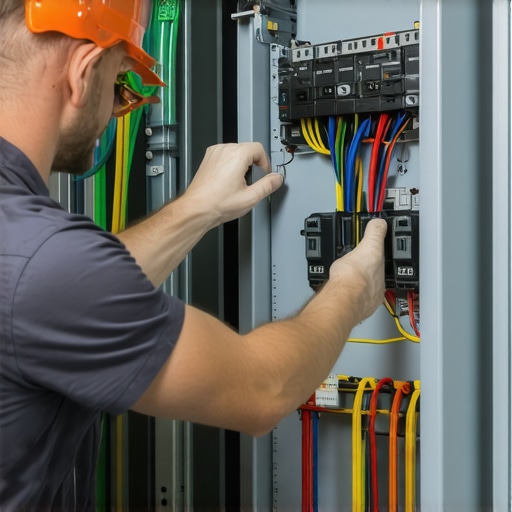
The Ghost in the Copper: Why Your Old Service is Screaming
Your house doesn’t care about your new smart appliances or that shiny EV parked in the driveway. It only cares about resistance. By 2026, the average American home is pulling a load that would have melted a service entrance cable back in 1975. If you are still running a 100-amp Zinsco or Federal Pacific panel, you aren’t just living in the past; you are living in a tinderbox. I’ve spent thirty-five years pulling dead rats out of switchgear and smelling the distinct, ozone-heavy stench of a bus bar that’s about to liquefy. When people ask why they need a Master Electrician for a 200-amp upgrade, I tell them it’s because electricity doesn’t give you a second chance.
My journeyman used to smack my hand if I stripped a wire with a knife. ‘You nick the copper, you create a hot spot,’ he’d scream. He was right. That tiny microscopic score in the metal becomes a point of high resistance. Under the heavy load of a modern HVAC system or a tiny home wiring project, that nick generates heat. Heat causes the metal to expand. When the load drops, it contracts. Do that ten thousand times, and your connection is loose. A loose connection is an arc waiting to happen. That’s the kind of forensic detail a handyman or a ‘pro-sumer’ with a pair of dikes and a YouTube degree will never understand.
The Physics of Failure: Cold Creep and the Aluminum Trap
In mid-century homes, we deal with the ‘Cold Creep’ phenomenon. Aluminum wiring was the darling of the late 60s because copper prices spiked. But aluminum is a fickle beast. It has a high coefficient of thermal expansion. It moves more than the steel or brass lugs holding it in place. Over time, the wire literally ‘creeps’ out from under the screw. This creates an air gap. Electricity, being lazy and aggressive at the same time, jumps that gap. That’s your arc. If you are looking into ensuring safe and efficient EV charging station setup at home, you cannot ignore the state of your main lugs. A 200-amp panel isn’t just about ‘more power’; it’s about having a bus bar thick enough to handle the thermal stress without degrading.
“Aluminum wire connections can overheat and cause a fire without tripping the circuit breaker.” – CPSC Safety Alert 516
When we do a power quality analysis, we aren’t just looking at voltage. We are looking for harmonics and transients that chew through insulation. Most people think a breaker trips because it’s ‘broken.’ No, the breaker is a thermal-magnetic gatekeeper. In those old FPE panels, the breakers are notorious for jamming. They won’t trip even when the wire is glowing cherry red. That is why a full panel changeout is the only solution. We pull out the old Romex, we check the rough-in for any signs of brittle insulation, and we ensure the home run to the panel is sized for the next twenty years of demand.
Infrastructure Context: The 2026 Energy Load
Why 2026? Because the grid is changing. We are seeing more transformer installation requirements for residential neighborhoods to handle the surge in electrification. If you’re adding a shed wiring install for a home office or a ceiling fan installation in every room to offset cooling costs, your total connected load is skyrocketing. A Master Electrician performs a rigorous load calculation. We don’t just ‘eye it.’ We account for the continuous load of an EV charger—which runs for hours—versus the intermittent load of a toaster.
When dealing with security camera wiring or a doorbell camera install, many homeowners think it’s ‘just low voltage.’ But if you’re tapping into an existing circuit that is already strained, you’re asking for a widow maker scenario. I’ve seen doorbell camera install attempts where the ‘handyman’ nicked a 120v line in the wall, energizing the entire low-voltage chime circuit. One touch and you’re part of the path to ground.
The Forensic Inspection: Beyond the Tick Tracer
Every amateur carries a tick tracer—those non-contact voltage detectors that beep when they’re near juice. A Master Electrician carries a Wiggy. A solenoid tester puts a load on the circuit. It tells you if you have ‘ghost voltage’ or a real, solid connection. If you are dealing with flood water electrical safety, you cannot trust a beep. You need to know if the dielectric strength of your wire insulation has been compromised by silt and contaminants. After a flood, the monkey shit (duct seal) in your conduits might be the only thing that kept the water out of your main 200-amp panel, but you have to know how to inspect it.
“All electrical equipment, including overcurrent protective devices, shall be installed and used in accordance with the instructions included in the listing or labeling.” – NEC 110.3(B)
We see a lot of issues with senior discount services where predatory contractors do a ‘quick fix’ on a flickering light. Usually, that flicker is a sign of a dropped neutral. If you lose your neutral, your 120v circuits can suddenly see 240v. It’ll fry your TV, your fridge, and your peace of mind. Our electrical wiring services focus on the integrity of the system from the utility tap to the last outlet in the attic. This is especially critical for tiny home wiring, where space is tight and heat dissipation is a major concern. If you’re struggling with flickering, read about how electricians tackle troubleshooting for lighting installations to understand the complexity involved.
The 200-Amp Heavy-Up: More Than Just a Box
A 200-amp upgrade is a ‘Heavy-Up.’ It involves the mast, the weather head, the meter can, and the grounding system. In 2026, grounding is more than just a rod in the dirt. We use Ufer grounds, cold water bonds, and supplemental rods to ensure that if lightning strikes or a transformer blows, the surge has a clear, low-resistance path away from your electronics. If you’re curious about costs or scheduling, you can contact us for a forensic evaluation of your current system. Don’t wait until the smell of burning fish (the smell of overheating Bakelite) fills your hallway. By then, the damage is done. Proper trim-out of a new panel involves torquing every single lug to the manufacturer’s inch-pound specifications. Hand-tight is not tight enough. We use calibrated torque wrenches because we know that thermal expansion is a law of physics, not a suggestion.