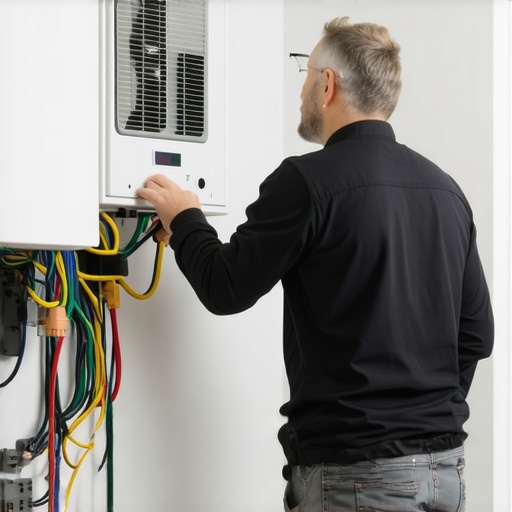
You can smell a bad attic fan installation before you see it. It is that distinctive, acrid tang of overheated dust and scorched Romex insulation. As we look toward a blistering 2026 summer, homeowners are scrambling to install whole house fans, but most of them—and frankly, most half-baked handymen—treat it like plugging in a toaster. It is not. You are installing a heavy inductive load in the hottest, most neglected part of your home infrastructure. If you do not respect the physics of heat and resistance, you are just building a very expensive fire starter.
The Old Timer’s Lesson: Why the Nick Matters
My journeyman used to smack my hand with a pair of dikes if he saw me stripping wire with a pocket knife. I remember one humid July morning in a cramped attic, my shirt soaked through with sweat and fiberglass. I had nicked the copper on a 12-gauge conductor. ‘You nick that copper, you create a hot spot,’ he’d scream. ‘The electricity doesn’t just flow through the wire; it creates a bottleneck right there. Heat builds, the copper expands, the connection loosens, and eventually, the whole thing arcs.’ He was right. In the 35 years since, I have seen dozens of ‘mystery’ attic fires that started exactly like that. When you are doing the rough-in for a high-CFM fan, you treat every inch of that wire with the respect it deserves.
Tactic 1: The Dedicated ‘Home Run’ and Ohm’s Law
The biggest mistake people make is tapping into the nearest bedroom lighting circuit. You cannot just piggyback a 1/2 horsepower motor onto a circuit that is already struggling to handle a computer and a space heater. When that motor kicks on, the inrush current is massive—often three to five times the running amperage. This causes a voltage drop that makes your lights flicker and stresses every electronic device in the house. If you are noticing these symptoms, you may need a professional troubleshooting session to prevent long-term damage. For a 2026-ready setup, you need a dedicated 20-amp circuit—a ‘Home Run’ directly from the panel to the fan. This ensures the fan has the ‘juice’ it needs without starving the rest of your home. If your panel is already stuffed to the gills, you are likely looking at a service entrance upgrade. Modern homes with EV charger installations and high-efficiency HVAC units are pushing 100-amp services to the breaking point. Do not add a whole house fan to a system that is already redlining.
“Aluminum wire connections can overheat and cause a fire without tripping the circuit breaker.” – CPSC Safety Alert 516
Tactic 2: Solving the Mid-Century Nightmare (Aluminum Wiring)
If your home was built between 1965 and 1975, there is a high probability you have aluminum wiring. In the world of forensic inspection, we call this the ‘Time Bomb.’ Aluminum has a much higher thermal expansion coefficient than copper. We call it ‘Cold Creep.’ Every time that fan motor turns on and generates heat, the aluminum wire expands. When it turns off, it contracts. This mechanical movement eventually backs the wire out from under the screw terminals on your switches and breakers. This creates a high-resistance gap. As the Master Electrician, I will tell you: never connect a new fan directly to old aluminum wire. You must perform a proper aluminum wiring repair using AlumiConn connectors or Copalum crimps. These create a gas-tight seal that prevents the oxidation layer from forming—a layer that acts as an insulator and creates even more heat. Always use your Tick Tracer to verify there are no ‘ghost’ voltages lingering in those old junction boxes before you start digging.
[image_placeholder_1]
Tactic 3: Advanced Grounding and Spa-Grade Safety
Most people think a fan just needs hot and neutral. Wrong. An attic fan is a giant spinning metal assembly. If a winding in the motor fails and shorts to the frame, the whole fan housing becomes energized. Without a solid ground path back to the panel, the fan stays live until someone touches it—or until it arcs to a nearby gas line. I treat these installs with the same gravity as EV charger troubleshooting or spa grounding services. You need a continuous, low-impedance ground path. If you are installing this fan near other metal systems, like ethernet wiring services or metal ductwork, you need to ensure everything is bonded. I have seen ‘Widow Maker’ scenarios where a lack of grounding turned an entire attic’s foil-faced insulation into a live conductor. Use a Wiggy to test your ground’s integrity; do not trust those cheap three-light testers.
Tactic 4: Integration with Home Automation and Smart Relays
By 2026, a manual crank timer on the wall is a relic. A proper home automation setup allows the fan to talk to your thermostat and humidity sensors. However, smart switches are notorious for failing under inductive loads. Motors are ‘noisy’—they create electromagnetic interference (EMI). If you do not use a relay rated for motor loads (not just incandescent lights), the internal contacts of your smart switch will weld shut within a month. When we do a lighting installation guide for smart homes, we emphasize load ratings for a reason. Always check the HP (horsepower) rating of your controller. If it is not rated for at least 1/2 HP, you are throwing money away. Use ‘Monkey Shit’ (duct seal) to seal the wire penetrations into the switch box; otherwise, that fan will pull hot attic air directly into your living room walls, creating a condensation nightmare and mold risk.
“All 125-volt, single-phase, 15- and 20-ampere receptacles installed in crawl spaces and unfinished basements must have GFCI protection.” – NEC Section 210.8
Conclusion: It Is Not a Hobby
Electricity is a lazy, dangerous beast that is always looking for the shortest path to the dirt. When you install a whole house fan, you are giving that beast a new playground. Between the vibration of the motor, the extreme heat of the attic, and the potential for improper wire termination, there is no room for ‘close enough.’ Whether you are upgrading for better cooling or safety, ensure your torque settings are to spec and your connections are solid. Sleep at night knowing your fan is cooling your house, not burning it down. If you’re also considering permanent holiday lighting or a kitchen range hood wiring project, remember that every load added to your panel requires a fresh look at your total demand. Do the math, or the math will do you.