The Hum of Inefficiency: Why Your High-Tech Home is Choking on Its Own Copper
You hear that? It is a high-pitched whine coming from the utility closet, right next to your $500 router. Most homeowners ignore it. I don’t. To me, that sound is the death rattle of bandwidth. As we push toward 2026, where every lighting install and doorbell camera install demands a slice of your home’s frequency spectrum, the physical wires behind your drywall are failing the stress test. My old journeyman, a man who could find a short in a blizzard just by the smell of ionized air, used to smack my hand if I stripped a wire with a pocket knife. ‘You nick that copper, you create a hot spot,’ he’d scream. ‘You’re not just making a connection; you’re building a radiator.’ He was right. Today, those nicks and sloppy rough-in habits are not just fire hazards; they are the reason your 8K stream is buffering. We are seeing a collision between 1970s electrical infrastructure and 2026 data demands, and the electrical panel is the battlefield.
“Communications cables shall have a vertical clearance of not less than 2.4 m (8 ft) from all points of roofs above which they pass.” – NEC Article 800.44
1. The EMI Nightmare: Running Data Parallel to Romex
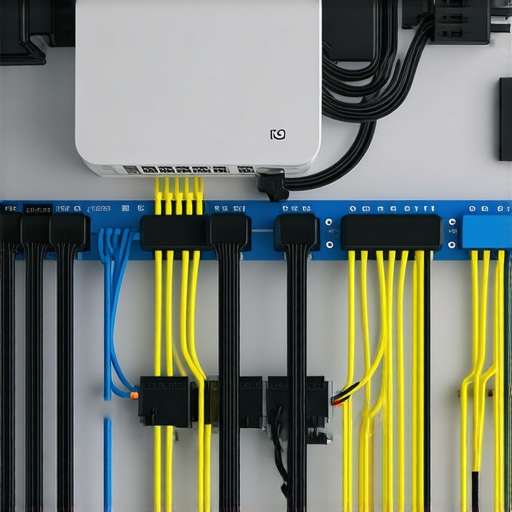
The biggest sin I see during a lighting install or a kitchen range hood wiring job is cable management—or the lack of it. When a ‘handyman’ zip-ties a Category 6A data cable directly to a 12/2 Romex line, they’ve created a transformer. This is basic physics: Ampere’s Law. Every time your refrigerator compressor kicks on or your whole house fan wiring pulls a heavy load, it creates an electromagnetic field. That field induces a current in the data line next to it. In the trade, we call this ‘noise.’ Your router sees this noise as corrupted packets and has to resend the data. By the time you’ve added permanent holiday lighting and a dozen smart switches, your internal network is screaming through a localized lightning storm. If you are troubleshooting for lighting installations that seem to flicker when the internet lags, you’ve likely got cross-talk and induction issues. You need separation. You need 12 inches of air or a grounded metal conduit, or you’re just paying for high-speed fiber that dies in the wall.
2. The Grounding Paradox and the 400 Amp Service Entrance
We are seeing an unprecedented surge in demand. Between hot tub wiring services, EV charger maintenance, and AI-driven home servers, a standard 200-amp panel is gasping for breath. Homeowners are now opting for a 400 amp service entrance to keep up. But here is the mistake: they beef up the service but ignore the grounding electrode system. If your ground is high-resistance—maybe because the copper clad rod was driven into sandy soil without any ‘monkey shit’ (duct seal) to protect the connection—you get a floating neutral. This creates ‘dirty power.’ High-frequency transients start looking for a path to ground, and they often find it through your smart hub’s sensitive circuitry. This is where AI fault detection becomes critical. Modern breakers can now sense these micro-arcs before they become fires, but they can’t fix a bad ground. You’ll see your smart devices drop offline randomly. It isn’t a software glitch; it is a physical failure of the electron return path. For a truly safe and efficient home setup, your grounding must be tested with a Megger, not just a tick tracer.
“Aluminum wire connections can overheat and cause a fire without tripping the circuit breaker.” – CPSC Safety Alert 516
3. Thermal Expansion and ‘Cold Creep’ in Smart Switches
Many homes built in the late 60s and 70s are ticking time bombs because of aluminum wiring. When you swap out a standard toggle for a smart dimmer during a lighting install, you’re often mixing metals. Aluminum and copper have different coefficients of thermal expansion. This leads to ‘Cold Creep’—the wire literally crawls out from under the screw terminal over time. The loose connection creates resistance, resistance creates heat, and heat slows down the switching speed of the semiconductor inside your smart device. Eventually, the plastic housing of the switch becomes brittle and cracks. I’ve opened boxes where the Romex insulation was so charred it crumbled like a burnt marshmallow. This is why rebate assistance programs often prioritize panel upgrades and rewiring. If you’re experiencing common EV charger issues, it might not be the car; it’s likely the home run back to the panel that’s heating up and dropping voltage. Use AlumiConn connectors or get the house re-wired. Don’t bet your roof on a loose screw.
4. The Low-Voltage Trap: Voltage Drop in Landscape and Security
When I do a landscape lighting install or a doorbell camera install, I see people using wire thin as dental floss. They think ‘low voltage means low risk.’ Wrong. Voltage drop is the enemy of 2026 smart tech. If your doorbell camera is at the end of a 100-foot run of 22-gauge wire, the 16V transformer at the other end is only delivering 11V by the time it reaches the lens. The camera’s Wi-Fi radio has to work twice as hard to maintain a signal at low voltage, causing it to overheat and throttle its upload speed. This is why your ‘4K’ camera looks like a Lego movie. When we do a trim-out, we calculate the circular mil area of the conductor to ensure we’re staying under a 3% drop. It’s the difference between a system that works and a ‘widow maker’ that shorts out in a rainstorm. If you want it done right, check out our step-by-step electrician guide. Always over-gauge your outdoor runs. Copper is cheap; replacing a fried AI-camera every two years is not. Stop treating your electrical system like a hobby. It’s the nervous system of your home, and right now, most of you have a pinched nerve. Get a Wiggy, check your voltages, and for the love of everything holy, torque your lugs to the manufacturer’s specs. If you have questions about your specific setup, you can always contact us for a forensic inspection before your walls start smelling like ozone.