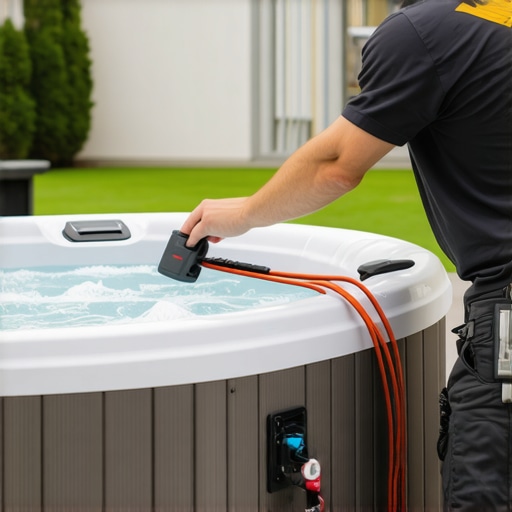
The Tingle That Signals a Death Trap
You are stepping into 500 gallons of water, and you feel a faint, vibrating ‘sting’ on a hangnail. Most people ignore it. I don’t. In my 35 years as a forensic inspector, that ‘tingle’ is the sound of a countdown. It means your backyard has become a giant capacitor, and you are the path of least resistance. When we talk about stop hot tub shocks, we aren’t just talking about a nuisance trip on a breaker; we are talking about preventing a cardiac event. Electricity and water don’t just dislike each other; they are engaged in a constant, violent struggle for equilibrium, and your body is often the bridge they use to find it.
I’ve walked into too many ‘fully renovated’ backyards where the flipper buried live junction boxes three inches under the sod and covered them with decorative mulch. I found one last summer with my tick tracer screaming before I even reached the edge of the deck. The flipper had used indoor Romex inside a standard PVC pipe that wasn’t even glued, allowing salt-heavy coastal groundwater to seep in and turn the copper into a green, bubbling slurry. This is the ‘Flipper Special’—it looks great in the listing photos, but it’s a widow maker waiting for the first humid night of the year. If you are adding a level 2 EV charger or a workshop electrical setup to your property, your total load is shifting, and your old grounding system is likely screaming for mercy.
1. The Equipotential Bonding Grid: The Physics of Neutrality
Most ‘handymen’ think ‘grounding’ and ‘bonding’ are the same thing. They aren’t. Grounding is for the equipment; bonding is for you. In a coastal environment, salt air corrosion acts as a catalyst for galvanic reaction, eating away at the copper wire that connects your spa’s metal frame to the ladder and the internal heater. This creates a voltage gradient. If the water is at 2 volts and the metal handrail is at 0 volts, you feel the shock. We use a home run of #8 solid copper to tie every metallic component together, ensuring they are at the exact same electrical potential. If everything is at the same voltage, no current flows through you. This is why we don’t just ‘ground’ the tub; we build a cage of safety around it.
“Equipotential bonding shall be installed to reduce voltage gradients in the pool area by connecting all metal parts together with a solid copper conductor.” – National Electrical Code (NEC) Article 680.26
In 2026, with the rise of demand response systems that cycle your power during peak hours, these bonding points are under more stress than ever. Rapid switching in the smart grid can induce small transients in your home’s electrical system. Without a robust bonding grid, those transients end up in your hot tub water. If you haven’t had a 200 amp panel install or a thorough inspection of your bonding lugs lately, you’re gambling with 1970s tech in a 2020s world.
2. The GFCI Forensic Audit: Why ‘Test’ Buttons Lie
Every hot tub has a GFCI (Ground Fault Circuit Interrupter). Most homeowners push the ‘test’ button once a year and think they’re safe. As a master electrician, I’ve seen GFCIs where the internal solenoid has seized due to salt air ingress, yet the button still clicks. The mechanical part moves, but the electrical path remains closed. This is why I use a Wiggy or a dedicated GFCI tester to simulate a true 5mA fault. In coastal regions, the ‘salt bridge’ effect can occur inside the breaker itself. Salt accumulates on the bus bar, creating a high-resistance path that mimics a load, eventually heating the breaker until the plastic casing deforms—a phenomenon known as ‘cold creep’ in the context of thermal expansion. This is why we use monkey shit (duct seal) to plug the conduits entering the panel; we have to keep that corrosive air out of the sensitive electronics.
3. Service Entrance Integrity and the 400 Amp Reality
If you are trying to run a hot tub, a level 2 EV charger, and a smart thermostat wiring system on an old 100-amp service, you are asking for a fire. I’ve seen 100 amp service upgrade jobs where the homeowner tried to ‘cheat’ the load calculation. The result? A 400 amp service entrance is becoming the new standard for modern ‘electrified’ homes. When you pull 50 amps for a spa and another 40 amps for a car, the heat generated at the main lugs of a 100-amp panel is enough to melt the insulation off the service entrance conductors. This heat travels. It oxidizes the connections, increasing resistance, which creates more heat—a death spiral for your electrical system. If your lights flicker when the hot tub heater kicks on, your panel is telling you it’s dying. Don’t ignore the warning signs. You might need a workshop electrical setup or a full commercial electrical services style heavy-up just to handle the modern domestic load.
“Aluminum wire connections can overheat and cause a fire without tripping the circuit breaker if the expansion and contraction cycles loosen the terminal lugs.” – CPSC Safety Alert 516
For those in coastal zones, the meter can often rots from the inside out. I’ve opened cans where the neutral lug was a pile of white powder. When you lose a neutral, the voltage in your house goes haywire—120V outlets might see 200V, and your hot tub’s computer board will likely fry, or worse, energize the water. A 200 amp panel install isn’t just an upgrade; it’s a structural necessity for safety. You can learn more about managing these high-draw devices in our guide on ensuring safe and efficient EV charging station setup at home.
4. Communication and Control: Smart Systems and Ethernet
In 2026, hot tubs aren’t just tubs; they are networked appliances. If you are running ethernet wiring services or speaker system setup near your spa, you are introducing low-voltage data lines into a high-voltage wet environment. If a high-voltage line faults into a low-voltage ethernet cable because they were crammed into the same rough-in, you can send 240V straight to your router, or worse, into the touch-panel of the spa. We maintain strict ‘separation of circuits.’ Never let a ‘handyman’ run your smart thermostat wiring or data cables in the same conduit as your power lines. It’s a violation of code and a recipe for an unpredictable disaster. If you’re seeing weird behavior in your spa’s digital display, it might be EMI (Electromagnetic Interference) from a poorly shielded level 2 EV charger circuit nearby. We often have to perform a forensic ‘trace-out’ to find where these signals are crossing. Check out our ev charger troubleshooting expert tips for more on how these systems interact.
The Final Torque: Sleep Better Tonight
Electricity isn’t a DIY hobby. It is a utility that is constantly trying to return to the earth, and it will go through you to get there if you give it an opening. From the trim-out of the smallest outlet to the massive 400 amp service entrance, every connection must be torqued to spec. I’ve spent decades fixing the ‘it works fine’ mistakes of others. If you suspect your hot tub isn’t 100% safe, or if you’re planning a major addition like a workshop electrical setup, get a professional to look at it. If you have questions about your current setup or need an inspection that goes deeper than a simple ‘on/off’ test, feel free to contact us. Your safety is worth more than a ‘handyman’s’ discount. Don’t wait for the tingle to become a tragedy.
This post highlights crucial safety aspects that many homeowners overlook until it’s too late. I especially resonated with the part about the bonding grid and how demand response systems can induce voltage transients. From personal experience working in coastal areas, I’ve seen how corrosion can silently undermine grounding systems, leading to dangerous voltage gradients. It’s a reminder that routine inspections and professional upgrades are vital, particularly as our homes become more electrified with EV chargers and smart systems. I wonder, how often would you recommend testing and rechecking these bonding connections, especially in salt-heavy environments? Also, does anyone have tips on verifying the integrity of a GFCI beyond just using the ‘test’ button? Sharing real-world maintenance routines could help many avoid disaster down the line.