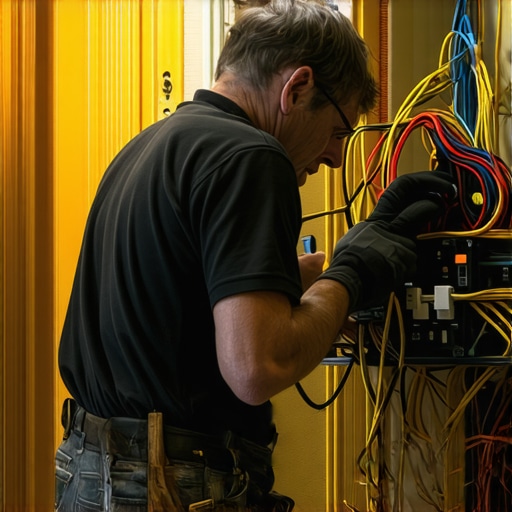
The Anatomy of a Hidden Hazard
Every time I step into a property that has survived a structural fire, the history of the house speaks to me through its scars. It isn’t just about the charred studs or the smell of wet soot that clings to your lungs for a week; it is about what happens inside the walls when the thermal envelope is breached. Most homeowners think that if the lights turn on, the system survived. They are wrong. A house built in the mid-century era is a ticking time bomb waiting for a catalyst, and a fire is the ultimate accelerant for pre-existing electrical decay. My journeyman used to smack my hand if I stripped a wire with a knife. ‘You nick the copper, you create a hot spot,’ he’d scream. He was right. That microscopic nick reduces the cross-sectional area of the conductor, increasing resistance. In a fire restoration scenario, we aren’t just looking for nicks; we are looking for the molecular breakdown of the entire infrastructure.
The Forensic Reality of Heat Damage
When copper is exposed to temperatures exceeding 200 degrees Fahrenheit, even if the flames never touch it, the PVC insulation begins a process called de-plasticization. It becomes brittle, turning into a crunchy shell that flakes off the moment you move a wire during the rough-in phase of restoration. If you try to reuse that wire, you are inviting a short circuit the moment the house settles. We use a Wiggy to check for solenoid-level voltage, but even a Tick Tracer—or what we call the Widow Maker in the trade—won’t tell you if the insulation integrity is compromised deep inside a conduit. You need a forensic eye to spot carbon tracking, where smoke residue creates a conductive path across the surface of a terminal, leading to a slow-motion arc that eventually finishes what the first fire started.
“Aluminum wire connections can overheat and cause a fire without tripping the circuit breaker.” – CPSC Safety Alert 516
Fix 1: The Aluminum Wiring Repair & Cold Creep Physics
If your 1970s home suffered a fire, the aluminum wiring is your primary suspect. The physics of aluminum is its own worst enemy. We call it Cold Creep. Aluminum expands and contracts at a much higher rate than the brass or copper terminals it is screwed into. Every time you turn on a space heater, that wire heats up, expands, and pushes against the screw. When it cools, it doesn’t quite return to its original shape. Over a decade, that screw becomes loose. A loose connection is a high-resistance connection. In a fire, this process is hyper-accelerated. The intense heat causes massive expansion, and as the house cools down, those aluminum wiring repair needs become urgent because the connections are now dangerously slack. We don’t just ‘tighten the screws.’ That’s a handyman’s death wish. We use AlumiConn connectors or COPALUM crimps to create a cold-weld transition from aluminum to copper. This ensures that the smart thermostat wiring you install later doesn’t melt off the wall because of a legacy metallurgical failure.
Fix 2: Fuse Box to Breaker Conversion & The 200 Amp Heavy-Up
Insurance companies in 2026 are no longer playing games. If you have an old Edison-base fuse box or a Federal Pacific ‘Stab-Lok’ panel, you aren’t just at risk—you are likely uninsurable after a fire claim. These old panels are notorious for ‘jamming.’ A breaker is supposed to be a safety valve; an FPE breaker is a doorstop. I’ve seen them literally weld themselves to the bus bar while the Romex in the wall turned into a heating element. A fuse box to breaker conversion is the baseline for restoration. But don’t stop at 100 amps. Modern life—with its network cable installation, high-draw appliances, and the inevitable overhead service drop demands—requires a 200 amp panel install. When we do a heavy-up, we are looking at the grounding electrode system. We aren’t just pounding a rod into the dirt; we are ensuring the path to ground is the path of least resistance so that lightning or surges don’t find a path through your new track lighting services.
“The service-entrance conductors shall be of a type that is suitable for the prevailing conditions and shall be protected against physical damage.” – NFPA 70: National Electrical Code (NEC)
Fix 3: Overhead Service Drop & Exterior Weatherproofing
The fire often starts or is exacerbated at the overhead service drop. The weatherhead, where the utility lines enter your home, is exposed to the elements 24/7. In a fire, the tension on these lines can pull the service mast away from the structure. We use Monkey Shit—that’s duct seal to the uninitiated—to block moisture from entering the mast, but if the fire damaged the exterior, that seal is gone. Water will travel down the inside of the service cable like a straw, right into your brand-new panel. During insurance claim electrical work, we prioritize the replacement of the entire service entrance. This includes the meter can and the mast. If you are dealing with pool pump electrical systems, we also have to ensure the bonding grid wasn’t compromised by the heat, as salt-air corrosion or heat-induced galvanic reaction can turn your pool into a live circuit.
Fix 4: Modernizing for the Future: Network and Smart Systems
Restoration is the only time you’ll have the walls open, so don’t waste the opportunity. This is the moment for network cable installation and running a Home Run for every major circuit. We’re talking about 10-gigabit speeds and dedicated lines for your smart thermostat wiring. Most people think they can just use Wi-Fi, but in a 2026 property, the interference from neighboring smart grids makes hardwired connections essential. We also look at track lighting services to provide flexible, modern illumination that doesn’t require cutting 50 holes in your new drywall. When we trim-out a house, we use our dikes to clean up the messy bundles of wire left by the previous generation, ensuring that every box has enough ‘reach’ and that no conductor is under tension. If you’re planning for an EV, check out our guide on ensuring safe and efficient EV charging station setup at home to make sure your 200-amp upgrade can handle the load. For those tight on time, our weekend electrician services are designed to keep the project moving without sacrificing the torque-to-spec requirements that keep your family safe.
The Final Torque: Sleeping Soundly
Electricity is a lazy, invisible force that is constantly looking for a way out. My job as a forensic inspector is to make sure the only way out is through the device you intended to power. Whether it’s troubleshooting for lighting installations or a total gut-job after a fire, the goal is the same: mechanical and electrical integrity. If you’ve had a fire, don’t trust the ‘visible’ inspection. Trust the physics. Trust the Wiggy. If you need expert eyes on your project, you can contact us for a full forensic assessment. For more tips on maintaining your system, read about how electricians tackle troubleshooting for lighting installations and keep your home from becoming another case file in my cabinet.