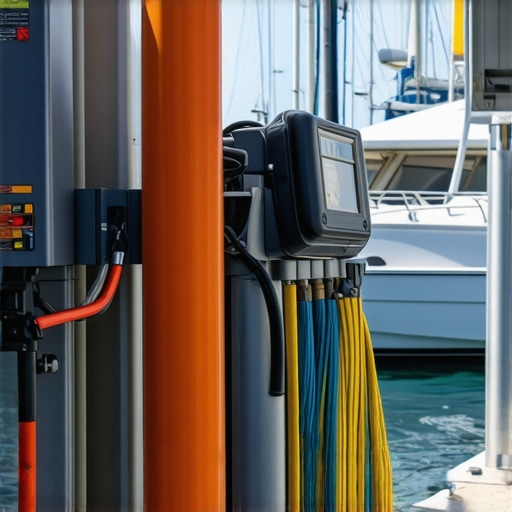
The Invisible Danger Lurking Under Your Dock
If you walk down to your slip and catch a whiff of metallic ozone or see a faint shimmering on the water’s surface near your pilings, do not touch the lift handle. You are likely smelling the precursor to a fire or feeling the effects of stray current. As a forensic inspector, I’ve seen enough ‘handyman specials’ on docks to know that water and 240 volts don’t just dislike each other—they are engaged in a permanent state of war. When preparing for the 2026 season, your boat lift isn’t just a convenience; it is a complex electrical system submerged in a corrosive electrolyte. Ignoring the state of your dock electrical services is a recipe for disaster. I walked into a ‘fully renovated’ boat house last year where the flipper had buried live junction boxes beneath the cedar decking, no gaskets, just a prayer and some electrical tape. I found them with my tick tracer because the wood was literally steaming after a rainstorm. That’s the kind of negligence that turns a weekend getaway into a tragedy.
1. The GFCI Breaker: Your First Line of Defense
The most critical component of any boat lift setup is the Ground Fault Circuit Interrupter (GFCI). This isn’t your standard kitchen outlet. For a dock environment, the NEC is uncompromising.
‘The equipment grounding conductor shall be an insulated copper conductor.’ – NEC 682.31(A)
If your breaker is ‘nuisance tripping,’ it’s not a nuisance—it’s a warning. In my 35 years, I’ve seen owners bypass these breakers because they were tired of resetting them. That is how you energize the water. When we perform troubleshooting on dock systems, we often find that the leakage is coming from microscopic cracks in the motor winding insulation. Component zooming: At the molecular level, salt air facilitates a ‘salt bridge’ across insulator surfaces. This creates a high-resistance path to ground that generates heat before it ever draws enough current to trip a standard thermal breaker, but a functional GFCI will catch it at 5 milliamps.
2. The Green Death: Combating Salt Air Corrosion
In coastal environments, the air is thick with sodium chloride. This leads to what we call the ‘Green Death’—the heavy oxidation of copper conductors. If you open your motor control box and see green crust on the terminals, that’s resistance. Resistance equals heat. Heat leads to voltage drop, which kills boat lift motors. We recommend applying dielectric grease to all termination points after a clean lighting install or motor hookup. This isn’t just a suggestion; it’s a barrier against galvanic reaction. When copper and aluminum meet in a salty environment without a proper inhibitor, the aluminum becomes the sacrificial anode and literally disappears into white powder, a process known as ‘Cold Creep’ in older aluminum-fed systems. If your dock uses an older service, you might need a panel heavy-up or a specialized troubleshooting session to ensure the integrity of the home run back to the main house.
3. Conduit Integrity and ‘Monkey Shit’
Don’t laugh—’Monkey Shit’ (duct seal) is your best friend. Every conduit entering your dock-side enclosures must be sealed. Why? Because warm, moist air travels through the conduit from the ground and condenses inside your expensive control panels. I’ve opened ‘weatherproof’ boxes that were half-full of water because of this chimney effect. During your 2026 inspection, check the PVC conduit for UV degradation. If the pipe is turning gray and brittle, it will crack, allowing moisture to seep into your Romex or THHN wires. For those running high-speed data to their boat houses, ensuring your network cable installation or fiber optic cabling is shielded from this moisture is vital. Water in a data line might just slow your Netflix, but water in a 220V motor line will trip your mains and potentially cause an arc flash.
4. Bonding and Stray Current Autopsy
Bonding is not grounding, and mistaking the two is a forensic inspector’s nightmare. Bonding connects all metal parts of the dock—the lift frame, the ladders, the pillings—to ensure they are at the same electrical potential. If there’s a fault, you want the metal to trip the breaker, not use your body as the path to ground while you’re swimming.
‘All metal parts in contact with the water, or within 8 feet of the water, shall be bonded together.’ – NFPA 70 Article 682
We often find that bonding wires have snapped due to wave action or electrolysis. If you see deep pitting on your metal lift components, you have a stray current issue. This could be coming from your own pool pump electrical system nearby or even a neighbor’s faulty solar panel electrical hookup. An arc flash study or a simple clamp-meter test can reveal if your dock is ‘leaking’ electricity into the lake.
5. Load Calculations for the Modern Dock
In 1990, a dock had a light and a small lift. Today, I see docks with 240V sauna heater installations, outdoor kitchens, and even EV charging station setups for electric boats. Your old 30-amp sub-panel can’t handle that. When you overload a circuit, the wire insulation undergoes thermal cycling. It expands when hot, contracts when cold, and eventually, the copper nicks the edge of a staple or a box connector. This is why we insist on a proper workshop electrical setup mentality even for outdoor docks. If you’re adding a sauna or heavy lighting, you need to calculate the total load or face the smell of burning PVC mid-summer. Always ensure your ‘Rough-in’ and ‘Trim-out’ phases are handled by a pro who understands the physics of voltage drop over long distances. If your dock is 200 feet from the house, you need to upsizing your conductors to prevent the ‘brownout’ effect that destroys motor capacitors.
Summary: Sleep Better with a Torqued System
Electricity isn’t a hobby, especially when it’s hovering over a body of water. Before the 2026 season kicks off, grab your Wiggy or a voltmeter and check your potentials. If the numbers don’t look right, or if you see the ‘Green Death’ creeping into your motor box, it’s time for a professional intervention. Safety isn’t about passing an inspection; it’s about knowing your family is safe when they jump off that dock. Don’t let a ‘handyman’ ruin your summer with a widow-maker circuit. Get it torqued, get it sealed, and get it right.