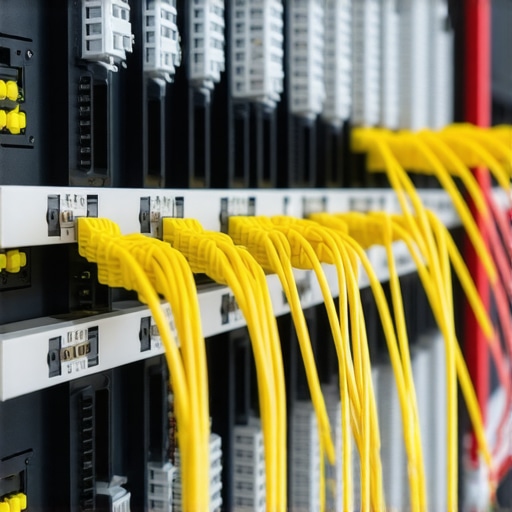
The 2026 Bandwidth Cliff: Why Your Current Wiring is a Fire Hazard in Disguise
I’ve spent the better part of four decades pulling wires through places that would make a rat claustrophobic. I’ve seen the evolution from knob-and-tube to the shiny, high-speed promises of the digital age. But here is the cold, hard truth that most ‘tech gurus’ won’t tell you: the infrastructure sitting behind your drywall right now is likely screaming under the pressure of modern demands. As we march toward 2026, where 10Gbps speeds will become the standard for the average American household, the gap between what your ISP delivers and what your walls can handle is becoming a chasm. I’m not talking about a slow Netflix stream; I’m talking about heat, interference, and the total failure of your smart home wiring.
My old journeyman used to smack my hand with a pair of dikes if I even thought about stripping a wire with a pocket knife. ‘You nick that copper, you create a hot spot,’ he’d bark. ‘A hot spot is just a fire waiting for a reason to happen.’ He wasn’t just talking about the 120-volt lines feeding your chandelier installation. He was talking about the integrity of the entire system. Today, I see ‘handymen’ treating fiber optic lines and CAT6 cabling services like they’re pulling garden hoses. They bend them too tight, staple them until the jacket crimps, and then wonder why the signal drops or the smart lighting installation starts flickering like a cheap horror movie set. If you think you can just plug a 10Gbps router into a house wired in 2010 and call it a day, you’re in for a very expensive awakening.
The Physics of the 10Gbps Bottleneck: Attenuation and Micro-Fractures
When we talk about 10Gbps, we aren’t just talking about ‘fast.’ We are talking about frequency. In a copper-based system like CAT5e or even older CAT6, pushing those speeds creates massive amounts of Electromagnetic Interference (EMI). If those data lines are run too close to your main disconnect services or parallel to a high-voltage pool pump electrical line without proper shielding, the crosstalk will kill your throughput. But the real future is fiber. Fiber optics rely on Total Internal Reflection (TIR). You’re sending light through a microscopic strand of glass. Component zooming into that strand reveals a world of physics where the slightest ‘micro-bend’—a bend radius tighter than ten times the cable diameter—causes light to leak out of the core and into the cladding. This is called attenuation.
“Optical fiber communication systems shall be installed in a neat and workmanlike manner. Cables installed exposed on the surface of ceilings and walls shall be supported by the building structure in such a manner that the cable will not be damaged by normal building use.” – NEC Article 770.24
I’ve walked into insurance claim electrical work scenes where the ‘tech’ ran fiber through the same holes as the Romex. The heat from the 20-amp circuit actually softened the jacket of the data line, causing the fiber to sag and eventually fracture. You can’t see these fractures with your eyes. You won’t find them with a tick tracer. You need an OTDR (Optical Time Domain Reflectometer) to see the forensic evidence of a bad install. By 2026, if your home isn’t utilizing OM3 or OM4 multi-mode fiber, or better yet, Single Mode Fiber (SMF), your 10Gbps service is going to be throttled by physical physics before it even reaches your desk.
Blueprint C: The Load Calculation of the Modern Digital Home
Electricity isn’t a hobby, and neither is high-speed data. We are seeing a massive shift in residential load requirements. It’s not just the EV charger troubleshooting we do or the RV hookup installation in the driveway; it’s the sheer volume of ‘always-on’ smart devices. Every smart lighting installation and every security camera adds a load to your network that eventually translates to physical energy. Most homes built in the mid-century were designed for a 100-amp service. Today, between the 10Gbps networking gear, the EV chargers, and the heat pumps, we are seeing heavy-ups to 200 or even 400 amps becoming the norm.
If your main disconnect services are dated, the heat generated by a high-performance network closet can actually lead to nuisance tripping. I’ve seen data racks pulling 15 amps of continuous load, 24/7. That’s 1,800 watts of constant heat. If that circuit wasn’t rough-in correctly with the right gauge wire, that breaker is going to get ‘tired.’ The internal spring mechanism loses its tension from the constant thermal expansion and contraction. This is where we see the ‘fishy smell’ of a burning bus bar. People blame the ISP for the internet going out, but usually, it’s the 1970s electrical panel gasping for air under a 2026 load.
The Forensic Inspection: Why Your CAT6 is Lying to You
Let’s talk about CAT6 cabling services. Many builders ‘daisy-chain’ these wires like they’re old phone lines. That’s a cardinal sin. Every data run needs to be a home run back to the central switch. I once inspected a ‘smart’ mansion where the sign lighting installation outside was causing the entire internal network to crash every time the sun went down. The installer had used unshielded twisted pair (UTP) and ran it right against the ballast of the sign. The EMI was so thick you could have picked it up with a Wiggy. We had to go back in, rip out the ‘monkey shit’ (duct seal) they used to plug the holes, and re-run shielded Category 6A just to get them to 1Gbps. For 10Gbps, you don’t even play with copper if the run is over 30 meters; you go straight to fiber.
“To minimize the risk of fire, aluminum wire connections require special materials and techniques. Failure to use these may result in fire or property damage.” – CPSC Safety Alert 516
While the CPSC quote above refers to aluminum power wiring, the principle of ‘special techniques’ applies to fiber. If you aren’t fusion splicing your connections, you’re leaving decibels of signal on the floor. Mechanical splices are for handymen. Real professionals use heat-shrink protectors and fusion splicers that align the glass cores to the micron. This is the level of precision required for the 2026 standard. If your electrician doesn’t know what a ‘cleaver’ is (and I don’t mean for a kitchen), he shouldn’t be touching your smart home wiring.
Preparing for the 10Gbps Reality: A Forensic Checklist
Before you sign a contract for 10Gbps service, you need a forensic audit of your home’s infrastructure. This isn’t about aesthetics; it’s about the technical backbone. First, check your grounding. If your data rack isn’t properly bonded to the home’s grounding electrode system, a surge on your pool pump electrical line could travel through your network and fry every smart device in the house. Second, look at your conduit. If your rough-in phase didn’t include 1-inch ‘smurf tube’ (flexible conduit) for data, you’re going to be cutting drywall every time the technology changes. Lighting installations made easy often overlook the control wires needed for high-end dimming systems that 10Gbps networks will support. Finally, ensure your main disconnect services can handle the increased thermal load of a high-performance home office. If you’re seeing flickering lights when your laser printer starts up or your server kicks into high gear, you have a voltage drop issue that will corrupt your 10Gbps data packets.
Don’t wait for the ‘time bomb’ of outdated wiring to go off. Whether you are dealing with EV charger troubleshooting or preparing for the next generation of internet speeds, the goal is the same: safety through precision. You want to be able to sleep at night knowing every terminal is torqued to spec and every fiber strand is pristine. If you have questions about your home’s readiness, you can contact us for a real inspection. Electricity and high-speed data are two sides of the same coin—they both require respect, or they’ll burn you. For more on maintaining your high-performance home, check out our top EV charger maintenance tips to see how we handle high-draw systems with the same forensic care.
This comprehensive article highlights some critical issues I’ve personally encountered with older wiring in high-tech homes. As someone who has worked on home automation and networking for over 15 years, I completely agree that many homeowners overlook the importance of proper infrastructure before upgrading their internet plans. One thing I’ve noticed is that many DIY enthusiasts try to patch or upgrade their wiring without addressing the core issues, leading to intermittent problems and potential fire hazards. It makes me wonder how many simply assume their existing wiring is sufficient because it currently works for basic internet or smart devices, but as speeds increase, these hidden flaws become glaring problems. Have others found that upgrading to fiber structures actually just exposes deeper electrical and load issues they weren’t aware of? Proper planning and assessment seem more crucial than ever before, especially with these looming 2026 deadlines.