The Scent of Impending Failure: Why Your Retail Space is a Liability
Walk into any retail storefront built between 1970 and 1990, and you’ll likely hear it before you see it. It’s that low-frequency 60-cycle hum vibrating through the T-grid ceiling, or the faint, metallic tang of ozone lingering near the stockroom panel. As a forensic inspector, those smells tell me a story of thermal stress and neglected maintenance. We are approaching a critical window—what I call the ‘2026 Thermal Peak’—where aging grid infrastructure meets the skyrocketing demand of modern electronics. If your retail wiring is still relying on the original rough-in from thirty years ago, you aren’t just looking at a potential blackout; you are looking at a forensic investigation in the making. Retailers often focus on the ‘trim-out’—the pretty fixtures and the smart lighting installation—while the guts of the building, the main disconnect services and the bus bars, are literally cooking themselves. We need to look at the physics of why these systems fail before we can talk about the solutions.
The Journeyman’s Lesson: The Microscopic Hotspot
My old journeyman used to smack my hand if I stripped a wire with a knife. He’d see me dragging the blade across the insulation and bark, ‘You nick that copper, you create a hot spot! That notch is a bottleneck for electrons, kid. It’ll glow red before the breaker even thinks about tripping.’ He was right, and that lesson applies ten-fold in a commercial setting. I recently inspected a strip mall unit where a kitchen range hood wiring job had been hacked together by a ‘handyman.’ He had used a utility knife to strip the 4 AWG feeders, leaving deep scores in the copper. Under the constant load of the exhaust fans, those nicks became points of high resistance. Using augmented reality troubleshooting, I showed the owner the thermal signature: those wire ends were hitting 190 degrees Fahrenheit. The copper was literally annealing, becoming brittle and ready to snap. This is why we insist on precision; electricity doesn’t forgive ‘close enough.’
“Aluminum wire connections can overheat and cause a fire without tripping the circuit breaker.” – CPSC Safety Alert 516
1. The Service Capacity Crisis: The 100 Amp Service Upgrade
Most mid-century retail spaces were designed for a different era of consumption. Back then, you had a few cash registers and some fluorescent tubes. Today, you have high-draw POS servers, espresso machines, and digital signage. If you are still operating on a 100-amp main, you are redlining your system. A 100 amp service upgrade is no longer a luxury; it’s a prerequisite for survival. When you pull 85 amps continuously on a 100-amp rated bus, you trigger a phenomenon called Cold Creep. The heat causes the metal lugs to expand, and the subsequent cooling causes them to contract. Over hundreds of cycles, the screw pressure lightens. Once that connection is loose, an air gap forms, and an arc begins to jump. This isn’t just a power flicker; it’s a plasma event that carbonizes the surrounding insulation. You can get free electrical estimates to determine if your service entrance can actually handle your current load profile before the 2026 demand spikes hit.
2. The Invisible Enemy: Harmonics in Smart Lighting and PA Systems
Modern retail depends on atmosphere. We see constant requests for smart lighting installation and PA system installation to create that ‘vibe.’ But there’s a technical cost: Switch-Mode Power Supplies (SMPS). Unlike old incandescent bulbs, LED drivers and digital amplifiers draw power in short, jagged pulses. This creates ‘harmonics’—electrical noise that reflects back into your neutral wire. In a 3-phase commercial system, these harmonics don’t cancel out; they add up. I’ve seen neutral wires in PA system installation racks that were physically hot to the touch because of harmonic distortion. If your electrician doesn’t understand the difference between linear and non-linear loads, they are leaving a time bomb in your ceiling. Understanding how electricians tackle troubleshooting for lighting installations is critical for any business owner who doesn’t want their ‘smart’ store to go dark because of a melted neutral.
3. The Main Disconnect and Lockout Tagout Training
Your main disconnect is the heart of your safety system, yet it’s often the most neglected component. In many older stores, the main breaker hasn’t been cycled in twenty years. The internal grease has turned to a clay-like substance, and the mechanical pivots are seized. If a catastrophic fault occurs, that breaker might ‘jam,’ refusing to trip. This is why lockout tagout training (LOTO) is vital for your maintenance staff. You need to know how to safely de-energize equipment. During a recent audit, I found a main disconnect where the internal blades were so pitted from ‘teasing’ the switch that they were barely making contact. Every time the store’s compressor kicked on, the disconnect would spray sparks internally. It’s a widow maker scenario. If you can’t kill the power instantly and safely, your store is a firetrap.
4. Backup Power: The Standby Generator Install
With the 2026 blackout projections, a standby generator install is the only way to guarantee your refrigeration and security systems stay live. But you can’t just slap a portable unit on the sidewalk. For retail, you need a permanent transfer switch and a dedicated home run to your critical load panel. We are even seeing some outdoor-centric retail hubs requesting RV hookup installation for mobile clinics or pop-up vendors. These high-draw exterior circuits require specialized weather-rated enclosures and monkey shit (duct seal) to prevent moisture from wicking into the conduit. Without a properly engineered backup plan, a two-day grid failure will cost you your entire inventory and your customer’s trust.
“All circuit breakers must be clearly labeled, and the workspace in front of the panel must be kept clear for 36 inches.” – NFPA 70E Standard for Electrical Safety
5. The Forensic Diagnostic: Augmented Reality and ‘Wiggys’
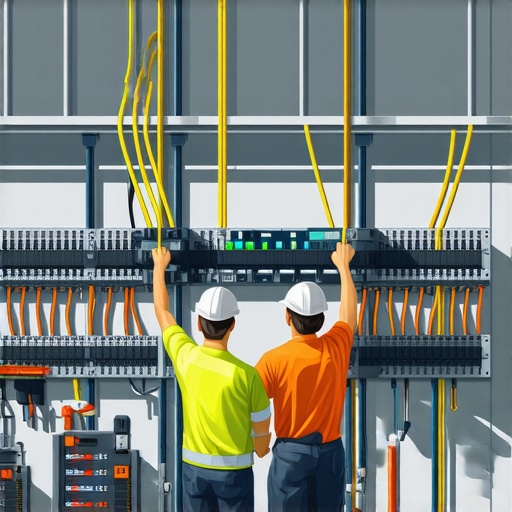
Gone are the days when a ‘tick tracer’ (non-contact voltage detector) was enough. Those things are liars; they pick up ghost voltages and lead to false sense of security. I rely on my Wiggy (a solenoid-based tester) because it puts a physical load on the circuit. If the voltage is fake, the Wiggy stays silent. For modern retail, we now use augmented reality troubleshooting. This allows us to overlay the original rough-in blueprints over the finished walls using thermal imaging. We can see the heat building up behind the drywall from a loose wire nut before it ever becomes a fire. It’s the difference between guessing and knowing. Don’t let a ‘handyman’ with a pair of dikes and some electrical tape touch your store’s nervous system. If you want to sleep at night, you ensure every lug is torqued to spec and every circuit is balanced. [IMAGE_HERE]