
The Hum of an Overloaded Life
You don’t usually hear electricity until it’s trying to escape. That low-frequency thrum coming from your service panel isn’t a sign of ‘power’; it’s the sound of molecular friction. As a forensic inspector, I’ve spent decades tracking down the scent of charred Bakelite and tracing the path of least resistance. Most homeowners think of their electrical panel as a static box. It isn’t. It’s a dynamic thermal environment where every connection is fighting against physics. When you start adding dual EV chargers, a 5-ton HVAC system, and a backyard workshop, your old 200-amp service isn’t just ‘busy’—it’s a bottleneck that’s generating heat where it should be delivering current.
My journeyman used to smack my hand if I stripped a wire with a knife instead of the proper dikes. ‘You nick the copper, you create a hot spot,’ he’d scream. He was right. Those tiny nicks reduce the circular mil area of the conductor, increasing resistance. Now, imagine that same principle applied to your entire home. If you’re pulling 180 amps through a 200-amp main breaker for hours on end, you are flirting with disaster. This is where the 400-amp upgrade—often called a 320/400 service—comes into play. It’s not about having more power than your neighbors; it’s about reducing the thermal stress on your infrastructure.
“Aluminum wire connections can overheat and cause a fire without tripping the circuit breaker.” – CPSC Safety Alert 516
The Physics of the Heavy-Up: Ohm’s Law and Your Home
When we talk about a 400-amp upgrade, we’re really talking about a total overhead service drop overhaul. We aren’t just swapping a box; we are changing the physics of how your home breathes. A standard 200-amp service is often the absolute limit for modern dwellings. Why? Because of the continuous load. The National Electrical Code (NEC) defines a continuous load as any load where the maximum current is expected to continue for three hours or more. Think of an EV charger. If you are ensuring safe and efficient EV charging station setup at home, you’re likely pulling 48 to 60 amps continuously. Add a pool heater and a heat pump, and your main lugs are screaming.
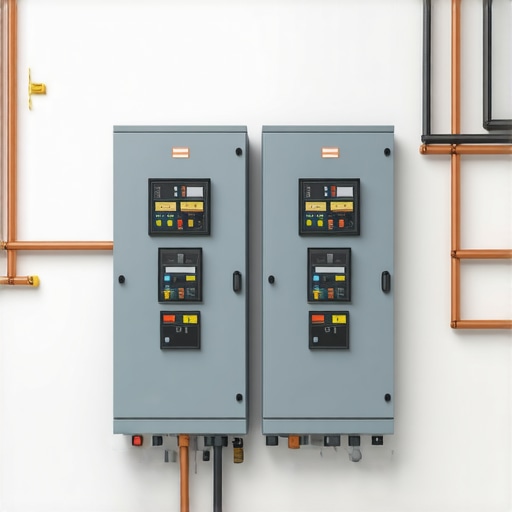
The upgrade typically involves a meter socket replacement with a class 320 meter. This ‘bolt-in’ style meter is beefier than the standard plug-in variety, designed to handle the massive current without the blades arcing. From there, we typically run two separate 200-amp ‘home run’ feeds to two different panels. This ‘dual-panel’ approach allows us to isolate noisy loads—like your HVAC and workshop—from the sensitive electronics in your data closet organization. It prevents the voltage sag that happens when the compressor kicks on, which can wreak havoc on your ethernet wiring services and high-end networking gear.
The Anatomy of the Service Entrance
During a warehouse lighting retrofit or a residential heavy-up, the first thing I check is the service mast. If you have an overhead feed, that mast has to be rigid heavy-wall conduit. I’ve seen flippers use thin-wall EMT that buckles under the weight of the triplex cable during a windstorm. When we do a 400-amp conversion, we often have to beef up the weather head and ensure the overhead service drop has the proper clearance from windows and decks. We don’t just ‘eye-ball’ it; we use a Wiggy or a high-end multimeter to verify voltage drop at the furthest point in the system.
Then there’s the equipotential grid. If you’re doing this upgrade because of a new pool or a massive concrete-floor workshop, we have to ensure all metal components are bonded together. This isn’t just grounding; it’s bonding. We want every piece of metal to be at the same potential so that you don’t become the path to ground when you touch a light switch. This is critical in lighting installation services for commercial spaces where large metal structures are common. I’ve walked into shops where the owner complained of a ‘tingle’ when touching the lathe—that’s a widow maker scenario waiting for a wet floor.
“All equipment grounding conductors shall be identified by the color green or by being bare.” – NEC Article 250.119
From Fuses to Freedom: The Conversion Process
If you are still living with a fuse box to breaker conversion on your to-do list, you are essentially driving a car with no brakes. Fuses are reliable, sure, but they can’t handle the multi-tap requirements of a modern home. People start ‘pennying’ fuses or putting 30-amp fuses on 14-gauge Romex. That’s how you turn your wall into a toaster element. When we perform an upgrade, we rip that old garbage out. We use monkey shit (duct seal) to plug the holes where the service enters the house to keep the moisture out—moisture is the catalyst for oxidation, especially in older mid-century homes with aluminum service feeds.
During the rough-in phase of a 400-amp upgrade, we calculate the load of every circuit. We don’t just guess. We look at the nameplates. We look at the preventative electrical maintenance history. If you have a priority service membership, we’ve already got a roadmap of your home’s weaknesses. We see where the breakers are discolored—a sure sign of ‘cold creep’ where the metal has expanded and contracted so many times the connection has loosened. We torque every lug to the manufacturer’s specific inch-pound rating. If you don’t see your electrician using a torque wrench on the main lugs, fire them. Seriously.
Why 400 Amps is the New Standard for Luxury and Tech
It’s not just about the heavy hitters like stoves and dryers. The modern home is a data center. Between ethernet wiring services, smart home hubs, and complex lighting installation services, the ‘base load’ of a house has tripled in the last twenty years. A 400-amp service provides the ‘headroom’ necessary to keep the power clean. When your service is maxed out, the heat in the panel increases. Increased heat increases resistance. Increased resistance causes a voltage drop. That voltage drop is what kills the power supplies in your expensive computers and LED drivers.
If you’re noticing flickering when the microwave starts, or if your tick tracer is lighting up near your water pipes, you have a neutral issue or a capacity issue. This is why preventative electrical maintenance is cheaper than an emergency call at 3 AM. We find the arcing bus bars before they weld themselves to the breaker. We identify the lack of a proper equipotential grid before someone gets shocked. And we ensure your data closet organization isn’t just a fire hazard of tangled CAT6 and power strips. If you’re serious about your home’s longevity, stop thinking of your electrical system as an appliance and start thinking of it as the foundation. You wouldn’t build a skyscraper on a wooden pallet; don’t run a modern life on a 100-amp service. Contact us to get a real load calculation done by someone who knows what ‘burnt’ actually smells like. “