
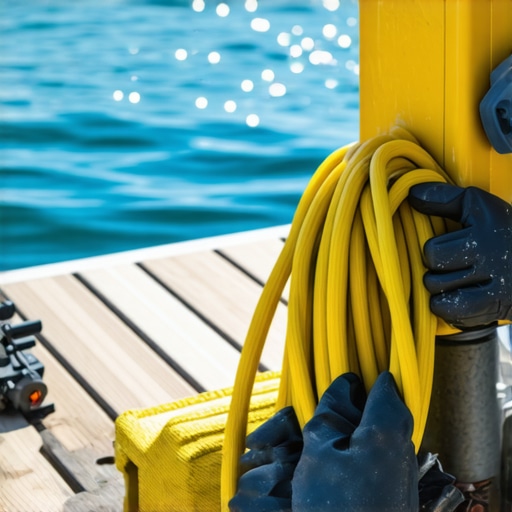
The Anatomy of a Dockside Disaster
You smell it before you see it. It’s not the salt air or the diesel fumes from the neighbor’s slip; it’s that sharp, metallic tang of ozone mixed with smoldering PVC. As a master electrician who has spent decades diagnosing why docks decide to spontaneously combust, I can tell you that electricity and water aren’t just bad roommates—they are mortal enemies. When you flip the breaker for the first time in the spring, you aren’t just turning on the lights; you’re testing the structural integrity of every atom in your electrical system. Most folks think a dock is just a patio on the water. To a forensic inspector, a dock is a high-voltage environment constantly under siege by corrosion, vibration, and thermal expansion. If you haven’t looked at your pedestal since last Labor Day, you’re not just behind on maintenance; you’re inviting a ‘Widow Maker’ scenario into your backyard.
My journeyman, a grizzly old-timer who could troubleshoot a dead circuit just by sniffing the air, once slapped my hand so hard I thought I’d lost a finger because I tried to use a standard wire nut on a shoreline lighting install. ‘That’s a sponge for salt, kid,’ he growled. ‘You use resin-filled heat-shrink or you’re building a slow-motion bomb.’ He was right. In this trade, there is no such thing as ‘good enough’ when the ground under your feet is liquid and highly conductive. We see it every year: people trying to save a few bucks with DIY fixes, only to end up needing warranty backed repairs after their boat’s hull becomes energized. If you’re a retiree looking to get your summer retreat ready, don’t forget to ask about our senior discount services before we start digging through that salty mess.
“Aluminum wire connections can overheat and cause a fire without tripping the circuit breaker.” – CPSC Safety Alert 516
The Forensic Breakdown: Why Docks Fail
Let’s conduct a forensic autopsy on a typical failed dock system. It starts with the ‘Salt Bridge.’ In coastal environments, salt spray doesn’t just sit on the surface; it migrates. It finds its way into the smallest fissures in your conduit and the microscopic gaps in your lug connections. This leads to Galvanic Reaction, where two dissimilar metals—like your copper wire and the zinc-plated screw on a cheap receptacle—start a chemical war mediated by saltwater. The result is a layer of non-conductive oxide that increases resistance. According to Ohm’s Law, as resistance goes up, heat goes up. This is ‘Component Zooming’ in action: that heat causes the metal to expand, which further loosens the screw, creating more resistance. Eventually, the lug glows cherry red inside the housing, and the next thing you know, the fire department is at your pier. This is why we perform arc flash studies for larger marine facilities; we need to know exactly how much energy is waiting to explode if a fault occurs.
[IMAGE_PLACEHOLDER_1]
The Hidden Enemy: Crevice Corrosion and Cold Creep
When I pull a tick tracer out of my bag, I’m looking for more than just a hot wire. I’m looking for stray current. One of the most dangerous phenomena on a dock is Electric Shock Drowning (ESD). If your ground path is compromised—perhaps because of a rusted-out junction box or a ‘bootleg ground’ installed by a handyman—the current can leak into the water. This turns the area around your dock into a lethal field. A swimmer enters the water, their muscles paralyze from the AC current, and they drown silently. It is the most horrific failure we see. This is why weekend electrician services are so often tied to emergency inspections after someone feels a ‘tingle’ while touching a handrail. We treat every dock like a restaurant kitchen electrical system: high moisture, high heat, and zero room for error.
“GFCI protection shall be provided for all 15- and 20-ampere, single-phase, 125-volt receptacles installed outdoors… for boat hoists and on docks.” – National Electrical Code (NEC) 210.8(A)(3)
To prevent this, you need to understand Cold Creep. Aluminum conductors, often used for the home run from the main house panel to the dock to save money, are notorious for this. They expand and contract at a different rate than the connectors. Over time, the wire literally ‘creeps’ out of the lug. If you don’t have an electrician who understands demand response systems and load calculations, you might be pulling more juice for your new boat lift than the old aluminum can handle. This is the same reason ev charger troubleshooting often reveals melted terminals; the continuous load is unforgiving.
The Solution: Code, Torque, and Monkey Shit
So, how do we fix it? We start at the rough-in. Every connection must be cleaned of oxidation and coated with a high-quality anti-oxidant compound. We don’t just use standard PVC; we use schedule 80 in areas prone to physical damage. And we use ‘Monkey Shit’—that’s duct seal for the laypeople—to plug every conduit opening so the humid, salty air can’t travel from the pedestal back to your main house panel. This prevents the ‘Wick Effect’ where moisture is literally drawn up the strands of the wire into your breakers. If you are doing office lighting upgrades or up lighting services for your pier, the same rules apply: every junction must be airtight and watertight.
Maintaining a dock is as critical as top ev charger maintenance tips. You need to test your GFCIs every single month. Not just by hitting the button, but by using a Wiggy or a dedicated GFCI tester to ensure the trip time is within milliseconds. If the breaker is ‘sticky’ due to salt air, it’s a paperweight. We often find that troubleshooting for lighting installations on docks reveals that the phone line installation from twenty years ago is now acting as a secondary (and dangerous) ground path. We rip that out. We clean it up. We make it safe. Whether it’s a lighting install or a full panel heavy-up, we ensure your system is torqued to spec. Because in the middle of July, when you’re jumping off that dock, the last thing you should be wondering is if the guy who wired it knew what he was doing. Sleep at night knowing it’s been inspected by someone who knows where the bodies are buried—literally. For more information, you can always contact us or check our privacy policy.