
The Sensory Warning: When Your House Starts Talking in Code
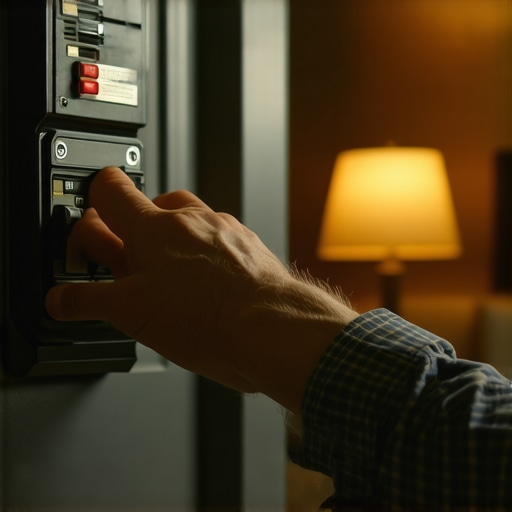
You’re sitting in your living room when the TV flickers, the lights in the kitchen dim to a ghostly orange, and a faint, acrid scent—something like burning fish and ozone—wafts from the hallway. You check the panel and find half the house is dead, but the other half is humming along. This isn’t a ‘glitch.’ It is a partial outage, and in my 35 years of crawling through spider-infested crawlspaces and tracing home runs, I’ve learned that a partial outage is usually a warning shot from a system on the verge of a catastrophic thermal event. When half your circuits go dark, you aren’t just dealing with a tripped breaker; you are likely looking at a lost phase or a neutral that has finally succumbed to decades of thermal expansion.
The Old Timer’s Lesson: Why the Details Kill
My old journeyman used to smack my hand with his dikes if he saw me stripping a wire with a pocket knife. ‘You nick that copper, kid, and you’ve just built a heater,’ he’d scream. He wasn’t just being a mean old bastard; he was right. Every time you nick a conductor, you reduce its cross-sectional area, creating a localized point of high resistance. Over twenty years, that ‘hot spot’ cycles through thousands of heating and cooling phases. The metal expands and contracts, a process known as thermal cycling, until the molecular bond weakens and the wire eventually snaps or arcs. This is why fire damage wiring restoration is such a massive part of the trade. People take shortcuts during the rough-in, and decades later, I’m the one digging through charred Romex to find the failure point.
“Aluminum wire connections can overheat and cause a fire without tripping the circuit breaker.” – CPSC Safety Alert 516
The Forensic Breakdown: The Physics of the ‘Half-Hot’ House
To understand the fastest way to restore power, you have to understand the ‘why’ behind the failure. In a standard 120/240V residential service, you have two ‘hot’ legs and one neutral. If one of those hot legs fails—whether it’s at the meter socket replacement point or a blown transformer down the street—half your 120V circuits will lose power. But it gets weirder. If you have a 240V appliance like a water heater turned on, it can ‘backfeed’ power through the heating element, causing the dead leg to show ghost voltages. This is where a Tick Tracer (non-contact voltage tester) will lie to you. It’ll beep and glow, making you think the circuit is live when it’s actually just a high-impedance phantom. I never trust my life to a glowing plastic pen; I pull out the Wiggy (solenoid voltmeter). If that solenoid doesn’t vibrate, there’s no real ‘oomph’ behind that voltage.
The Mid-Century Time Bomb: Aluminum and FPE Panels
If your home was built between 1960 and 1980, you’re likely dealing with the ‘Mid-Century Special.’ This usually involves Federal Pacific Electric (FPE) panels and aluminum branch wiring. The problem with aluminum isn’t the metal itself; it’s Cold Creep. Aluminum is softer than copper. Under the pressure of a terminal screw, it literally ‘flows’ away from the pressure point. This loosens the connection. Once the connection is loose, an oxide layer—which is non-conductive—forms between the wire and the terminal. Resistance goes up, heat goes up, and eventually, the plastic housing of your circuit breaker replacement melts into a puddle of toxic goo. If you’re experiencing a partial outage in an FPE-equipped home, don’t just flip the breaker. Those breakers are notorious for ‘jamming’—they look like they are in the ‘ON’ position but have internally disconnected, or worse, they refuse to trip during a dead short.
Component Zooming: The Meter Socket and Salt Air Decay
Sometimes the failure isn’t in your basement; it’s outside in the meter can. This is especially true if you have fence line lighting or exterior loads that pull heavy current. If the jaws in the meter socket lose their spring tension—a process called annealing caused by excessive heat—they won’t grip the meter blades tightly. This creates a gap. Electricity hates a gap, so it jumps it. That arc can reach temperatures hotter than the surface of the sun. If you see ‘monkey shit‘ (duct seal) around the service entrance that has turned brittle and cracked, moisture is getting into that socket. We often find that a partial outage is just one leg of the service entrance cable that has literally rotted away inside the pipe. This is why drone light inspections are becoming popular for commercial PA system installation and industrial complexes; we can see the thermal signature of a failing lug from forty feet in the air before it starts a fire.
“The grounded conductor shall be connected to the equipment grounding conductor and to the grounding electrode conductor at each service.” – NEC Article 250.24
The Fix: Code-Compliant Restoration vs. The Handyman Special
The fastest way to restore power safely is a systematic isolation of the failure. First, check your main lugs. If you have 120V on one leg and 40V on the other, your problem is ‘upstream’ at the utility side or the meter. If you have 120V on both at the main, but a whole row of breakers is dead, you’re looking at a bus bar failure. This is common in older garage wiring services where moisture has wicked up through the conduit. If the failure is localized to a single room, we look for buried junction boxes. I’ve seen flippers bury attic fan installation splices behind drywall with no access—a massive Code violation. To find these, we use circuit tracers to follow the path of the home run. If you are dealing with a demand response system or a solar panel electrical hookup, the troubleshooting gets even more complex because you have multiple power sources ‘fighting’ for priority on the bus bar. For those looking to modernize their infrastructure while fixing these issues, ensuring safe and efficient EV charging station setup at home is the best way to force a full system audit. You can’t just slap a 50-amp load on a failing 100-amp service and expect it to hold. For general lighting failures, you can check how electricians tackle troubleshooting for lighting installations to see the methodical approach we take during the trim-out phase.
Sleep at Night: The Importance of Torquing to Spec
Restoring power isn’t about getting the lights back on; it’s about ensuring the connection can handle the load at 2:00 AM when the AC kicks in and the water heater cycles. Every screw in a modern panel has a torque rating in inch-pounds. If you ‘hand tighten’ it until it feels ‘good,’ you’re guessing. An under-torqued lug will arc; an over-torqued lug will stress the metal and eventually snap. We don’t guess. We use calibrated torque wrenches. If you’ve had a partial outage, don’t just reset the breaker and go to bed. That breaker tripped—or that phase failed—for a reason. If you need a forensic eyes on your system, contact us before the ‘fishy smell’ turns into a 911 call. Electricity isn’t a hobby; it’s a force of nature that we’ve temporarily tricked into staying inside copper pipes. Treat it with the respect it’s earned.