
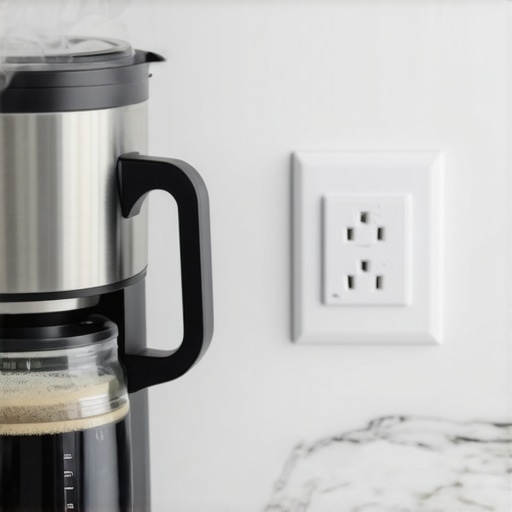
You’re standing in your kitchen at 6:15 AM, half-awake, reaching for that first cup of sanity. You hit the ‘on’ switch on your high-end espresso machine or that battered drip pot that’s seen better days, and—snap. The lights stay on, but the kitchen goes silent. That little plastic button on the outlet has popped out like a middle finger from the ghost of Thomas Edison. You reset it, try again, and it happens again. Most people think it’s just a nuisance, a ‘sensitive’ outlet. I’ve spent 35 years in the trade, and I’m here to tell you that a GFCI tripping isn’t a nuisance; it’s a life-saving device doing exactly what it was engineered to do. When that coffee maker pulls 12 amps, it’s not just heating water; it’s stress-testing every inch of your kitchen’s Home Run circuit back to the panel.
The Old Timer’s Lesson: The Sin of the Nicked Wire
My journeyman back in the late 80s was a man who didn’t believe in second chances. I remember a Rough-in on a split-level home where he caught me stripping Romex with a pocket knife instead of a proper pair of Dikes or wire strippers. He didn’t just yell; he smacked my hand so hard I dropped my tool belt. ‘You nick that copper, kid, and you’ve just built a bottleneck,’ he’d growl. ‘That nick creates a hot spot. Heat leads to expansion. Expansion leads to a loose connection. A loose connection leads to a fire, and I’m not going to jail because you were too lazy to use the right tool.’ He was right. In your kitchen, that coffee maker is a high-wattage resistive load. If I come in for a forensic inspector visit and pull that GFCI out, I often find where a previous installer nicked the wire or failed to use a Wiggy to verify the integrity of the line. That tiny nick, under the load of a coffee maker, generates enough heat to slightly alter the resistance, which a modern, sensitive GFCI detects as a leakage current.
“Aluminum wire connections can overheat and cause a fire without tripping the circuit breaker.” – CPSC Safety Alert 516
Component Zooming: The Physics of the Trip
To understand why your coffee is causing a blackout, we have to look at the Component Zooming of the GFCI itself. Inside that plastic housing is a toroidal transformer—a tiny, donut-shaped coil of wire. The GFCI monitors the current going out on the ‘hot’ wire and coming back on the ‘neutral.’ In a perfect world, those numbers are identical. However, the moment there is a difference of even 5 milliamperes (0.005 amps), the coil detects the magnetic imbalance and triggers the solenoid to drop the bridge. Why does your coffee maker trigger this? It’s often due to Thermal Expansion and Cold Creep. If you live in a mid-century home built between 1960 and 1980, you might have aluminum wiring. Aluminum is a fickle beast; it expands and contracts at a much higher rate than copper. This ‘creeping’ causes the screws on the side of the outlet to loosen over time. When the heavy current of the coffee maker hits that loose connection, it creates micro-arcing. To the GFCI, that micro-arc looks like a ground fault, and it kills the power before your kitchen walls turn into a tinderbox.
The Mid-Century Menace: Aluminum Wiring and FPE Panels
If your home falls into that 1960-1980 bracket, you aren’t just dealing with coffee makers; you’re dealing with a ticking time bomb of infrastructure. This was the era of Federal Pacific Electric (FPE) and Zinsco panels. These aren’t just old; they are fundamentally flawed. FPE ‘Stab-Lok’ breakers are notorious in the trade for ‘jamming.’ They won’t trip even when the wire is literally melting off the bus bar. If your GFCI is tripping, it might actually be your last line of defense because the main breaker in the panel is frozen shut. This is why ensuring safe and efficient EV charging station setup at home often requires a full meter base replacement and panel upgrade—because you cannot trust 40-year-old metallurgy with modern high-amperage demands. When we do a Trim-out on these older homes, we often find the insulation on the wires behind the kitchen backsplash is brittle and charred. We call these ‘widow makers’ for a reason.
Inductive Loads and the Moisture Factor
Coffee makers are unique because they combine a high-wattage heating element (resistive load) with a water pump (inductive load). As the heating element ages, the internal ceramic insulation can develop microscopic cracks. When the water heats up, steam permeates these cracks. This creates a tiny, almost imperceptible path for electricity to jump from the element to the grounded chassis of the machine. It’s not enough to blow a standard 20-amp breaker, but it’s more than enough to satisfy the 5mA threshold of the GFCI. This is the same reason why electricians tackle troubleshooting for lighting installations with such precision; moisture and heat are the twin enemies of electrical stability. If your coffee maker only trips the GFCI once it starts steaming, the appliance is likely the culprit, not the house wiring.
“The grounded conductor shall be connected to the equipment grounding conductor only at the service disconnecting means.” – NEC Article 250.24(A)(5)
Forensic Analysis: The Grounding Electrode and Microgrids
Sometimes the problem isn’t in your kitchen at all; it’s under your feet. A proper grounding electrode install is critical for stabilizing the voltage in your home. If your ground rod is corroded—common in coastal areas where salt air eats through copper-bonded steel—your entire electrical system loses its reference to ‘zero.’ This can cause ‘ghost trips’ on GFCIs when large motors (like a refrigerator or a coffee pump) kick on. In modern microgrid integration or homes with smart meter installation, the electrical noise on the line can also confuse the sensitive electronics inside a GFCI. We’ve even started using drone thermography scans to look at service drops and meter cans from the outside to see where heat is building up before we even step inside. If you’re seeing frequent trips, it might be time for a meter base replacement or an insurance claim electrical work assessment to ensure the main service isn’t compromised.
Safety Beyond the Kitchen: From Pools to Floods
Electrical safety is a holistic system. The same principles that keep your kitchen safe apply to swimming pool bonding. If the bonding grid around your pool is compromised, a stray milliamp can be fatal. Likewise, flood water electrical safety is a massive concern in low-lying areas. If your outlets have ever been submerged, they must be replaced. No exceptions. The silt and minerals left behind by flood water create conductive bridges that lead to fires years after the water recedes. For our veterans, we often provide a military discount wiring program to help update these critical safety components, whether it’s pendant light hanging in the dining room or a full service ‘heavy-up.’ We don’t do it to be nice; we do it because nobody should live in a house where they’re afraid to make a pot of coffee.
The Verdict: Don’t Just Push the Button
If your GFCI keeps tripping, stop resetting it. You are forcing current through a failure point. First, plug the coffee maker into a different circuit (maybe the dining room, which shouldn’t be GFCI protected if it’s an older home) to see if it trips the breaker there. If the coffee maker works fine elsewhere, the kitchen GFCI is doing its job by detecting a fault the other circuit is ignoring. If you need help, contact us to have a pro put a Tick Tracer and a load tester on the line. Whether it’s a simple pendant light hanging job gone wrong or a complex issue with your grounding electrode install, electricity is a silent, invisible force that doesn’t care about your morning routine. It only cares about the path of least resistance. Make sure that path isn’t through you. For more tips on maintaining your high-power devices, check out top EV charger maintenance tips which cover similar high-load circuit logic.