
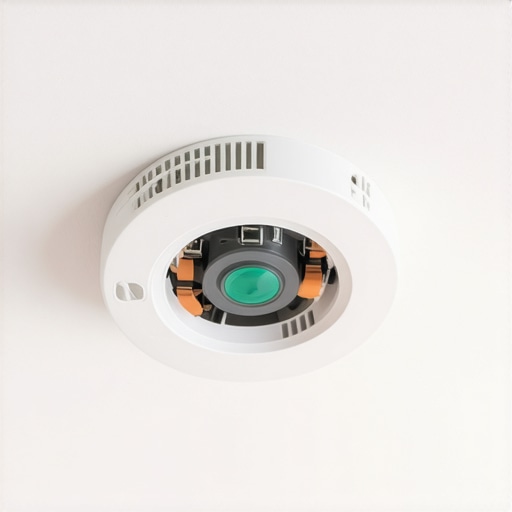
The Death Chirp: An Autopsy of False Security
You’re dead asleep at 3:00 AM when it starts. That rhythmic, high-pitched chirp coming from the hallway. You roll over, annoyed, and figure you’ll deal with it in the morning. But as a forensic inspector who has walked through the charred remains of three-bedroom ranchers, that chirp doesn’t annoy me—it terrifies me. It’s the sound of a failing chemical power source in a device that is supposed to be your last line of defense. Most homeowners treat smoke detectors like a ‘set it and forget it’ appliance, but the reality is that battery-only models are a compromise. If you want to actually survive a house fire, especially in an older home, you need a system that doesn’t rely on a $5 alkaline cell from the grocery store check-out line.
My journeyman used to smack my hand if I stripped a wire with a knife. ‘You nick the copper, you create a hot spot,’ he’d scream. He was right. That lesson stayed with me for 35 years. Every connection, every rough-in, and every terminal screw has to be perfect because electricity is lazy—it’s always looking for the easiest path to ground, and it’ll burn your house down to find it. This same obsession with integrity is why I advocate for hardwired detectors. A battery-only unit is an island. It’s isolated. A hardwired system is a network, a coordinated defense where every component is linked by a dedicated home run back to your electrical panel.
“Smoke alarms shall be interconnected by hard-wiring or wireless so that the actuation of one alarm will cause the constituent alarms in all other rooms to sound.” — NFPA 72, National Fire Alarm and Signaling Code
The Physics of Failure: Why Batteries Falter
Let’s talk about the anatomy of a cheap battery-powered smoke alarm. Inside that plastic shell is a sensing chamber—usually ionization or photoelectric—powered by a 9V battery. In the winter, especially in older homes with poor insulation, the temperature in your hallways can drop significantly. Cold weather slows down the chemical reaction inside a battery. This leads to voltage sag. When the voltage drops below a certain threshold, the device’s logic board triggers a low-battery warning. That’s the chirp. But if a fire starts during that period of low voltage, the piezoelectric horn might not have the juice to reach the 85 decibels required to wake a heavy sleeper. [image_placeholder]
In a hardwired setup, the primary power comes from your home’s 120V AC service. The battery is strictly a backup. This means the sensor is always receiving a steady, regulated current. When we perform lighting installation services, we often see the difference in how integrated systems behave. A hardwired detector uses a third wire—the orange traveler. This is the ‘interconnect.’ If the detector in the basement senses smoke from a faulty furnace, it sends a 9V signal down that orange wire to every other detector in the house. Every horn fires simultaneously. You aren’t waiting for the smoke to reach your bedroom door; you’re warned the moment the threat begins three floors below.
Forensic Breakdown: The Resistance Factor
When I’m out in the field doing a troubleshooting for lighting installations or inspecting a meter socket replacement, I see the toll that age takes on wiring. In homes built between 1900 and 1950, we deal with brittle insulation and oxidized copper. Adding a battery-only smoke detector to an old house is like putting a band-aid on a broken leg. These homes have complex air currents and ‘dead zones’ where smoke doesn’t reach the ceiling for several minutes. By the time a standalone battery unit in the hallway trips, the fire has already consumed the stairwell. Hardwired units allow us to place detectors in strategic locations, including inside every bedroom and at the top of every stairwell, ensuring total coverage regardless of the building’s thermal envelope.
I use my Wiggy and a tick tracer to verify that these circuits are clean. We don’t just tap into the nearest light fixture. A proper smoke detector circuit should be a dedicated line. This prevents the system from being compromised if a ‘handyman special’ outlet in the kitchen trips a breaker because of a toaster. We also integrate these systems into larger infrastructure projects, such as EV charger installation or retail store wiring, where the load calculation is critical. You don’t want your safety system competing with a 50-amp car charger for stable voltage.
“Fire alarm circuits shall be identified at terminal and junction locations in a manner that will prevent unintentional interference with the signaling circuit during testing and servicing.” — NEC Article 760.30
Beyond the Basics: Smart Integration and Load Management
Modern electrical safety isn’t just about one device. It’s about how your home handles demand. We’re seeing more people ask about demand response systems and data closet organization. These setups often include structured wiring panels that can monitor the health of your hardwired smoke detectors. Some advanced systems can even trigger your low voltage lighting to turn on and illuminate an exit path when the alarm sounds. This is something a battery-powered puck from a big-box store will never do. When we do the trim-out on a new project, we ensure that every wire is torqued to spec. I’ve seen too many ‘monkey shit’ (duct seal) patches in my time where someone tried to hide a lack of proper boxes. A hardwired detector requires a proper junction box, ensuring that any internal arcing is contained within a fire-rated enclosure.
The Verdict: Don’t Gamble with Your Life
If you’re still relying on that old battery unit you bought five years ago, you’re gambling. The sensor itself has a lifespan—usually 10 years—and after that, the radioactive source or the light-sensing diode becomes unreliable. When we replace a meter socket or perform ethernet wiring services, we always check the date codes on the detectors. If it’s old, it’s garbage. Investing in a professional hardwired installation means you’re opting for a system that’s monitored, interconnected, and backed by the full power of your home’s electrical service. It’s the difference between a toy and a tool. Don’t wait until you smell ozone or see the glow of a fire under the door to realize you should have called an electrician. Get it wired, get it torqued, and sleep through the night knowing your family is actually protected.