
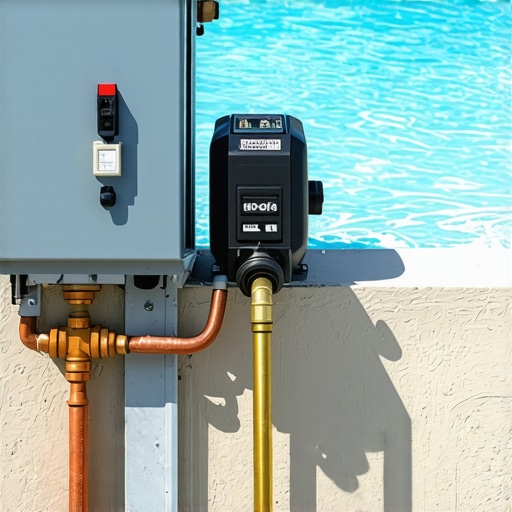
You’re standing on the pool deck, barefoot and damp, and you hear it—the unmistakable, sharp ‘clack’ of a 20-amp breaker snapping open in the subpanel. The hum of the pool pump dies instantly. Most homeowners just walk over, flip the handle back to ‘on,’ and hope for the best. But as a master electrician who’s spent 35 years tracking down phantom faults and carbon-tracked bus bars, I can tell you that a tripping breaker is a scream for help from your infrastructure. It’s not an annoyance; it’s a safety mechanism preventing a localized inferno or a lethal grounding failure. When water and 240 volts of alternating current are in play, there is zero room for guesswork. You need a forensic understanding of why that circuit is opening before you find yourself dealing with much more than a stagnant pool.
The Forensic Breakdown: Why the Logic Fails
I walked into a ‘fully renovated’ backyard last July where the owner complained his boat lift wiring and pool pump were constantly fighting each other for dominance. The previous contractor—likely a flipper special—had buried three live junction boxes behind a faux-stone retaining wall. No ‘Monkey Shit’ (duct seal) in the conduits, no gaskets on the covers. I found them with my tracer because the ground was literally steaming after a heavy rain. The salt air had turned the wire nuts into a green, calcified mess of high-resistance garbage. This is where we start the autopsy. When a breaker trips, it’s usually one of three culprits: a short circuit, an overload, or a ground fault. In the world of pool pumps, the ground fault is the most common and the most dangerous. Your GFCI (Ground Fault Circuit Interrupter) is sensing a ‘leak’ of current—as small as 5 milliamps—that isn’t returning through the neutral wire. It’s finding another path to ground, perhaps through the water you were just about to jump into.
“Aluminum wire connections can overheat and cause a fire without tripping the circuit breaker.” – CPSC Safety Alert 516
Component Zooming: The Physics of the Pump Motor
Let’s talk about the motor itself. Most people see a metal canister; I see a complex assembly of copper windings, a centrifugal switch, and a start capacitor. Over time, the enamel insulation on those copper windings undergoes thermal degradation. Every time that motor kicks on, it experiences an ‘inrush current’—a massive surge that can be five to six times its running amperage. This creates mechanical stress. The wires inside the motor literally vibrate. Eventually, you get a ‘pinhole’ breach in the varnish. Once that happens, the magnetic flux isn’t contained. It jumps to the motor frame. If your bonding grid—that thick, solid copper wire connecting all your metal pool components—isn’t perfectly intact, that current is looking for a home. During my electrical safety audits, I often find that the bonding lugs have corroded so badly they’ve snapped off, leaving the pump ‘floating’ and ready to shock the next person who touches the filter housing.
The Coastal Enemy: Salt Air and Galvanic Corrosion
If you live near the coast, your electrical system is under constant chemical attack. Salt air is a magnificent conductor. It enters your outdoor enclosures and settles on the terminals. This leads to galvanic reaction—a process where two dissimilar metals, like the copper of your home run wire and the aluminum of a lug, trade electrons until one of them disintegrates. This creates an oxidation layer. Oxidation is an insulator. Now, your pump has to work harder to pull current through that high-resistance layer, which generates heat. This is the ‘Cold Creep’ phenomenon in action. The metal expands when hot, contracts when cold, and eventually, the screw holding that wire in place becomes loose. A loose wire is an arcing wire. I’ve seen meter cans rot from the inside out because the salt-laden air was pulled through the conduit like a chimney. This is why I always insist on using stainless steel enclosures and a healthy dose of dielectric grease or ‘Monkey Shit’ to seal those entries. Without it, you’re just waiting for a holiday emergency call when your pool turns into a giant, un-grounded battery during a party.
“Ground-fault circuit-interrupters shall be installed in a readily accessible location.” – National Electrical Code (NEC) 680.5
Testing with the Right Tools: No More Guesswork
Don’t reach for a cheap hardware store tester. I use a ‘Wiggy’ (a solenoid voltmeter) or a high-end multimeter for a power quality analysis. First, we check the capacitor. If the start capacitor has leaked its electrolyte, the motor will hum but won’t spin, drawing massive amperage until the thermal protection or the breaker snaps. Then, we look at the ‘Tick Tracer’ readings around the conduit. If I’m getting a hit on the outside of a PVC pipe, we’ve got a major insulation failure inside. We also look at the sign lighting installation or bollard light installation nearby. Often, these outdoor circuits are daisy-chained. A leak in a garden light can trip the same GFCI that protects your pool pump. This is why a proper rough-in and trim-out are essential; you cannot mix high-draw motor loads with sensitive lighting circuits without expecting a ‘nuisance trip’ that isn’t a nuisance at all—it’s a warning.
The Solution: Don’t Be the Handyman’s Victim
If your breaker is tripping, the fix isn’t a bigger breaker. That’s how you start a fire. The fix is a systematic forensic investigation. We check the torque on every lug, we megger the motor windings to test insulation integrity, and we verify the bonding grid. For those who want to be proactive, augmented reality troubleshooting and virtual consultation wiring are starting to help, but nothing replaces an inspector with a ‘Wiggy’ and a flashlight in the dirt. Whether you are dealing with a doorbell camera install that’s acting up or a complex PA system installation at a resort, the principles of Ohm’s Law don’t change. Resistance creates heat, heat destroys insulation, and destroyed insulation creates a path to ground that shouldn’t exist. Keep your pool safe by ensuring your wiring is torqued to spec and your enclosures are sealed against the elements. You can find more about specialized troubleshooting in our guide on how electricians tackle lighting installations or reach out to us directly through our contact page for a comprehensive audit. Electricity isn’t a hobby; it’s a force of nature that needs to be respected, especially when you’re wearing a swimsuit. “