
The Sound of a House Trying to Stay Alive
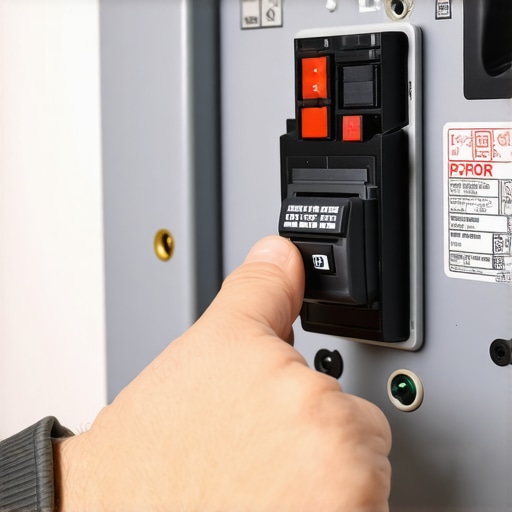
Listen. That sound—that hollow, plastic thunk—is the sound of a microprocessor deciding your house isn’t going to burn down today. When an AFCI (Arc-Fault Circuit Interrupter) trips and refuses to reset, most homeowners treat it like a stubborn toaster. They flip the handle back and forth with increasing aggression until they’ve effectively ruined the internal spring tension. Stop. You are not fighting a simple mechanical switch; you are fighting a sophisticated piece of forensic hardware that has detected a signature of heat and light you cannot see. As a licensed master electrician with 35 years in the trenches, I can tell you that a breaker that won’t reset is a gift. It is a warning. Old man Miller, my first boss, used to say, ‘If you don’t hear the click, you’re just wishing.’ He would watch me reset a breaker during my apprenticeship, and if I didn’t snap it all the way to the ‘off’ position with authority before slamming it ‘on,’ he’d make me do the whole panel over. He was right. Electricity demands respect, or it takes your house as a tax.
[image_placeholder]
The Anatomy of the Arc: Why It’s Not Just a Short
To understand why your AFCI is being stubborn, you have to understand the physics of the arc. A standard breaker trips because of overcurrent—you plugged in too many space heaters and the copper got hot. An AFCI is different. It’s looking for the arc. Imagine a wire inside your wall, perhaps a piece of Romex that was nicked during the rough-in thirty years ago. Over time, through the process of ‘cold creep’ and thermal expansion, that tiny nick becomes a gap. When electricity jumps that gap, it creates a plasma channel that reaches temperatures exceeding 10,000 degrees Fahrenheit. This isn’t just heat; it’s a micro-explosion. The AFCI detects the specific wave signature of this arcing.
“Arc-fault circuit-interrupter protection shall be provided as required in 210.12(A), (B), (C), and (D).” – National Electrical Code (NEC) Section 210.12
This code exists because, unlike a standard short, an arc can smolder at a low enough amperage that a traditional breaker won’t even blink while your studs are turning into charcoal.
The Forensic Autopsy: Step-by-Step Diagnostics
When you’re staring at that dead circuit, don’t just reach for the handle. Start the autopsy. First, clear the line. Unplug every single device on that circuit. I’m talking about the hidden cell phone chargers, the floor lamps, and especially the vacuum cleaners. Often, the ‘fault’ isn’t in your home run or your structured wiring panels; it’s in a frayed cord on a $10 lamp. If the breaker resets with everything unplugged, you’ve found your culprit. If it still trips immediately, the problem is ‘hard-wired.’ This is where I pull out my Wiggy or a high-end tick tracer to see where the juice stops. In older homes built between 1900 and 1950, we often find insulation brittleness that has finally reached its breaking point. The cloth-covered wire becomes a ‘widow maker’ when it’s disturbed. If you’ve recently had storm damage electrical repair, the surge may have compromised the internal MOV (Metal Oxide Varistor) inside the AFCI itself. Yes, the breakers themselves can fail, especially after a lightning strike nearby bridges the gap between phases.
The Ghost in the Machine: Energy Storage and Modern Loads
Modern homes are more complex than the simple loops of the 70s. If you have energy storage systems or complex battery backup wiring, the interaction with AFCI breakers can be finicky. Inverters produce ‘dirty’ power—high-frequency harmonics that can trick a sensitive AFCI into thinking there’s an arc. This is where you need certified journeyman services to perform a proper load calculation and harmonic analysis. If your breaker trips every time your solar battery kicks in, you don’t have a fire; you have a compatibility issue. Furthermore, with the rise of network cable installation and sign lighting installation, we are seeing more ‘noise’ on the electrical lines. If your AFCI is shared with a sign or a high-voltage data rack, the electromagnetic interference can trip the breaker’s internal logic.
“Aluminum wire connections can overheat and cause a fire without tripping the circuit breaker.” – CPSC Safety Alert 516
While this alert refers specifically to aluminum, the principle applies to any loose connection at the terminal. If the screw holding the wire to the breaker isn’t torqued to spec, the vibration of 60Hz AC current will eventually create a carbon bridge.
When to Call the Heavy Hitters
If you have gone through the steps—unplugged the devices, checked the visible outlets, and verified it’s not a simple overload—and the breaker still snaps back to the middle ‘tripped’ position, stop touching it. You are likely dealing with a series arc hidden behind a wall or a ‘bootleg ground’ that has finally failed. This is not a DIY job for a Saturday afternoon. You need a licensed master electrician who understands the nuances of troubleshooting for lighting installations and complex home circuits. If you’re in a bind, some firms offer weekend electrician services or a priority service membership to get someone out before the smell of fishy, burning plastic fills your hallway. For those trying to handle lighting installations on their own, remember that a single nicked neutral can trip AFCIs for the entire house if the circuits are shared. Don’t risk your family’s safety over a $150 service call. If you need professional eyes on the problem, you can contact us here to ensure your panel is actually safe and not just temporarily functional. Sleep at night knowing every lug is torqued and every arc is suppressed.