
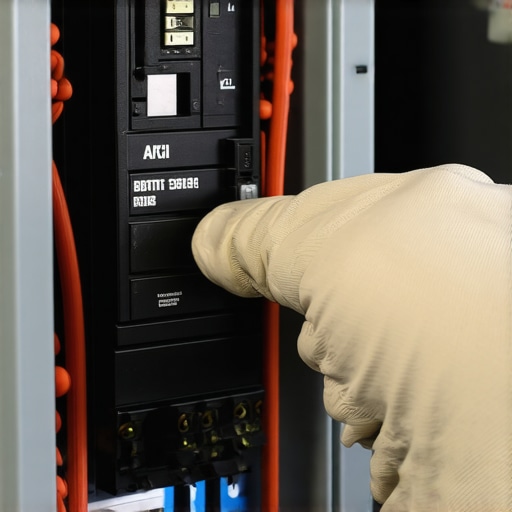
The 2:00 AM Click: A Forensic Look at Arc-Fault Failures
You’re dead asleep when the silence is punctured by a sharp, metallic thwack from the hallway. The white noise machine dies. The house goes black. You stumble to the panel, flip the breaker, and it holds—for ten minutes. Then, another thwack. This is the ‘Mystery Trip,’ and if you’ve got Arc-Fault Circuit Interrupter (AFCI) breakers, you aren’t just fighting a circuit; you’re fighting the physics of ionized gas. As a licensed master electrician, I’ve spent decades chasing these phantoms. An AFCI isn’t your standard thermal-magnetic breaker that only cares if you’ve plugged in too many space heaters. It is a sophisticated microprocessor designed to distinguish between the normal spark of a vacuum cleaner motor and the lethal arc of a staple driven too deep into Romex.
The Journeyman’s Curse: Why Every Nick Matters
My old journeyman used to watch me like a hawk during the Rough-in phase. I remember one humid July afternoon in a cramped basement when I used a utility knife to strip a 14-2 wire instead of my dikes or proper strippers. He grabbed my wrist so hard I thought he’d break it. ‘You nick that copper, kid, and you’ve just built a heater,’ he growled. ‘The wire gets thin there, the resistance goes up, and ten years from now, when the house settles, that nick starts to arc. By then, I’ll be retired, and you’ll be the one trying to explain to a crying homeowner why their wall is on fire.’ He wasn’t exaggerating. That tiny gouge in the copper creates a ‘hot spot’ through a process called Joule heating. Under the load of modern living—think hot tub wiring services or 4K theaters—that localized heat causes the copper to expand and contract, eventually brittle-fracturing and creating a micro-gap. That gap is where the arc lives.
“Arc-faults are one of the leading causes of residential electrical fires, often occurring in damaged power cords or through wire penetration by nails or staples.” – CPSC Safety Alert 516
The Anatomy of an AFCI Failure: Component Zooming
To understand why your breaker is tripping, we have to look at Cold Creep and thermal expansion. In many mid-century homes built between 1960 and 1980, we see a lot of shared neutrals. In the old days, we thought we were being efficient. In the modern AFCI era, a shared neutral is a death sentence for circuit stability. An AFCI breaker monitors the balance between the hot and the neutral. If even a fraction of a milliamp leaks off onto another circuit’s neutral—a ‘bootleg ground’ or a cross-wired junction—the breaker’s logic board sees a signature that looks like a parallel arc and kills the power. This isn’t a ‘nuisance trip’; it’s the breaker doing exactly what it was engineered to do. However, the breakers themselves aren’t immortal. The electrolytic capacitors on those tiny internal circuit boards can dry out, especially in hot garage panels. When those caps fail, the breaker loses its ability to filter out ‘line noise’ from things like LED drivers or AI fault detection algorithms in high-end appliances. Suddenly, your lighting install is causing the breaker to trip every time you dim the lights because the breaker can no longer distinguish between the ‘chopped’ sine wave of a dimmer and a dangerous arc.
Forensic Troubleshooting: Using the Wiggy and the Tick Tracer
When I arrive for a priority service membership call, I don’t start by swapping breakers—that’s a rookie move. I start at the Home Run. I use a Wiggy (a solenoid voltmeter) because it puts a small load on the circuit, unlike those digital meters that pick up ‘ghost voltages’ that don’t mean a lick. If the voltage drops significantly under the Wiggy’s load, I know I’ve got a high-resistance connection somewhere. Then comes the Tick Tracer. I’m sniffing for the electromagnetic signature of an arc behind the drywall. Often, the culprit is tree mounted lights or permanent holiday lighting where moisture has entered a socket, creating a carbon path. Carbonized paths are conductive; they allow electricity to ‘leak’ across insulation. This is why how electricians tackle troubleshooting for lighting installations is so critical—it’s about finding that one point where the insulation has turned into a semiconductor.
The 200 Amp Panel Install: Why Upgrading Saves the Logic
If your home is still running on an old 100-amp Federal Pacific or Zinsco panel, you aren’t just dealing with mystery trips; you’re sitting on a powder keg. These old bus bars undergo galvanic corrosion, especially if you’re in an area with high humidity. The connection between the breaker and the bus bar weakens, creating—you guessed it—an arc. Upgrading to a 200 amp panel install allows for the proper physical spacing required for modern AFCI and GFCI breakers. It also allows us to perform arc flash studies on a residential scale, ensuring that the ‘available fault current’ won’t melt the lugs off the meter can if a true short occurs. If you’re adding heavy loads like up lighting services or EV chargers, the old infrastructure simply cannot handle the thermal stress. For those struggling with charger issues, I always recommend checking ev charger troubleshooting expert tips to fix common issues before assuming the breaker is the only problem.
“The AFCI shall be installed in a readily accessible location… to protect the branch circuit against the effects of arc faults.” – National Electrical Code (NEC) Section 210.12
When to Replace vs. When to Rewire
Is the breaker bad? If the AFCI trips with nothing plugged into the circuit—no lamps, no chargers, no ‘vampire’ loads—and the Trim-out looks clean, the breaker’s internal logic has likely been fried by a surge. But if it trips only when the washing machine starts, you’ve likely got a ‘Series Arc’ in the motor or the outlet. We don’t use monkey shit (duct seal) to fix these; we use forensic mechanical connections. We torque every lug to the inch-pound specified on the manufacturer’s label. Why? Because a loose screw is just an arc waiting for an invitation. If you are tired of the guessing game, contact us for a full diagnostic. We don’t just swap parts; we find the ‘Widow Maker’ in your walls and kill it before it kills your peace of mind. Electricity is a lazy beast; it’s always looking for a shortcut to the ground. My job is to make sure that shortcut isn’t through your living room sofa.