
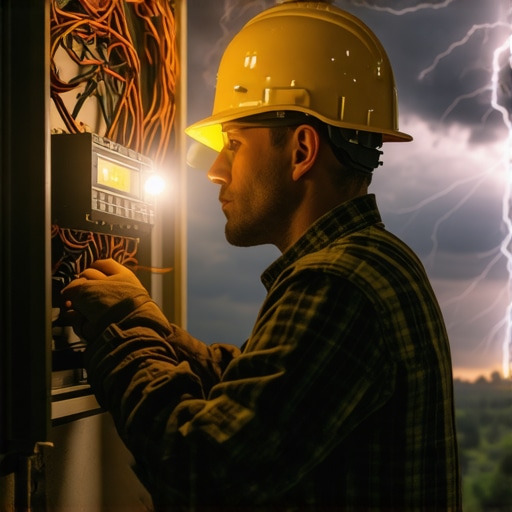
The Sensory Warning: When the Air Smells Like Ozone and Regret
You’re sitting in your living room when the sky turns a bruised shade of purple. The first strike isn’t a flash; it’s a physical thud that vibrates your marrow. Then the lights do that stutter—a flickering dance that signals a transformer just committed suicide three blocks away. That’s not just a ‘power flicker.’ That’s a massive transient voltage spike, a wall of electricity moving at nearly the speed of light, looking for the path of least resistance. Usually, that path leads straight through your expensive appliances or your delicate AFCI breaker services. I’ve spent 35 years smelling the aftermath: the charred scent of burnt phenolic resin and the metallic tang of vaporized copper. If you smell fish, something is arcing. If you smell ozone, the air itself is becoming a conductor.
“Aluminum wire connections can overheat and cause a fire without tripping the circuit breaker.” – CPSC Safety Alert 516
I once walked into a ‘fully renovated’ house after a heavy storm where the flipper had buried live junction boxes behind the kitchen backsplash. I found them with my tracer because the surge from a nearby strike had jumped the gap between a poorly spliced wire and the metal lath of the tile. The wall was literally humming. The homeowner thought it was just ‘storm vibes.’ I had to take my dikes and cut the power before the whole kitchen became a kiln. That’s the reality of code violation corrections; they aren’t about red tape, they’re about keeping your house from becoming a statistic. When you skip a proper home run for a major appliance, you’re just building a fuse out of your drywall.
The Forensic Breakdown: Why Your Devices Die in Nanoseconds
To understand a surge, you have to understand Cold Creep and thermal expansion. In many mid-century homes, aluminum wiring was the standard. Aluminum expands and contracts at a different rate than the brass screws on your outlets. Over time, these connections loosen. When a storm surge hits, that microscopic gap becomes an invitation for a plasma arc. The voltage jump creates a bridge of ionized air. This isn’t a clean flow of juice; it’s a violent, high-heat event that pits the metal of your bus bars. If you’re running restaurant kitchen electrical equipment, a single surge can fry the logic boards of a $20,000 combi-oven because the flipper didn’t install a surge-rated shunt. Most people think a cheap power strip from a big-box store will save them. Wrong. Those things use Metal Oxide Varistors (MOVs) that are basically kamikaze components. They take one hit and die, often without telling you they’re dead. You’re left with a glorified extension cord and zero protection.
We need to talk about the physics of the fire alarm system install during these events. A surge doesn’t just hit your outlets; it travels through your data lines and signaling circuits. I’ve seen fiber optic cabling remain intact—because glass doesn’t conduct—while the media converters on either end were melted into slag. This is why energy storage systems are becoming vital. They act as a buffer, but even they need proper lockout tagout training protocols for maintenance after a major weather event. If your system isn’t properly grounded with an 8-foot copper-clad rod driven into the earth, that surge is going to find a ground through your doorbell camera install or your holiday light installation, blowing the sensors and leaving you vulnerable.
“Surge protective devices shall be UL listed and installed per the manufacturer’s instructions to ensure the safety of the electrical system.” – NEC Article 285
The Anatomy of a Failure: From Meter Can to AFCI
If you’re in a coastal area, your biggest enemy isn’t just the lightning; it’s the salt air. Salt is a conductor. It builds up inside your meter can, creating a ‘salt bridge’ between phases. When a storm brings high humidity and a voltage spike, that bridge becomes a path for a catastrophic short. I’ve seen meter cans rot from the inside out, looking perfectly fine on the exterior while the interior lugs were crumbling into green dust. This is why troubleshooting for lighting installations often reveals deeper service entrance issues. You think it’s a bad bulb; I see a service mast that’s been vibrating in the wind for twenty years until the insulation rubbed raw.
When we perform AFCI breaker services, we’re looking for the ‘signature’ of an arc. Modern Arc-Fault Circuit Interrupters are smart—they can tell the difference between the normal spark of a vacuum cleaner motor and the dangerous arc of a nail driven through Romex. But a surge can blind these sensors. If your panel is a Federal Pacific or a Zinsco, you’re already living with a ‘widow maker.’ Those breakers are notorious for jamming. You could have a dead short and that breaker will sit there, fat and happy, while the wire turns into a heating element. Upgrading to a modern square-D or Eaton panel isn’t about ‘upselling’; it’s about having a safety net that actually catches you. For those with electric vehicles, ensuring a safe EV charging station setup is critical because an EV charger is a massive load that can act as a lightning rod for your entire home grid.
The Fix: Professional Intervention vs. The Handyman Special
Don’t trust your architectural lighting or complex holiday light installation to someone who uses a ‘tick tracer’ as their primary diagnostic tool. I use a Wiggy. It’s a solenoid tester that puts a load on the circuit. If the voltage is ‘phantom,’ the Wiggy won’t move. A cheap non-contact tester will beep at a static charge from your polyester shirt, leading to false confidence. When we do a rough-in, we ensure every box is sealed with ‘monkey shit’ (duct seal) to prevent moisture migration, especially in restaurant environments. If you’ve suffered a surge, you need a forensic inspection. We look for ‘pitting’ on the contact points of your breakers. If we see it, that breaker is compromised. It’s like a car tire with a bubble in the sidewall; it might hold for now, but you don’t want to be on the highway when it lets go.
Properly maintaining your high-draw devices is non-negotiable. For instance, following EV charger maintenance tips can prevent a surge from finding a weak point in your car’s charging port. If you’re already seeing issues, checking EV charger troubleshooting guides might help, but for a storm-related event, you need a Master Electrician. We check the torque on every lug. A loose neutral is a silent killer. It can cause your voltage to swing wildly—sending 180 volts to one leg and 60 to the other—frying half your house while the other half stays dim. Sleep at night knowing your system is torqued to spec and your grounds are solid. Electricity isn’t a hobby; it’s a force of nature that wants to return to the earth, and it doesn’t care if your house is in the way.