
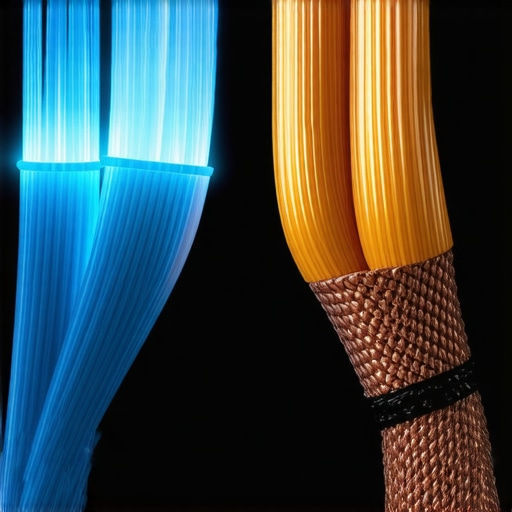
The Backbone of the Modern Home: Fiber vs. Coax
I remember my journeyman back in 1988; he used to smack my hand with a pair of dikes if I ever used a standard utility knife to strip back a low-voltage cable. ‘You nick that center conductor, kid, and you’ve just created a bottleneck that’ll drive the customer crazy for a decade,’ he’d growl. He wasn’t just being a mean old-timer; he understood the physics of signal impedance before ‘high-speed internet’ was even a household term. Today, we aren’t just pulling Romex for a couple of outlets; we are integrating complex data streams into the very skeleton of the building. Whether it is three phase power services for a commercial hub or a simple residential rough-in, the choice between fiber optic and traditional coaxial cable determines whether your infrastructure is a robust highway or a clogged artery.
The Anatomy of Resistance: Why Coax Is Showing Its Age
Traditional coaxial cable, or ‘coax,’ relies on a copper-plated steel center conductor. It’s been the workhorse of the industry for sixty years. You see it everywhere—the thick, black wire coming off the pole, entering the house through a hole some cable guy drilled through the siding without a drip loop. Inside that cable, data travels as electrical signals. This is the first point of failure. Because coax is metallic, it is susceptible to Electromagnetic Interference (EMI). If you run a coax line too close to a high-voltage home run or a poorly shielded transformer installation, you get ingress. That’s the ‘snow’ on the TV of yesteryear or the dropped packets of today.
“Aluminum wire connections can overheat and cause a fire without tripping the circuit breaker.” – CPSC Safety Alert 516
Wait, why talk about aluminum wiring in a fiber vs coax debate? Because the physics of ‘Cold Creep’ and oxidation apply to the connectors. In my 35 years, I’ve seen more F-connectors turned to green dust by salt air and moisture than I care to count. When that copper core oxidizes, resistance goes up. When resistance goes up, signal-to-noise ratios plummet. You end up with a ‘hot’ wire that’s doing nothing but generating micro-heat and zero data. This is why we insist on warranty backed repairs; if the physical layer is compromised, the software doesn’t stand a chance.
Fiber Optics: The Speed of Light in a Glass Tube
Fiber optic technology is a different beast entirely. Instead of moving electrons through copper, we are pulsing photons through hair-thin strands of silica glass. There is no copper to oxidize. There is no metallic path for a lightning strike to follow into your sensitive microgrid integration systems. From a forensic inspector’s view, fiber is the gold standard because it is immune to EMI. You could wrap a fiber line around a 400-amp service feeder and it wouldn’t care. The signal remains pristine because it operates on the principle of Total Internal Reflection.
However, fiber is fragile during the rough-in phase. If a ham-fisted apprentice kinks a fiber line, the glass fractures internally. You won’t see it on the outside, but your signal is dead. This is where I pull out my tick tracer and Wiggy to check the power side, but for the fiber, you need an OTDR (Optical Time-Domain Reflectometer). It’s about precision. If you’re setting up battery backup wiring to keep your servers running during a blackout, you want that data pipe to be fiber to ensure your monitoring systems don’t glitch when the generator transfer switch kicks over.
The Infrastructure Conflict: Heat, Power, and Data
The biggest mistake homeowners make is thinking that data cables don’t interact with the electrical system. They do. Heat is the enemy of all conductivity. When we perform AFCI breaker services, we often find that heat from overloaded circuits has baked the insulation on nearby coax cables, making them brittle and prone to failure. Fiber optic cables generally handle higher ambient temperatures better, but they still require proper landscape lighting install techniques if they are being buried. You don’t want a shovel-wielder nicking your fiber line while they’re putting in bollard light installation units along the driveway.
“All electrical equipment shall be installed in a neat and workmanlike manner.” – National Electrical Code (NEC) Article 110.12
That ‘workmanlike manner’ is what’s missing in most modern ‘renovations.’ I’ve walked into basements where the coax was draped over steam pipes. I’ve seen emergency exit lighting wired with scraps of old extension cords. When you upgrade to fiber, you are usually forced to clean up the ‘spaghetti’ in the utility room. This is a good thing. It allows us to inspect the transformer installation and ensure the grounding electrode system is actually bonded. For more on how we clean up these messes, check out lighting installations made easy.
The Load Calculation: Can Your House Handle Modern Tech?
We are seeing a massive surge in demand for three phase power services in residential ‘mansion-tech’ builds and high-end home offices. Why? Because everyone wants 10Gbps fiber, but they’re trying to run the hardware on a 100-amp service that’s already screaming for mercy from the AC unit and the new ev-charger. If you’re looking at ensuring safe and efficient ev charging station setup, you have to consider the data backbone that manages that power. Smart chargers need reliable connectivity. Coax often fails here because the high-frequency switching noise from the EV charger can bleed into the coax line. Fiber? It doesn’t even notice. It’s the only way to go for a truly integrated home.
Forensic Conclusion: Why I Recommend Fiber Every Time
If I’m looking at a house after a fire or a major surge event, I’m looking for the path of least resistance. Coax is a conductive path. It brings external surges right into your living room. Fiber is a dielectric; it breaks the electrical path. It is safer, faster, and—when installed by someone who knows how to handle glass—it lasts indefinitely. Don’t let a ‘handyman’ tell you coax is ‘good enough.’ In the age of microgrid integration and battery backup wiring, ‘good enough’ is just another word for a future service call. If you’re having trouble with your current setup, see our guide on ev charger troubleshooting or contact us to get it done right the first time. Tighten your lugs, torque your breakers, and for heaven’s sake, stop kinking the cables.