
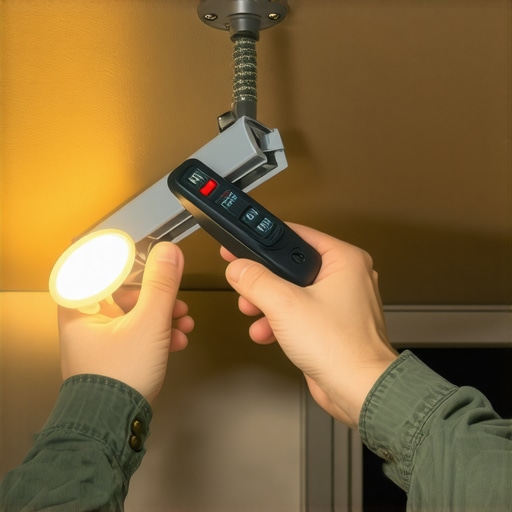
The Anatomy of a Failing Connection: Why Your Track Lighting is Flickering
You hear it before you see it—that faint, rhythmic ‘tick-tick-tick’ coming from the ceiling. Then comes the flicker, a strobe-light effect that turns your kitchen into a 1970s disco, followed by the unmistakable, sickly-sweet scent of ozone. As a licensed master electrician with 35 years in the trenches, I can tell you that a dead track light is rarely just a dead bulb. It is an autopsy waiting to happen. Most homeowners reach for a new LED and call it a day, but they are ignoring the physics of resistance and heat that are currently chewing through their insulation. When you have a broken track lighting connection, you aren’t just looking for a loose wire; you are looking for the point where the electrical integrity of your home has surrendered to age, heat, or poor workmanship. Using a tick tracer might tell you if there is power at the track, but it won’t tell you why the connection is failing under load. To find that, we have to look deeper into the metallurgy and the mechanics of the system.
The Old Timer’s Lesson: The Sin of the Nicked Conductor
My journeyman used to smack my hand if I stripped a wire with a knife back in the eighties. ‘You nick the copper, you create a hot spot,’ he’d scream over the sound of a hammer drill. He wasn’t being a jerk; he was teaching me the law of the land. When you nick a conductor during the rough-in phase, you reduce the cross-sectional area of that wire. Think of it like a four-lane highway suddenly bottlenecking into one lane. The electrons don’t just wait their turn; they crowd together, creating friction and heat. Over time, that heat cycles the metal, leading to cold creep. I’ve seen track lighting ‘pro’ installs where the installer used a utility knife like a steak knife, leaving every connection point one thermal cycle away from a fire. This is why how electricians tackle troubleshooting for lighting installations involves more than just swapping parts; it involves a forensic look at every inch of the copper.
“Aluminum wire connections can overheat and cause a fire without tripping the circuit breaker.” – CPSC Safety Alert 516
The Mid-Century Menace: Aluminum Wiring and Cold Creep
If your home was built between 1965 and 1978, your track lighting troubleshooting just got a lot more dangerous. You are likely dealing with aluminum wiring repair issues. Aluminum is a temperamental metal. It has a much higher coefficient of thermal expansion than copper, meaning it grows and shrinks significantly every time you flip the switch. This movement, known as ‘cold creep,’ slowly backs the wire out from under the terminal screws on your track’s live-end feed. Once the connection is loose, an arc-fault begins. This micro-arcing is a high-temperature plasma that carbonizes the surrounding plastic. This is exactly why AFCI breaker services are no longer optional for modern safety standards; an AFCI breaker is designed to ‘listen’ for the specific signature of that arcing and shut the power down before the wood framing catches. If you are troubleshooting a track in a mid-century home, stop. You need a licensed master electrician to verify if you have a ticking time bomb behind that mounting plate.
The Autopsy of the Track: Component Zooming
Let’s perform a forensic breakdown of the track itself. A standard track is essentially two copper bus bars housed in a PVC or aluminum extruded shell. The ‘dead’ spot in your track is often caused by a failure of the spring-tensioned copper tabs on the light fixture head. Over years of operation, the heat from halogen lamps (which can reach upwards of 350 degrees Fahrenheit) causes the copper tabs to lose their ‘spring.’ They no longer bite into the bus bar. This creates a high-resistance junction. Resistance generates more heat, which further weakens the metal, until eventually, the contact point oxidizes. This oxide layer acts as an insulator, blocking the 120 volts from reaching the lamp. If you are doing a lighting install, you must ensure that the track heads are seated perfectly. If you see black soot or pitting on the track’s inner rail, the track is compromised and must be replaced. No amount of ‘cleaning’ will restore the structural integrity of that metal.
“All electrical connections shall be tightened to the torque values specified by the manufacturer to prevent overheating.” – National Electrical Code (NEC) Section 110.14(D)
Advanced Troubleshooting: From Smart Meters to Smart Cameras
Modern homes have more complex ‘home run’ circuits than ever. With the rise of smart meter installation, we can now see load fluctuations in real-time, but that won’t help you if the flipper who owned your house before you buried a junction box behind the drywall. If your track lighting is tied into a broader system, like a doorbell camera install or a speaker system setup, you might be dealing with shared neutrals or induced voltage. I’ve walked into jobs where a ceiling fan installation on the same circuit caused enough vibration to loosen a poorly torqued track lighting feed. For the tech-savvy, troubleshooting might involve drone light inspections for high-atrium commercial tracks, but for a residential setting, it comes down to the Wiggy (solenoid voltmeter). A digital multimeter can give you ‘ghost voltages’ through induction, but a Wiggy puts a load on the circuit. If the Wiggy doesn’t pull, you don’t have a real connection. While you are at it, consider if your home can even handle the new loads; sometimes a safe and efficient EV charging station setup or a heavy-duty appliance can expose weaknesses in your lighting circuits that were previously hidden.
Code Compliance and the Senior Safety Priority
We take our senior discount services seriously because older homeowners are often the most targeted by ‘handyman’ hacks. A senior shouldn’t be climbing a 10-foot A-frame ladder to wiggle a flickering track head. That flicker is a signal that the system is failing. Whether it is a simple ceiling fan installation or a complex rewire, the goal is always the same: low resistance, high integrity. If you’ve gone through the bulbs, checked the tabs, and verified the breaker hasn’t tripped, you are likely looking at a failure at the ‘monkey shit’ (duct seal) entry point or a loose neutral in the panel. Don’t gamble with 120 volts. For peace of mind, reach out for a professional evaluation at our contact page. Proper electrical work isn’t about making the lights come on; it’s about making sure they stay on without burning the house down around you. Every screw must be torqued, every wire must be stripped without a nick, and every circuit must be protected by the right breaker. That is how you sleep at night.”, “image”: {“imagePrompt”: “A macro photography shot of a burnt electrical track lighting connector, showing carbonized plastic and oxidized copper bus bars inside the rail, with a master electrician’s hand holding a non-contact voltage tester (tick tracer) nearby.”, “imageTitle”: “Forensic Inspection of a Burnt Track Lighting Feed”, “imageAlt”: “Close-up of a damaged track lighting connection showing electrical arcing damage and oxidation.”}, “categoryId”: 0, “postTime”: “”}