
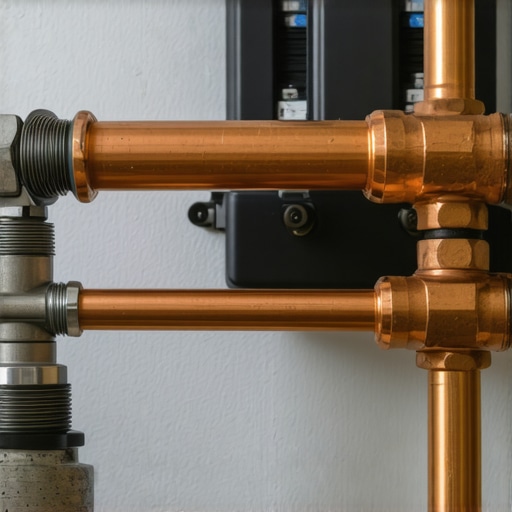
The Invisible Safeguard: A Forensic Look at Bonding
You probably don’t think about your plumbing when you turn on your toaster, but in a mid-century home, those two systems are more intimate than you’d like to imagine. I’ve spent over three decades sniffing out the scent of toasted insulation and chasing ghosts in the wiring of houses built when ‘code’ was more of a suggestion. The most terrifying thing I find isn’t always the mouse-chewed Romex; it’s the missing or corroded bonding jumper. Without that small, unassuming piece of copper, your entire home’s metallic infrastructure—your gas lines, water pipes, and even your bathroom exhaust fan housing—could become a ‘live’ part of the circuit during a fault. If you touch a faucet and feel a tingle, you aren’t sensitive to ‘energy’; you’re becoming the main disconnect services return path for a stray current that has nowhere else to go.
The Old Timer’s Lesson: The Sin of the Nicked Conductor
My old journeyman, a man who smelled exclusively of pipe tobacco and electrical ozone, used to smack my hand with his dikes if he caught me stripping a wire with a pocketknife. ‘You nick that copper, kid, and you’ve just built a fuse,’ he’d growl. He wasn’t just being a crank. He understood the physics of resistance. A nick in a wire creates a localized hot spot. When we talk about bonding jumpers, that integrity is everything. If the connection between your neutral bar and your grounding bus is loose, or if some ‘handyman’ used a sub-standard wire that he nicked or bent too tightly, the equipotential grid of your home collapses. I remember a job where a homeowner was getting ‘bit’ by her kitchen sink. It turned out the main bonding jumper in her 1974 panel had been nicked during the rough-in and finally snapped after years of thermal expansion. The entire cold water line was sitting at 90 volts.
“The bonding jumper shall be a wire, bus, or screw. It shall be of copper or other corrosion-resistant material.” — NEC 250.28
The Anatomy of a Failure: Why Bonding Matters
To understand bonding, you have to stop thinking of ‘ground’ as a magic sink where electricity disappears. Electricity wants to return to its source—the transformer on the pole. If a hot wire in your 1960s dishwasher shorts to the metal frame, that frame becomes energized. If that dishwasher is properly bonded to the grounding system via an Equipment Grounding Conductor, the current rushes back to the panel, hits the main bonding jumper, and flows into the neutral, creating a massive spike in amperage that trips the breaker instantly. That’s a successful ‘fault.’ But if that bonding jumper is missing—common in electrical panel upgrade jobs performed by amateurs—the breaker won’t trip. The metal frame of the dishwasher just sits there, waiting for you to touch it while your feet are on a damp tile floor. This is why being a bonded insured electrical professional isn’t just a marketing slogan; it’s a legal requirement to ensure these life-saving paths are verified.
Component Zooming: Cold Creep and Aluminum Bonding
In homes built between 1965 and 1978, the bonding situation is often a ticking time bomb due to aluminum wiring. We need to talk about the physics of Cold Creep. When electricity flows through an aluminum bonding jumper, it heats up and expands. Because aluminum has a much higher coefficient of expansion than the steel lugs in old Zinsco or Federal Pacific panels, the metal actually deforms under the pressure. When the load drops and it cools, the wire stays deformed. This creates a microscopic gap. In the presence of humidity, a layer of aluminum oxide forms in that gap. Unlike copper oxide, which is somewhat conductive, aluminum oxide is an insulator. Now, your bonding path has high resistance. During a short circuit, the resistance in that oxidized bond limits the current flow just enough so the breaker doesn’t trip, but it generates enough heat to ignite the monkey shit (duct seal) or plastic bushings nearby.
“Aluminum wire connections can overheat and cause a fire without tripping the circuit breaker.” — CPSC Safety Alert 516
The Modern Grid: Microgrid Integration and Remote Diagnostics
The stakes are even higher today. With the rise of microgrid integration, solar inverters, and battery storage, your home is no longer a simple end-point for utility power; it’s a power plant. These systems require a sophisticated equipotential grid to ensure that there is zero potential difference between all metallic surfaces. In a fault scenario, a floating neutral in a microgrid setup can lead to catastrophic equipment failure or fire. This is why we now recommend remote electrical diagnostics. Using thermal imaging and power quality monitoring, we can see the heat signature of a failing bond before it ever smells like fish or ozone. If you’re planning office lighting upgrades or installing high-draw equipment, you cannot rely on 50-year-old bonding jumpers. We often find that these old jumpers were never sized for the increased loads of modern life.
The Forensic Inspection: Finding the Hidden Danger
When I perform a forensic inspection, I don’t just look at the panel. I use a Wiggy (solenoid tester) and a Tick Tracer to check for induced voltage on gas lines and water mains. Often, I find that a previous homeowner ‘upgraded’ to PEX plumbing but failed to realize they broke the electrical continuity of their water pipe grounding. They effectively cut the bonding jumper to the earth. This is a common find in senior discount services where contractors might take shortcuts on older homes. A proper repair involves jumping those PEX sections with heavy-gauge copper wire and specialized clamps to restore the path. We also look at the bathroom exhaust fan installations; these are notorious for being ungrounded in older homes, turning a simple appliance into a hazard in a high-moisture environment. For those looking for more technical guidance, our guide on lighting troubleshooting explains how these grounding issues often manifest as flickering or phantom voltages.
Protecting Your Investment: Maintenance and Upgrades
Safety isn’t a one-and-done event. The vibrations of a house, the seasonal expansion of the foundation, and the simple passage of time all work to loosen mechanical lugs. This is why annual maintenance contracts are the only way to sleep soundly. We go through and re-torque every lug in your panel to the manufacturer’s inch-pound specifications—something most handymen haven’t even heard of. If your panel is a ‘no-name’ brand or a known fire-hazard like a Federal Pacific, an electrical panel upgrade isn’t an ‘upsell’; it’s a life-preserver. We ensure that the new main disconnect includes a robust, code-compliant main bonding jumper that links your grounded conductor to the grounding electrode system perfectly. If you’re concerned about your home’s safety, you should contact us for a thorough evaluation. Don’t wait until you smell the ozone or feel the tingle. Electricity doesn’t give warnings; it gives results. Make sure your home’s bonding is up to the task.