
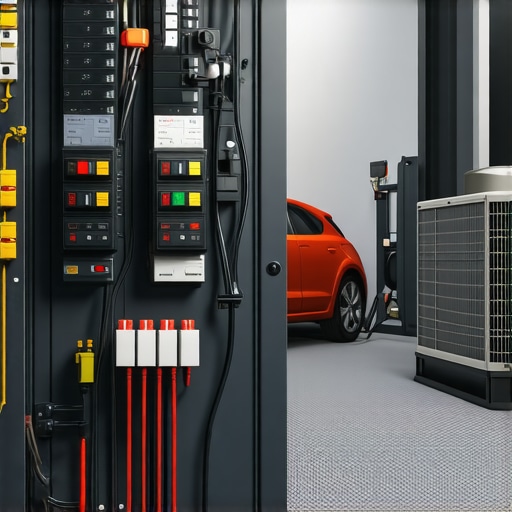
The Ghost in the Walls: Why Your 100-Amp Panel is a Fire Hazard Waiting to Happen
I walked into a ‘fully renovated’ mid-century ranch last week where the kitchen backsplash looked like a Pinterest dream. But my tick tracer was screaming before I even touched the tiles. The flipper had buried three live junction boxes behind a thick layer of subway tile and grout because they didn’t want to move the home run circuits. I found them buried there, steaming, just waiting for a high-draw appliance to turn that decorative tile into a convection oven. This is the reality of modern living in an old infrastructure: people dress up the surface while the heart of the home—the electrical service—is cardiac-arresting under the weight of 21st-century demand.
When your house was built in 1972, a 100-amp service was the gold standard. You had a fridge, a few lamps, and maybe a color TV that took five minutes to warm up. Today, you’re asking that same load center to handle a 50-amp EV charger, a 30-amp heat pump, two home offices, and a recessed lighting installation in every room. You aren’t just pushing the limit; you are redlining a machine that was never designed for this race. This is where electrical load calculations become the difference between a functional home and a 24 hour emergency electrician visit at 3 AM.
“Aluminum wire connections can overheat and cause a fire without tripping the circuit breaker.” – CPSC Safety Alert 516
The Physics of Failure: Why Wires Melt
Let’s talk about the overhead service drop. These are the triplex wires swinging from the utility pole to your weatherhead. On a 100-amp service, those conductors are sized for a specific thermal limit. When you exceed that limit, the physics of resistance take over. As current increases, so does heat. This leads to thermal cycling—the wire expands when hot and contracts when cold. Over decades, this movement loosens the lugs at the meter base. I’ve seen meter cans where the lugs were so loose they started arcing, creating a pool of molten aluminum at the bottom of the enclosure. We call that ‘Monkey Shit’ (duct seal) won’t fix that mess; you need a full load center upgrade.
Resistance isn’t just a number on a Wiggy; it’s a physical destroyer. When you have a loose neutral in a 100-amp panel, the voltage can swing wildly, frying your expensive electronics. This is why infrared thermography scans are non-negotiable during an inspection. A thermal camera will show a ‘hot’ breaker long before it trips. If that breaker is a Federal Pacific or a Zinsco, it might never trip at all. Those brands are the ‘widow makers’ of our industry. They don’t just fail; they weld themselves to the bus bar, allowing the wire to turn into a heating element inside your walls.
The Heavy-Up: More Than Just a Bigger Box
Upgrading to a 200-amp or 400-amp service isn’t just about the panel. It’s a systemic overhaul. It starts with the grounding electrode install. Most old homes rely on a single copper water pipe that has likely been interrupted by PEX plumbing years ago, leaving the house completely ungrounded. A modern service requires two eight-foot copper-clad ground rods driven into the earth, spaced at least six feet apart. Without this, a lightning strike or a utility surge has nowhere to go but through your motherboard.
Then there’s the access control wiring and smart home integration. Every time you add a smart doorbell or a security system, you’re adding a small but constant ‘phantom load.’ Multiply that by thirty devices, and your baseline consumption is already eating 20% of your 100-amp capacity before you even turn on the microwave. If you are planning an ensuring safe and efficient EV charging station setup at home, you absolutely cannot do it safely on a 100-amp service without risking a total system collapse during a summer heatwave.
“The total connected load shall not exceed the carrying capacity of the service-entrance conductors.” – NEC Article 230.42
Future-Proofing or Fire-Fighting?
If you’re looking at a solar panel electrical hookup or a home backup generator install, you’re moving into the realm of ‘micro-grids.’ These systems require sophisticated transfer switches and interlock kits that require space—physical and electrical space—that a 100-amp panel simply doesn’t have. When we do a rough-in for a modern home, we are looking at the trim-out ten years from now. We use dikes to clean up the rats’ nests left by previous ‘handymen’ and ensure every lug is torqued to the specific inch-pounds required by the manufacturer.
Don’t wait for the smell of ozone—that sickly sweet, metallic scent of melting PVC insulation—to call us. If your lights flicker when the AC kicks on, that’s not ‘character’; that’s a cry for help from your overhead service drop. Whether you need lighting installations made easy or a full-scale service heavy-up, the goal is the same: making sure you can sleep at night without wondering if your walls are brewing a sun-hot arc fault. Check our contact us page to get a forensic look at your system before the ‘Time Bomb’ in your garage finally goes off. Modern life demands power; don’t try to feed a stallion with a straw.
The Reality of Load Calculations
When an electrician performs electrical load calculations, they aren’t just guessing. We look at the square footage, the small appliance branch circuits, and the nameplate ratings of your permanent equipment. If that math doesn’t add up, adding more circuits is like trying to put a V8 engine in a golf cart. You might move for a second, but something is going to snap. Safety isn’t an ‘upsell’; it’s the baseline of the trade. If you’re experiencing issues with your chargers, see ev charger troubleshooting for expert tips, but remember: the best maintenance is a solid foundation. See our top ev charger maintenance tips for more info on keeping your high-draw devices running cool. It all starts with the service entrance.