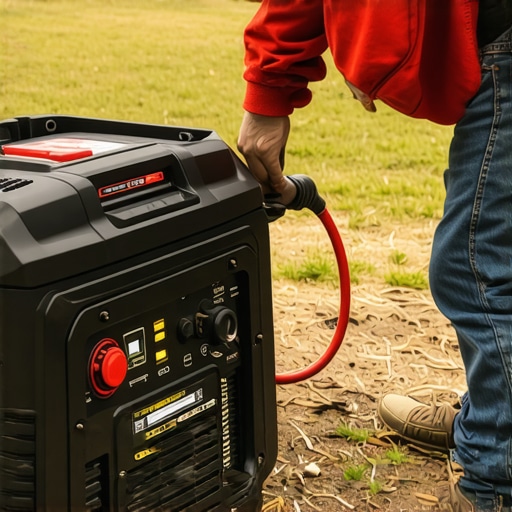
The Anatomy of a Disaster: When Your Backup Becomes a Threat
I’ve spent 35 years crawling through attics filled with itchy fiberglass and digging trenches in frozen Georgia clay just to fix what ‘handymen’ broke. I’ve seen enough arcing wires to last three lifetimes, and the smell of ozone from a cooking breaker is something you never forget. Usually, I’m called in after the smoke clears, performing a forensic autopsy on a system that never stood a chance. The absolute worst scenarios always involve portable generators. People think it’s just a cord and a motor; they don’t realize they’re tethering a mini-power plant to a house that might still be running on a service meant for the 1950s. If you’re banking on a backup system for 2026, you need to understand that electricity isn’t your friend—it’s a force of nature that wants to find the shortest path to ground, usually through your appliances or your heart. I’ve walked into ‘fully renovated’ garages where the homeowner had buried a junction box behind new drywall, only for me to find it with my tracer while the wall was literally smoldering. I’ve seen the ‘Flipper Special’—a kitchen with beautiful countertops but kitchen range hood wiring that was essentially two bare wires twisted together with electrical tape. It’s that same level of negligence that turns a simple generator hookup into a house fire.
“No person shall connect a generator to a building’s electrical system unless the connection is through a transfer switch or other device that prevents the accidental interconnection of the generator and the normal power source.” — National Electrical Code (NEC) Article 702.5
Error 1: The Suicide Cord (The Male-to-Male Death Trap)
Let’s talk about the most egregious sin in the electrical trade: the ‘Suicide Cord.’ This is a double-male plug home-built by someone who thinks they’re smarter than the NEC. They plug one end into the generator and the other into a dryer outlet, ‘back-feeding’ the panel. This is a Widow Maker. The physics here are simple and terrifying. When you back-feed, you are energizing the entire panel, which sounds convenient until you realize that energy is traveling back through your main breaker to the utility transformer. That transformer doesn’t care which way the power flows; it will step that 240V from your generator up to 7,200V or more on the utility lines. You could kill a linesman three streets away who thinks he’s working on a dead wire. Locally, it’s even worse. If your main breaker isn’t pulled, and the grid power suddenly kicks back on, the two phases will be out of sync. The resulting explosion will turn your 100-amp panel into a shower of molten copper. If you’re still rocking a fuse box to breaker conversion that hasn’t been touched since the 80s, that old bus bar will buckle under the thermal shock. You need a 200 amp panel install with a proper interlock kit or a manual transfer switch to even think about doing this safely.
Error 2: Ignoring the Bonded Neutral Conflict
Most portable generators come from the factory with a ‘bonded neutral’—meaning the neutral wire is connected to the generator’s frame. Your house also has a neutral-to-ground bond at the main service entrance. When you connect a bonded-neutral generator to a house panel via a transfer switch that doesn’t switch the neutral, you create a ‘ground loop.’ Now, you have two parallel paths for the return current. This is where Cold Creep and thermal expansion become your enemies. The current starts flowing over the grounding system—the copper pipes, the bollard light installation in the yard, and the green wires in your pendant light hanging in the foyer. This stray current creates heat. In older homes with un-grounded systems or brittle insulation, this heat can lead to a slow-motion disaster. I’ve used thermal imaging inspections to find house frames literally humming with electricity because of a ground loop. The solution? You either need a GSA-approved transfer switch that switches the neutral, or you have to modify the generator (if the manufacturer allows it) to be a ‘floating neutral’ system. Don’t guess. Use a Wiggy to test your potentials before you throw that switch.
Error 3: Under-sizing the Conductors and Overheating the Lugs
People love to buy a massive 12,000-watt generator and then try to run it through a 10-gauge extension cord. Resistance generates heat, and heat increases resistance—it’s a vicious cycle of physics. If the wire is too small for the load, the atoms in the copper start vibrating so violently that the insulation melts. This is especially dangerous at the connection points. If your patio cover outlets aren’t rated for high-amperage continuous draw, the spring tension in the outlet fails. I’ve seen outlets where the plastic turned to charred ‘Monkey Shit’ because of a loose connection. Every lug must be torqued to spec. If it’s loose, you get arcing. Arcing creates an oxide layer on the metal, which is an insulator. Now, the current has to jump that layer, creating even more heat—sometimes reaching 3,000 degrees Fahrenheit. This is why a 24 hour emergency electrician gets called at 3 AM during a storm. If you are preparing for 2026, ensure your CAT6 cabling services and other sensitive electronics are protected by a clean, regulated power supply, as the ‘dirty’ power from a cheap portable unit can fry the logic boards in your driveway sensor lights before you even realize there’s an issue. Check out our guide on ensuring safe and efficient home power setups to see how we handle high-draw loads correctly.
“Aluminum wire connections can overheat and cause a fire without tripping the circuit breaker.” — CPSC Safety Alert 516
Error 4: Placing the Unit Near Air Intakes (The Silent Killer)
This isn’t just about the wires; it’s about the Forensic Inspector in me who has seen the results of carbon monoxide (CO) poisoning. People put their generator under a porch or near the kitchen range hood wiring vent to keep it out of the rain. CO is colorless, odorless, and heavier than air. It will seep into the basement or through the vent for your pendant light hanging fixtures. If you’re running a generator, it needs to be 20 feet from the house, period. I don’t care if it’s raining. If you’re worried about it, build a dedicated, ventilated enclosure. While you’re at it, make sure your driveway sensor lights are working so you can see to refuel the thing without spilling gas on a hot muffler. I’ve seen entire homes lost because someone tripped in the dark with a five-gallon jerry can. If your outdoor lighting is shot, you can learn about lighting installations made easy to get that sorted before the next blackout hits.
Error 5: Neglecting the Transfer Switch Maintenance
A transfer switch is a mechanical device. Inside, there are copper bus bars and sliding contacts. If it sits for three years in a humid garage, those contacts will oxidize. The first time you try to throw the switch during a real emergency, the resistance will be through the roof. I always recommend thermal imaging inspections once a year. We load up the system and look for ‘hot spots’ in the panel. If a lug is glowing at 180 degrees under a 20-amp load, it’s going to fail when the generator is screaming at full capacity. This is just as critical as maintaining your vehicle. If you wouldn’t ignore your car’s brakes, don’t ignore the device that stands between your generator and a house fire. For those with high-tech gear, remember that proper maintenance is key for all high-voltage systems, whether it’s a generator or an EV charger. If you’re seeing flickering or smelling something fishy, don’t wait—reach out to a professional through our contact page immediately.
Conclusion: Sleep at Night Knowing It’s Torqued
Electricity is the only utility that can kill you, burn your house down, and ruin your life in a fraction of a second. Setting up a backup for 2026 isn’t about being handy; it’s about being compliant. Whether you need a fuse box to breaker conversion to modernize your safety or a 200 amp panel install to handle the heavy-up, do it right. Don’t be the forensic autopsy I have to perform next winter. Get a pro to handle the rough-in, ensure the trim-out is clean, and never, ever use a suicide cord. If you’re dealing with flickering lights or suspect a bad install, check out our tips on how electricians tackle troubleshooting to understand the depth of the diagnostic process. Stay safe, stay grounded, and keep the ‘Monkey Shit’ in the conduit where it belongs.