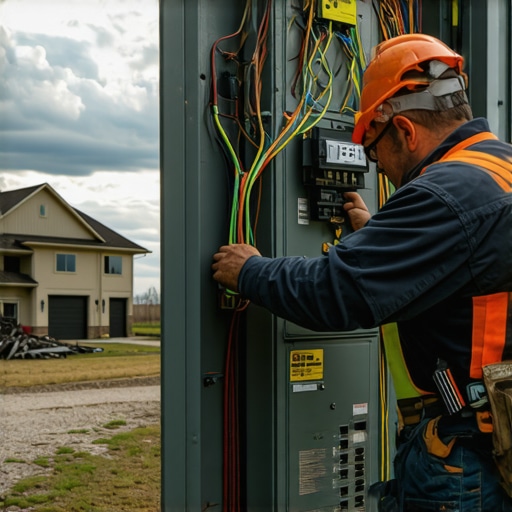
The Sound of a House Trying to Set Itself on Fire
If you wake up at 2 AM after a Category 2 storm and hear a sound like bacon frying coming from behind your laundry room wall, don’t reach for your phone to check the weather. Reach for the main disconnect. That sizzle is the sound of electricity leaping across a gap—an arc—and it is currently turning your copper wire into a plasma torch. I have spent 35 years in the mud and the dark, and let me tell you, electricity is the only thing that works harder than a debt collector, and it is far more unforgiving. Most homeowners think a storm only causes damage if a tree hits the roof. They are dead wrong. The real killers are the silent surges and the creeping corrosion that starts the second moisture hits a live bus bar. I remember walking into a ‘fully renovated’ basement in 2024 where the flipper had buried three live junction boxes behind a custom walnut shiplap wall. The sump pump had failed during a heavy rain, and the water climbed just high enough to reach those boxes. I found them with my tracer, but only after the owner complained of a ‘static’ feeling when they touched the drywall. The flipper had used the wrong wire nuts, and the capillary action of the floodwater had pulled moisture six feet up the inside of the Romex jacket. It was a ticking time bomb waiting for the first humid day of 2026 to blow. This is why forensic inspections matter.
“Aluminum wire connections can overheat and cause a fire without tripping the circuit breaker.” – CPSC Safety Alert 516
1. The Forensic Eye: Why Drone Thermography Scans are the New ‘Wiggy’
In the old days, I’d climb a ladder with a Wiggy or a tick tracer and hope I caught the hot spot before my hair stood up. In 2026, we don’t guess. After a major weather event, the thermal stress on your service mast and transformer installation can be invisible to the naked eye. This is where drone thermography scans come in. A transformer’s laminations can vibrate loose during wind-induced vibration, creating eddy currents that generate massive heat. We use high-resolution thermal imaging to spot the ‘purple glow’ of high resistance. If your service mast has been pulled even a quarter-inch by a falling limb, you’ve likely compromised the weather head. Water doesn’t just sit there; it follows the path of least resistance right into your panel. Once moisture hits the breaker’s pivot point, the internal mechanism corrodes, and the breaker jams. A jammed breaker is just a piece of plastic; it won’t trip when your sauna heater installation shorts out, and that’s how you lose a house. If you suspect damage, getting same day service appointments isn’t about convenience; it’s about life safety.
2. Hardening the Home: Energy Storage and Demand Response
We are seeing more grid instability than ever. If you are still relying on a single 200-amp service with no backup, you are living in the 1980s. Integrating energy storage systems is no longer a luxury for the eco-conscious; it is a critical buffer against the surges that follow storm-related grid switching. When the utility company re-energizes a line, you get a ‘voltage swell’ that can fry the control boards in your HVAC or your smart thermostat wiring. By using a battery buffer and demand response systems, you can isolate your home’s critical loads during the ‘dirty power’ phase of a restoration. This prevents the thermal shock that kills home automation setup components. I have seen more $500 smart switches killed by grid fluttering than by direct lightning strikes. You need a transformer installation that is sized for your actual peak load, especially if you have high-draw equipment in a workshop electrical setup. If your voltage drops below 114V under load, your motors are running hot, and heat is the slow-motion fire that ruins insulation.
“Arcing at loose connections can reach temperatures exceeding 10,000°F, which is hotter than the surface of the sun.” – NFPA 70E Safety Standards
3. The ‘Cold Creep’ Crisis in Coastal and Humid Zones
For those of you near the coast, the enemy isn’t just wind; it’s the salt. Salt is an electrolyte. It turns a tiny gap into a conductive bridge. We see this often in recessed lighting installation where salt-laden air pulls into the attic and settles on the thermal protectors. If you have older aluminum wiring or even copper that wasn’t torqued to spec, you deal with ‘Cold Creep.’ Metal expands when it’s hot (under load) and contracts when it’s cold. This mechanical movement slowly backs the screw out of the lug. A loose wire is a high-resistance wire. High resistance creates heat. Heat creates oxidation. Oxidation is an insulator, which forces the electricity to jump the gap—and now you have an arc. If you are planning a lighting installation, ensure your electrician is using a torque screwdriver, not just ‘wrist-tight.’ Code requires specific inch-pounds for a reason. I’ve seen main lugs so loose you could spin the nut with your pinky, all because of ten years of thermal cycling and one bad storm that vibrated the house.
4. Load Calculations and Post-Storm Upgrades
Before you go adding that new EV charger, you need to look at your service capacity. I see people trying to cram an EV charger troubleshooting session into a schedule because their breaker keeps tripping, only to find they have a 100-amp Zinsco panel that’s already at 95% capacity. If you’re ensuring safe EV charging station setup, you have to do a real-world load calc. Don’t let a handyman just ‘slap a 50-amp breaker in there.’ That is how you burn down a garage. A proper workshop electrical setup or a high-draw sauna requires a heavy-up—upgrading your service to 200 or 400 amps. During a storm repair, that is the best time to do it. You already have the permit pulled and the inspector coming out. Use the opportunity to move your panel to a location that isn’t prone to flooding and get rid of the ‘widow maker’ breakers that haven’t been tested since the Reagan administration. If your electrician doesn’t pull out a calculator and ask about your future plans for home automation setup, find a new one. You’re paying for expertise, not just someone to pull Romex through a hole.