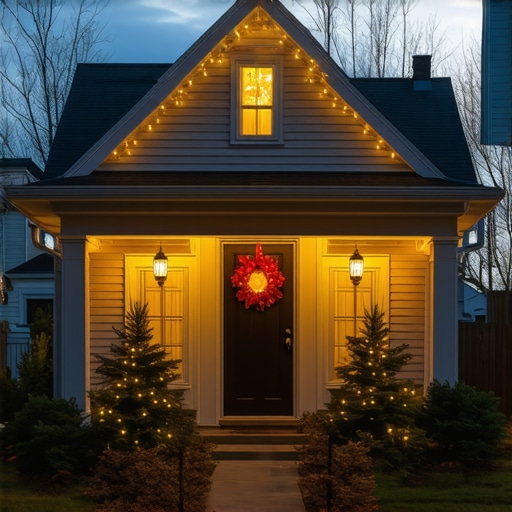
The Ghost of Electrical Disasters Past
If you are still dragging frayed orange extension cords across a slush-covered lawn or daisy-chaining power strips in a damp garage, you aren’t decorating for the holidays; you are conducting a high-stakes experiment in residential arson. I’ve spent over three decades in the trade, and I have seen the same story play out every December. It starts with a flickering LED strand and ends with me standing in a charred living room, performing a fire damage wiring restoration because someone thought a 15-amp circuit could handle 4,000 watts of festive cheer. My mentor, an old-timer who could smell a loose neutral from the curb, once slapped a utility knife out of my hand when he saw me stripping 12-2 Romex too aggressively. ‘You nick that copper, and you’ve just engineered a hot spot,’ he barked. He was right. That microscopic notch creates a bottleneck for electrons, leading to localized heating that eventually liquefies insulation. In the mid-century homes we often see in this region—those built between 1960 and 1980—this risk is multiplied by the presence of aluminum wiring and panels that are essentially ticking time bombs.
The Mid-Century Menace: Why Your Old Panel Can’t Handle 2026
The core of the problem isn’t the lights; it’s the infrastructure. Mid-century homes were designed for a world with one television and a toaster. They weren’t built for a 2026 lifestyle involving security camera wiring, EV chargers, and 365-day architectural lighting. If your home still sports a Federal Pacific Electric (FPE) or Zinsco panel, you are living with a safety hazard. These brands are notorious in the forensic community because their breakers often refuse to trip even when the bus bar is melting. This is known as ‘jamming,’ and it is the primary reason many insurance companies will flat-out deny coverage for homes with these relics. Upgrading your service isn’t an ‘upsell’—it is a survival strategy. An electrical panel upgrade ensures that when a short circuit occurs in your holiday display, the breaker actually does its job.
“Aluminum wire connections can overheat and cause a fire without tripping the circuit breaker.” – CPSC Safety Alert 516
This phenomenon, called ‘Cold Creep,’ happens because aluminum expands and contracts at a different rate than the steel or brass screws in your outlets. Over time, the connection loosens, oxygen gets in, an oxide layer forms—which is resistive—and suddenly you have a 2,000-degree arc in your wall.
Fix 1: The ‘Home Run’ Dedicated Circuit
The first permanent fix is ditching the extension cords for dedicated holiday circuits. In the industry, we call this a ‘Home Run’—a direct line of 12AWG copper from the breaker panel to a specific set of patio cover outlets or soffit boxes. By separating your lighting load from your interior outlets, you prevent the ‘vacuum cleaner blackout’—that annoying moment when someone turns on a space heater or vacuum and kills the entire outdoor display. For 2026, we recommend these be 20-amp circuits protected by GFCI and AFCI breakers. This isn’t just about convenience; it’s about mitigating the risk of arcing in the attic during the rough-in phase. When we handle lighting installations made easy, we focus on placing these outlets where they are invisible but accessible, often tucked behind the fascia board.
Fix 2: Professional Soffit Outlets and Weatherproofing
Stop climbing ladders every November. A permanent fix involves installing weather-resistant (WR) outlets directly into your soffits. These should be controlled by a smart timer or a dedicated switch inside the house. When we perform a trim-out, we ensure every box is sealed with ‘monkey shit’ (duct seal) to prevent moisture from migrating into the wall cavity. Moisture is the silent killer of outdoor electrical systems. It facilitates ‘tracking,’ where current leaks across a dirty or damp surface, eventually carbonizing the material and creating a path for a full-scale arc. If you are struggling with existing setups, you can find help through our troubleshooting for lighting installations guide.
Fix 3: Integrating Architectural Lighting with Security
In 2026, holiday lighting isn’t a standalone project; it’s part of a whole-home exterior strategy. We are seeing a massive shift toward permanent RGBW architectural lighting that stays up year-round but changes color for the seasons. This system often piggybacks on the same infrastructure used for security camera wiring. By running a unified low-voltage or PoE (Power over Ethernet) network alongside your 120V lines, you can control your home’s ‘vibe’ and its safety from a single app. This is far superior to the temporary power services used by fly-by-night installers who leave a mess of zip ties and exposed wire that will inevitably degrade under UV exposure.
Fix 4: Underground Wiring and Sign Lighting
For those who go big with lawn displays or even commercial-grade sign lighting installation, the only safe way to move power is through underground wiring services. This involves trenching and laying Schedule 40 PVC conduit. Don’t be the guy who buries ‘direct burial’ Romex six inches deep and forgets about it until a shovel blade finds it. That is a ‘Widow Maker’ waiting to happen. True bonded insured electrical work requires conduit buried at least 18 inches deep (or 24 inches for non-GFCI protected lines) to meet NEC standards.
“All 15- and 20-ampere, 125-volt receptacles installed in damp or wet locations shall have an enclosure that is weatherproof whether or not the attachment plug cap is inserted.” – NEC Section 406.9
Fix 5: The Portable Generator Hookup (Manual Transfer Switch)
Winter storms and holiday lights go hand-in-hand, and nothing ruins a party like a blackout. A portable generator hookup is the final piece of the 2026 puzzle. By installing a manual transfer switch and an inlet box, you can safely power your home’s critical circuits—including your lighting and heating—without the dangerous practice of ‘backfeeding’ through a dryer outlet. Backfeeding can energize the utility lines outside your home, potentially killing a lineworker who thinks the wires are dead. It’s illegal, it’s stupid, and it’s a fast way to lose your homeowner’s insurance. If you need a professional to look at your setup, it is time to contact us for a real inspection before the first frost hits.
Conclusion: Sleep Better with a Torqued System
Electricity is not a hobby. It is a physical force that is constantly looking for a path to ground, and your body or your house is a perfectly acceptable path. Whether you are upgrading for EV charging station setup or just want the best house on the block in December, the difference between a ‘handyman special’ and a master electrician’s work is found in the details: the torque on the lugs, the depth of the conduit, and the quality of the breakers. Don’t gamble with 1970s technology in a 2026 world. Get it done right, get it bonded, and keep the ‘fireworks’ limited to the sky.