
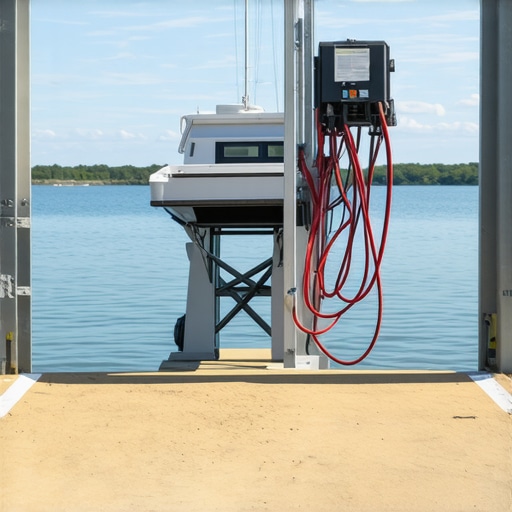
The Tingle in the Water: A Forensic Dissection of Dockside Electrocution
I remember a call-out to a canal-front property where the owner complained of a ‘funny feeling’ every time he touched his stainless steel cleats. I didn’t need my Wiggy to know I was walking into a disaster. I pulled out my tick tracer, and the damn thing started screaming three feet before I even stepped onto the gangway. Some ‘handyman’ flipper had tried to save a few bucks by burying standard indoor Romex in a shallow trench leading to the dock. He didn’t use monkey shit to seal the entries, and he definitely didn’t understand the concept of a home run. The insulation had turned to mush in the brackish muck, and the ground wire had simply dissolved into green powder. I found the fault with my tracer—a live junction box buried directly behind a rotted piling. It wasn’t a circuit; it was an electric chair waiting for someone to jump in the water. This is the reality of marine electrical work: it’s not about convenience; it’s about preventing a coroner’s report.
“Ground-fault circuit-interrupter protection for personnel shall be provided for cables and receptacles on piers, wharves, and docking facilities.” – NEC Section 555.19(B)(1)
The Anatomy of Failure: Why Standard Wiring Kills at the Waterline
When you’re dealing with a boat lift, you aren’t just fighting gravity; you’re fighting the very physics of electrolytic corrosion. Most people think a 60 amp panel upgrade is just for adding a hot tub, but out on the dock, that power has to travel. If your load center upgrades didn’t account for the distance from the main service, you’re dealing with massive voltage drop. This isn’t just a performance issue; it’s a heat issue. As voltage drops, amperage rises to compensate, turning your wires into heating elements. In a coastal environment, salt air acts as a conductive bridge. It creeps into the strands of copper, causing oxidation layers that increase resistance. This resistance creates heat, which expands the terminal, which then cools and contracts—a process called Cold Creep. Eventually, that connection becomes loose, starts arcing, and if you’re lucky, it just melts the motor. If you’re unlucky, it energizes the lift frame and every drop of water around it.
Component Zooming: The Physics of the Marine Environment
Let’s talk about the 400 amp service entrance. Many modern homes are pushing the limits of their original 1970s infrastructure. When you add a heavy-duty boat lift motor to a system already strained by lighting installations and multiple AC units, you’re asking for a phase imbalance. We often see homeowners try to bridge the gap with temporary power services that are never meant to be permanent. A proper boat lift install requires more than just a breaker. You need underground wiring services that utilize Schedule 40 or 80 PVC, with every joint solvent-welded to prevent moisture ingress. But even PVC breathes. That’s where the wire choice becomes critical. You cannot use THHN; you need THWN-2. The ‘W’ stands for water-resistant, and in my book, it stands for ‘Will not kill you today.’ We also integrate whole house surge protection because a single lightning strike near the water will follow that dock line straight back into your expensive kitchen appliances.
“The risk of electric shock is significantly increased in wet locations, requiring specialized equipment and bonding techniques to ensure safety.” – CPSC Safety Bulletin on Marine Power
The Forensic Breakdown: The Grounding vs. Bonding Myth
The biggest mistake I see in my forensic inspections is the confusion between grounding and bonding. People think sticking a rod in the mud solves the problem. It doesn’t. Bonding is what saves lives. Every metal component of that boat lift—the tracks, the motor housing, the pile caps—must be bonded together into a single equipotential plane. This ensures that if a fault occurs, there is zero potential difference between any two surfaces. If you touch the lift and the water simultaneously and they aren’t bonded, you become the path of least resistance. This is why NEC code updates are so aggressive regarding marine docks. We often perform a warehouse lighting retrofit logic on docks, using high-efficiency LEDs and specialized track lighting services that are rated for NEMA 4X environments. This isn’t just for aesthetics; it’s about using enclosures that won’t rot out in six months of salt spray.
The Fix: Proper Infrastructure and Emergency Readiness
If you suspect your dock is hot, do not wait. This is a 24 hour emergency electrician situation. The first thing we do is a ‘leakage test’ using a specialized clamp meter. If we see even 30mA of current leaking into the water, we shut the whole system down. Often, the solution involves a complete load center upgrade. We move the protection closer to the point of use. If your lift is 200 feet from the house, you need a sub-panel at the bulkhead. This allows us to use GFCI protection that actually trips when it’s supposed to, rather than being desensitized by the capacitance of a long wire run. Whether you are planning a new installation or troubleshooting an old flicker, the rules of physics do not negotiate. Use dikes to clean up those messy terminations, ensure your rough-in is deep enough to avoid the lawnmower, and never, ever trust a ‘handyman’ with a dock circuit. You can contact us to verify your system is torqued to spec. Because in the world of marine electricity, there are no participation trophies—only survivors and statistics.
Comments
One response to “The Safe Way to Wire a Boat Lift Without Creating a Shock Hazard”
This post hits home for anyone who’s ever tackled marine wiring projects. I appreciate the detailed explanation of bonding versus grounding because, honestly, I used to think they were interchangeable until I read this. The part about electrolytic corrosion and Cold Creep is a real eye-opener; salt air and moisture are relentless enemies to electrical integrity. In my experience, investing in proper underground wiring, especially using THWN-2, is worth every penny—even if it costs more upfront—because it significantly reduces future issues and safety risks. I’ve seen too many DIY attempts that overlook the importance of continuous bonding and proper enclosure ratings, leading to disastrous results down the line. Has anyone here found a particularly effective way to ensure long-term bonding integrity in saltwater environments? I’d be curious to hear approaches that have worked well over years of exposure.