
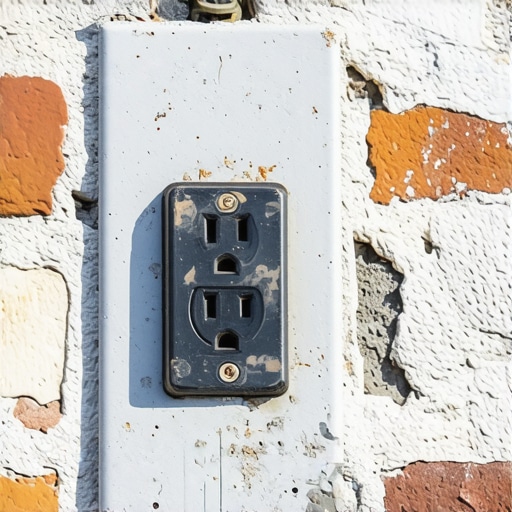
The Anatomy of a Short: Why Your Outdoor Outlet is a Sleeping Dragon
You smell it before you see it. That pungent, metallic tang of ozone followed by the sickly-sweet scent of melting PVC. I’ve spent thirty-five years chasing those smells through crawlspaces and behind cedar siding. When an outdoor receptacle fails, it’s rarely a quiet affair. It’s usually a frantic 2:00 AM call because the landscape lights are flickering like a horror movie or the garage freezer quit and $400 worth of ribeye is turning into a biohazard. Most homeowners—and frankly, too many ‘trunk-slammers’ posing as electricians—treat outdoor power as an afterthought. They slap a standard $2 outlet in a plastic box and walk away. But physics doesn’t care about your budget. Outside, the environment is actively trying to turn your electrical system back into raw ore through oxidation, UV degradation, and thermal cycling.
The Old Timer’s Lesson: The Sin of the Nicked Conductor
My journeyman, a man who could bend 1-inch EMT with his bare hands and a scowl, used to catch me prepping wires during the rough-in. One afternoon, he saw me using a pocket knife to strip the insulation off a piece of Romex. He didn’t just correct me; he slapped my hand so hard I thought I’d broken a finger. ‘You nick that copper, kid, and you’ve just built a heater,’ he’d scream. He was right. That tiny score mark in the copper creates a localized point of high resistance. As current flows, that spot gets hotter than the rest of the wire. Under the constant expansion and contraction of outdoor temperature swings, that nick becomes a fracture, the fracture becomes an arc, and the arc becomes a structural fire. That lesson stuck. In the forensic world, we call that a ‘stress riser,’ and it’s the smoking gun in more house fires than I care to count.
The Forensic Breakdown: Why Standard Outlets Die in the Rain
When I’m called out to inspect a failed outdoor circuit, I start with my Wiggy and a Tick Tracer. Usually, the failure isn’t the breaker; it’s the forensic reality of ‘Carbon Tracking.’ Standard receptacles use nylon or cheap plastic faces that aren’t UV-stabilized. Over five years in the sun, that plastic becomes porous. Rainwater, mixed with atmospheric pollutants, seeps into those pores. This creates a conductive path—a bridge of filth—between the hot and neutral terminals. Eventually, the voltage ‘tracks’ across this path. It starts as a micro-arc, barely enough to warm the device, but it eventually carves a permanent carbon path into the plastic. Once that path is established, the resistance drops, the heat spikes, and the device goes into thermal runaway. This is why the National Electrical Code (NEC) stepped in with the Weather-Resistant (WR) requirement.
“All 15- and 20-ampere, 125- and 250-volt nonlocking-type receptacles located in damp or wet locations shall be listed and identified as weather-resistant type.” – NEC 406.9(A)
A WR-rated receptacle isn’t just a marketing gimmick. It’s engineered with nickel-plated mounting straps and internal brass components to resist the galvanic reaction that occurs when dissimilar metals meet moisture. The plastic housing is made from high-impact, UV-stabilized polycarbonate that won’t crack when the temperature hits ten below zero or turn brittle under the July sun. If you’re installing anything else outside, you’re just installing a future service call.
Component Zooming: The Physics of the GFCI Toroid
Let’s zoom into the guts of the Ground Fault Circuit Interrupter (GFCI). Most people think a GFCI works like a breaker, tripping on overcurrent. It doesn’t. A GFCI is a mathematical watchdog. Inside is a differential transformer—a tiny ferrite toroid. The hot and neutral wires both pass through this ring. According to Kirchhoff’s Law, the current going out on the hot should exactly match the current returning on the neutral. If there’s a difference as small as 4 to 6 milliamperes—the equivalent of a leaky faucet’s worth of electrons—it means electricity is finding an alternative path to ground. That path could be the damp concrete you’re standing on or the metal ladder you’re holding. The sense coil detects the magnetic imbalance, triggers a solenoid, and snaps the contacts open in less than 1/40th of a second. This is why how electricians tackle troubleshooting for lighting installations often starts with checking the integrity of these sensitive devices.
The ‘In-Use’ Cover: Why Your Old Flip-Lids Are Illegal
For decades, we used those horizontal metal flip-lids. They were great—as long as nothing was plugged in. The moment you plugged in a holiday light string or a power tool, the lid stayed open, inviting rain to run straight down the cord and into the energized slots. The NEC updated Section 406.9(B)(1) to mandate ‘Extra-Duty’ covers, often called ‘In-Use’ or bubble covers. These allow the cord to remain plugged in while the protective housing stays sealed. If I walk onto a property and see the old-style metal flaps on a deck, I know the owner is one thunderstorm away from a tripped ‘Home Run’ and a dead circuit. These covers must be rated ‘extra-duty’ to withstand the physical abuse of being bumped by lawnmowers or kicked by boots. When you’re ensuring safe and efficient EV charging station setup at home, this protection is even more critical, as those high-amperage draws generate significant heat that moisture can turn into a catastrophe.
The 250-Volt Expansion: The New Frontier of Safety
The 2020 and 2023 NEC updates didn’t just stop at your standard 120V outlets. They expanded GFCI requirements to 250V receptacles. This hit the industry like a sledgehammer. Now, your outdoor AC disconnect, your pool pump, and your outdoor EV charger connections often require GFCI protection. Why? Because a 240V shock will stop your heart just as fast as 120V, and the equipment is just as susceptible to the ‘creeping green’ corrosion of copper wires. When we do a ‘Rough-in’ for a modern home, we’re no longer just pulling a single circuit; we’re managing structured wiring panels and industrial motor controls for HVAC systems that all demand this level of forensic-grade safety.
“GFCI protection shall be provided for all 125-volt through 250-volt receptacles supplied by single-phase branch circuits rated 150 volts or less to ground installed in outdoors, kitchens, and basements.” – NFPA 70 (NEC) 210.8(A)
The Infrastructure Trap: Aluminum Wiring and Old Boxes
If your home was built between 1965 and 1975, you might be dealing with the ‘Time Bomb’ of aluminum wiring. Aluminum has a high coefficient of thermal expansion. It moves. Every time you plug in a heavy load, the wire heats up, expands, and pushes against the screw terminal. When it cools, it contracts, but it doesn’t always return to its original seat. This is ‘Cold Creep.’ Over time, the connection becomes loose. A loose connection is a high-resistance connection. In an outdoor environment, this is compounded by oxidation. Aluminum oxide is an insulator, not a conductor. If you have aluminum wiring and you’re trying to update your outdoor receptacles, you can’t just screw them on. You need AlumiConn connectors and a specialized torque screwdriver. This isn’t a suggestion; it’s a requirement to keep the ‘Monkey Shit’ (duct seal) from being the only thing holding your box together.
The Final Torque: Electricity is Not a Hobby
I’ve seen ‘Handyman Specials’ where someone used a ‘bootleg ground’—jumpering the neutral to the ground screw because the old house didn’t have a dedicated ground wire. In an outdoor setting, that’s a death sentence. If the neutral wire breaks upstream, every metal part of that tool you’re holding becomes energized at 120V. My job as a forensic inspector is to find these ‘Widow Makers’ before they find you. Whether you are dealing with a top EV charger maintenance routine or just replacing a back-porch outlet, remember that code isn’t a list of ‘nice-to-haves.’ It’s a document written in the blood of people who thought they knew better. Torque your terminals to the manufacturer’s specs—usually about 12 to 14 inch-pounds—and use the right WR-rated gear. You’ll sleep better knowing your house isn’t trying to burn itself down while you dream.