
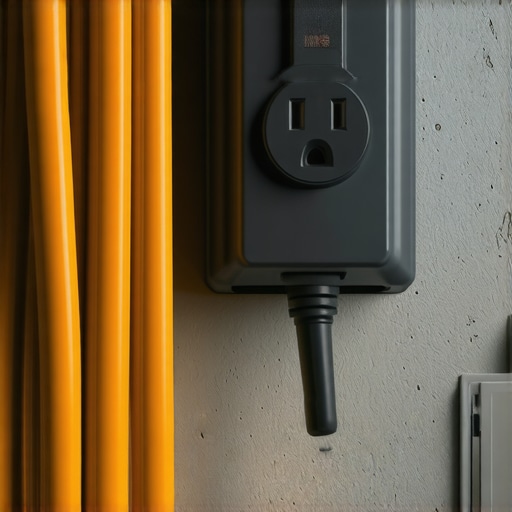
The Garage: A High-Voltage Death Trap in Disguise
Your garage is not just a place to park your car or store half-finished DIY projects; it is, from a forensic electrical perspective, one of the most hazardous environments in your home. For thirty-five years, I’ve walked into garages where the smell of ozone was thick enough to chew on, and most homeowners didn’t even realize they were one damp foot away from a lethal encounter with 120 volts. The National Electrical Code (NEC) doesn’t update its rules every three years because the members are bored; they do it because the bodies have been counted, and the science of electrocution has evolved. We’re talking about the convergence of concrete floors—which are essentially giant grounding pads—and high-torque machinery, creating a perfect storm for ground faults.
My journeyman back in the late 80s used to have a nasty habit of checking for ‘phantom’ voltage with his bare knuckles. One afternoon, we were looking at an old 60 amp panel in a damp garage. He reached out to tap the casing and his whole arm locked. I had to tackle him off the ladder. He stood up, rubbed his shoulder, and said, ‘The minute you treat a garage panel with anything less than fear, you’re already dead.’ He was right. That panel had a ‘bootleg ground’ where some previous owner had tied the neutral to the ground screw to fool a three-prong tester. In a garage, that’s a death sentence. This is why a 60 amp panel upgrade isn’t just about more power; it’s about modernizing the safety architecture of your home.
“GFCI protection shall be provided for all 125-volt, single-phase, 15- and 20-ampere receptacles installed in garages and service buildings.” – NEC Section 210.8(A)(2)
The Physics of Failure: Cold Creep and Aluminum Nightmares
If your home was built between 1965 and the late 70s, you’re likely sitting on a mid-century time bomb: aluminum wiring. Unlike copper, aluminum is a fickle metal. It suffers from a phenomenon we call ‘Cold Creep.’ When electricity flows through a wire, it heats up and expands. When it stops, it cools and contracts. Aluminum expands at a significantly higher rate than copper. Over years of powering your garage fridge or shop vac, those wires literally ‘creep’ out from under the terminal screws of your outlets and breakers. This creates a gap. That gap creates resistance. Resistance creates heat. And heat creates fire. This is why aluminum wiring repair is the single most important safety investment for homes of this era. We don’t just tighten screws; we use AlumiConn connectors or COPALUM crimps to create a gas-tight seal that prevents oxidation.
Oxidation is the silent killer here. When aluminum is exposed to air, it forms an aluminum oxide layer. Unlike copper oxide, which is still somewhat conductive, aluminum oxide is an insulator. This means the connection gets even hotter as the electricity fights to push through that crusty layer. I’ve pulled out outlets in garages that looked fine from the front, but the back was a melted puddle of plastic and charred Romex. When we perform warranty backed repairs, we aren’t just slapping a band-aid on it; we are correcting the metallurgical failure points that the original installers didn’t understand. [image_placeholder_1]
Panel Shaming: The Federal Pacific and Zinsco Legacy
In the trade, we call Federal Pacific Electric (FPE) and Zinsco panels ‘widow makers.’ If you see one of these in your garage, stop reading this and contact us immediately. These panels are the lead actors in many forensic fire investigations. The FPE ‘Stab-Lok’ breakers have a documented failure rate where they simply refuse to trip. You could have a dead short in your garage—maybe your saw blade hit a nail—and instead of the breaker snapping off, it stays closed. The wire becomes a heating element inside your wall until the house burns down. Zinsco panels have a different flaw: the bus bars are made of an alloy that corrodes and pits, causing the breakers to literally weld themselves to the panel. You can’t turn them off even if you wanted to.
Modern NEC updates have virtually outlawed these designs in favor of Arc-Fault Circuit Interrupters (AFCI) and specialized Ground-Fault Circuit Interrupters (GFCI). While a standard breaker protects the wire from melting, a GFCI protects *you*. It monitors the balance of current between the hot and neutral wires. If it senses as little as 5 milliamps leaking out—perhaps through your body into the concrete garage floor—it snaps the circuit in less than a twentieth of a second. This is critical for camper electrical panel setups or when you’re doing a solar panel electrical hookup in a garage environment. The presence of moisture makes the garage a high-risk zone for these imbalances.
Modern Loads: EVs, Data Centers, and the 60 Amp Limit
We are asking our 1970s garages to do things they were never designed for. I’ve seen people try to run a data center power setup for crypto mining alongside a Level 2 charger in a garage with 12-gauge Romex that’s forty years old. It’s madness. When you add a modern load, you need to understand ensuring-safe-and-efficient-ev-charging-station-setup-at-home. A 60-amp service was fine when the garage had one lightbulb and an outlet for a corded drill. Today, between up lighting services, sign lighting installation, and access control wiring, the demand is astronomical. This is where we see the most thermal damage—at the ‘Home Run’ where all the circuits converge at the panel.
“Aluminum wire connections can overheat and cause a fire without tripping the circuit breaker.” – CPSC Safety Alert 516
When I do a virtual consultation wiring review, the first thing I look for is the ‘monkey shit’ (duct seal) at the service entrance. If your conduit isn’t sealed, moist air from the garage is being sucked into the panel, accelerating corrosion on the bus bars. We also check the grounding electrode system. Most old garages rely on a single rusted water pipe. Modern Code requires at least two 8-foot ground rods driven into the earth. Without a solid path to ground, your surge protectors are just expensive plastic boxes and your chassis-grounded tools are potential electrified handles. Whether we are doing a rough-in for a new workshop or a trim-out for a renovation, we follow the current NEC to ensure that your garage is a workspace, not a liability. If you’re experiencing flickering or smell something fishy, you need to know how-electricians-tackle-troubleshooting-for-lighting-installations and panel issues before the ‘Tick tracer’ starts screaming in a dead-front cabinet. Electricity isn’t a hobby—it’s a force of nature that we’ve managed to put inside our walls. Respect it, or it will bite back.