
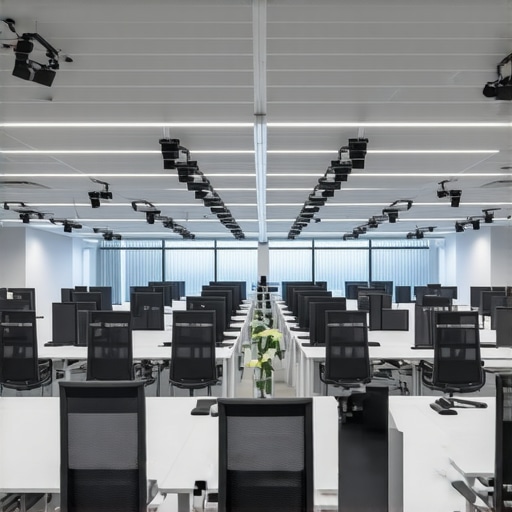
The Truth About Your Workspace Lighting: It’s Not Just About Aesthetics, It’s About Amps
Most designers talk about ‘mood’ and ‘flow’ when they design a flexible workspace. I talk about resistance, thermal expansion, and the smell of melting PVC. You see a sleek mobile track lighting system; I see a series of mechanical connections that, if not torqued to spec, turn into tiny space heaters inside your ceiling. When you start moving light heads around to accommodate a new desk layout, you aren’t just changing the ‘vibe’—you are stressing the mechanical integrity of the copper bus bars inside that track. As a forensic inspector, I’ve spent decades using my Tick Tracer to find where the magic smoke escaped, and more often than not, it’s because someone thought electricity was a ‘plug and play’ hobby.
The Flipper Special: A Cautionary Tale of Hidden Junctions
I once walked into a ‘fully renovated’ commercial office in an old textile mill. The client complained that their new mobile track lighting was flickering whenever the printer kicked in. I pulled out my Wiggy to check the voltage drop and found the levels swinging like a pendulum. After tearing a hole in the pristine drywall, I found what I call the ‘Flipper Special’: the previous contractor had buried three live junction boxes behind the backsplash of the breakroom, all fed by a single Romex run that was pinched between a 2×4 and a steel beam. They had tapped the entire track lighting system into a circuit already screaming under the load of a commercial refrigerator. The wire nuts were distorted from heat, and the copper was beginning to show that tell-tale iridescent blue of a system on the verge of catastrophic failure. This is why commercial electrical services aren’t just a luxury; they are the difference between a productive Monday and an insurance claim.
The Physics of the Track: Why ‘Flexible’ Often Means ‘Frustrating’
Track lighting is essentially a continuous open bus bar system. Unlike a standard receptacle where the connection is fixed, a track head relies on spring-tensioned contacts to bite into the copper rails. Every time you slide those heads, you’re creating micro-abrasions on the conductor. Over time, these abrasions oxidize. In my 35 years, I’ve seen ‘mobile’ systems that haven’t been moved in five years seize up because of galvanic reaction between dissimilar metals in the track head and the rail. When the contact is poor, resistance goes up. According to Ohm’s Law, when resistance increases in a fixed-voltage system, heat is the inevitable byproduct. This isn’t a theory; it’s a fire code violation waiting to happen.
“Aluminum wire connections can overheat and cause a fire without tripping the circuit breaker.” – CPSC Safety Alert 516
While most modern tracks use copper, many older office buildings still have aluminum home run feeds. If you’re trying to integrate new track lighting into an old mid-century panel, you’re dealing with the nightmare of Cold Creep. Aluminum expands and contracts at a different rate than the steel lugs in your breaker panel. Every time you flip the switch, the wire ‘walks’ out from under the screw. Eventually, the connection becomes loose, an arc starts, and your ‘flexible workspace’ becomes a kiln. This is why I tell people that lighting installations made easy only happens when the underlying infrastructure is actually up to the task.
The Load Calculation: Blueprint for a High-Output Office
Most people think a 20-amp breaker means they have 20 amps to play with. Wrong. The National Electrical Code (NEC) dictates that for a continuous load—anything running for three hours or more, like your office lights—you have to derate that circuit by 125%. That 20-amp breaker is now a 16-amp breaker in reality. If you’re planning a large-scale track system and you’re also thinking about hot tub wiring services or a shed wiring install on the same property, you need to look at your total service capacity. I’ve seen 100-amp panels that were so crowded they looked like a bowl of black spaghetti, yet the owner wanted to add an electric gate opener and a full pathway lighting install on the same weekend. You can’t cheat the math.
Component Zooming: The Anatomy of a Failure
Let’s look at the track itself. A high-quality track is extruded aluminum with a thick PVC or polycarbonate insulator. Inside are two or three solid copper bus bars. The failure point is almost always the ‘End Feed’ or ‘Live End.’ This is where the building’s building wire connects to the track’s internal conductors. If the installer didn’t use a rough-in box properly or if they failed to use a strain relief, the weight of the track starts to pull on those connections. I’ve performed autopsies on melted end-caps where the installer used dikes to snip the wire too short, leaving no room for thermal expansion. The resulting arc-fault didn’t trip the breaker because the current didn’t exceed the 20-amp threshold, but it generated enough localized heat (over 1,100 degrees Fahrenheit) to liquefy the plastic housing.
“The grounded conductor shall be connected to the screw shell of a lampholder.” – NEC Section 200.10(C)
If you get the polarity swapped on a track system, the entire outer casing of the track heads could become energized. Touch a metal desk and a track head at the same time, and you become the path to ground. This is why weekend electrician services from a guy with a ladder and a pair of pliers are a bad idea. You need someone who stays current on NEC code updates to ensure your ‘flexible’ office isn’t a giant widow maker.
Expanding the Infrastructure: Beyond the Desk
Often, a workspace redesign is just the beginning. I frequently see clients who start with lighting and move to underground wiring services for a detached home office or even dock electrical services for a waterfront ‘zoom room.’ Each of these environments introduces new enemies. In a shed or dock, you’re fighting moisture and Monkey Shit (that’s duct seal to you civilians) becomes your best friend. You need to seal every conduit to prevent the chimney effect, where warm moist air is sucked into your cold electrical panels, condensing on the bus bars and causing ‘green death’—the copper carbonate corrosion that eats your system from the inside out.
Whether you are dealing with temporary power services during a renovation or a permanent commercial electrical services upgrade, the rules of physics don’t change. You need to ensure your home run is sized for the voltage drop, especially if that track lighting is at the end of a 100-foot run. If you’re also looking into ensuring safe and efficient EV charging station setup at home, your total load calculation becomes critical. Don’t assume your panel can handle it just because there’s an open slot for a breaker.
Final Inspection: Don’t Trade Safety for Flexibility
Flexibility in a workspace is a great goal, but it shouldn’t come at the cost of your peace of mind. Before you buy that designer track system, look at your panel. If you see a Federal Pacific or a Zinsco logo, stop right there. Those panels are notorious for ‘jamming’—the breakers won’t trip even when the wire is melting. I’ve seen them glow red without ever cutting power. Upgrading your panel is the only way to sleep at night. If you’re experiencing issues, check out how electricians tackle troubleshooting for lighting installations to see the level of rigor required. When you’re ready to do it right, contact us and get a pro who knows the difference between a tight connection and a fire hazard. Electricity isn’t a hobby—it’s an invisible force that’s always looking for a way out. My job is to make sure it stays in the wires where it belongs.