
The Attic Ghost: Why Your Bathroom Fan is a Silent Threat
I’ve spent thirty-five years dragging my tool belt through the claustrophobic, dust-choked lungs of Victorian homes and mid-century ramblers. When a homeowner calls me because their bathroom fan is ‘acting funny’ or they smell a faint, metallic tang in the air, I already know what I’m going to find before I even pull my Tick Tracer out. Usually, it’s a ‘Handyman Special’ where some guy with a ladder and a lot of confidence decided to vent a 100-CFM fan directly into the attic insulation instead of through the roof. This isn’t just a moisture problem; it’s an electrical catastrophe waiting to happen. In these older structures, you’re often dealing with cloth insulated wiring replacement needs that have been ignored for decades. When you pump gallons of hot, humid shower steam directly onto brittle, 1940s-era cotton-and-rubber insulation, you aren’t just inviting mold—you’re hydrating a fire.
“Aluminum wire connections can overheat and cause a fire without tripping the circuit breaker.” – CPSC Safety Alert 516
My old journeyman used to smack my hand if I stripped a wire with a knife. ‘You nick the copper, you create a hot spot,’ he’d scream. He was right. That lesson applies to every inch of a bathroom install. If you don’t respect the physics of resistance and the chemistry of corrosion, the house wins and you lose. Venting through the roof is the only code-compliant way to ensure that moisture leaves the building envelope, protecting both the structural integrity and the OSHA compliance wiring we work so hard to maintain.
The Forensic Breakdown: Moisture, Electrolysis, and Arcing
Let’s talk about Cold Creep and thermal expansion. When you have a bathroom fan that isn’t vented properly, the attic space reaches a dew point that turns your electrical boxes into petri dishes for oxidation. Most people don’t realize that electrical terminals are sensitive to atmospheric changes. A loose neutral wire in a junction box, when exposed to high humidity, begins to develop a layer of oxide. This oxide is resistive. Resistance generates heat. Heat causes the metal to expand. When the fan turns off and things cool down, the metal contracts. Over hundreds of shower cycles, this ‘breathing’ of the metal loosens the screw further. Eventually, you get a micro-gap where electricity jumps—an arc. That arc is hotter than the surface of the sun. If that box is buried under blown-in cellulose insulation and vented with steam, you’ve just built a kiln.
When we do a rough-in for a new bathroom, we aren’t just thinking about the light switch. We’re looking at the home run back to the panel. Is the circuit shared with an attic fan installation? If so, are we exceeding the 80% load rule? Most DIYers don’t know how to use a Wiggy to check for phantom voltage, and they certainly don’t consider the voltage drop when they start daisy-chaining patio cover outlets and bathroom fans onto the same 15-amp breaker. This is why annual maintenance contracts are vital; a pro can spot the discolored plastic of a terminal before it turns into a 911 call.
Step 1: The Roof Penetration and the ‘Monkey Shit’ Seal
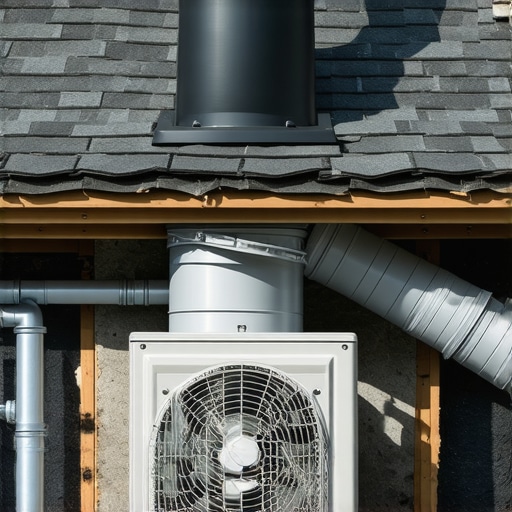
Properly venting through the roof requires a dedicated roof jack. You don’t just shove a hose through a hole. You need to cut a 4-inch orifice through the roof deck, install a flanged vent cap, and use high-grade roofing cement—what we call Monkey Shit in the trade—to seal the flashing. From an electrician’s perspective, the ducting must be insulated. If you use uninsulated flex-duct, the steam condenses inside the pipe and runs straight back down into the fan motor. Now you have water sitting on a 120V motor housing. This leads to winding failure and, in many cases, a grounded condition that your old, non-GFCI breakers won’t even notice until the motor starts smoking.
Step 2: Electrical Integration and GFCI Requirements
Every bathroom fan today should be protected by a GFCI outlet installation or a GFCI breaker. If you’re installing a fan over a tub or shower, it’s not a suggestion—it’s the law. I’ve seen too many ‘Widow Makers’ where a fan was tapped into an old ungrounded circuit. If you are living in a home built before 1950, you are likely dealing with a cloth insulated wiring replacement scenario. This wiring doesn’t have an equipment grounding conductor. You cannot safely install modern electronics on these circuits without a proper retrofit. This is also a good time to look at your overall service. If you’re adding fans, EV charger stations, and modern appliances, your 100-amp Zinsco or Federal Pacific panel is a ticking time bomb. I always tell clients that ensuring safe and efficient EV charging station setup at home starts with the same fundamental principle as a bathroom fan: a robust, grounded, and calculated electrical load.
“Where a bathroom motor is installed over a bathtub or shower, it shall be protected by a Ground-Fault Circuit-Interrupter (GFCI).” – NEC Article 410.10(D)
Step 3: The Trim-Out and Testing
During the trim-out, we ensure the fan housing is tight against the drywall. Any gaps will allow conditioned air to escape into the attic, causing the fan to work twice as hard. We use dikes to cleanly snip our wires, ensuring no stray strands are hanging out of the wire nut to cause a short. If the homeowner is interested in safety, we also discuss fire alarm system install options that include heat sensors in the attic. This is critical because a fire in an attic can rage for twenty minutes before a standard smoke detector in the hallway even ‘wakes up.’ We also look at battery backup wiring for emergency egress lighting, especially in larger homes where a bathroom short could plunge the entire floor into darkness.
The Hidden Dangers of the ‘Handyman’ Approach
I recently did a forensic inspection where the homeowner had hired a ‘jack-of-all-trades’ to install a fan. The guy had used underground wiring services techniques—basically UF cable—inside an attic, which is a code violation because of the heat dissipation ratings. He’d also failed to support the ductwork, so it sagged, filled with three gallons of water, and eventually collapsed, ripping the Romex out of the junction box. The resulting arc charred the rafters. If they hadn’t smelled the ‘fishy’ scent of burning plastic, that house would be a hole in the ground. When you’re dealing with troubleshooting for lighting installations or fans, you have to look beyond the surface. Is the wire rated for the ambient temperature of an attic? Is the mechanical venting creating a back-pressure that’s overheating the motor?
Final Thoughts: Sleep Better with Code-Compliance
Electricity is a lazy, invisible beast that wants to find the shortest path to the ground, and it doesn’t care if that path is through your bathroom ceiling or your chest. Properly venting a fan through the roof is about more than just steam—it’s about preserving the dry environment that your electrical system requires to function safely. Whether you are adding patio cover outlets for the summer or upgrading your fire alarm system install, do not cut corners on the ‘invisible’ work. If you’re having issues with your current setup, checking out expert tips to fix common issues can help you understand the complexity of modern electrical demands. Don’t be the guy whose house becomes a case study in my next forensic report. Get it torqued, get it vented, and get it inspected.