
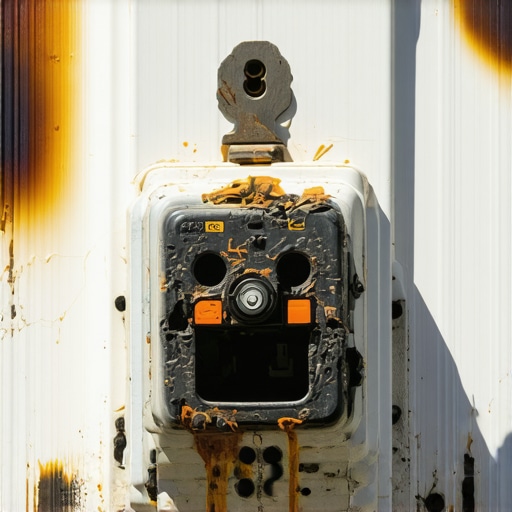
The Scent of Impending Doom: A Forensic Autopsy of Your Electrical Service
You probably won’t see the fire coming. You’ll smell it first—that cloying, synthetic stench of ozone mixed with scorched Bakelite. It’s a scent that every Master Electrician knows in their marrow. It means a connection is losing its battle with physics. I walked into a ‘fully renovated’ kitchen last year where the flipper had buried live junction boxes behind a designer marble backsplash. I found them with my tracer, hidden like landmines. The homeowner thought they were safe because the cabinets were new, but the meter socket outside was literally dripping molten plastic down the side of the house. This is the reality of many mid-century homes: beautiful interiors powered by a rotting, 50-year-old heart.
The Metallurgy of Disaster: Why Meter Jaws Fail
To understand why your meter socket is melting, we have to look at ‘Component Zooming.’ We aren’t just talking about a box on a wall; we are talking about the interface between the utility company’s massive conductors and your home’s internal bus bars. In most homes built between 1960 and 1980, these components are often aluminum. Aluminum is a fine conductor, but it has a nasty habit called ‘Cold Creep.’ Under pressure and thermal cycling, the metal literally flows away from the connection point. As the lug loosens, resistance increases. In the world of electricity, resistance isn’t just a hurdle; it’s heat. Specifically, it’s I-squared-R heating. Every amp you pull for that hot tub wiring services or a new lighting install multiplies the heat at that loose point.
“Aluminum wire connections can overheat and cause a fire without tripping the circuit breaker.” – CPSC Safety Alert 516
The meter sits in ‘jaws’—spring-loaded copper or aluminum clips that hold the meter’s blades. Over decades, the tension in these springs degrades due to constant expansion and contraction. Once that tension is lost, a small air gap forms. Electricity, being lazy but persistent, jumps that gap. This is arcing. An arc can reach temperatures exceeding 3,000 degrees Fahrenheit. It doesn’t trip your breaker because the current isn’t necessarily exceeding the breaker’s rating; it’s just burning through the enclosure. If you are planning a recessed lighting installation or pendant light hanging, your electrician should first check the ‘Home Run’ back to the meter to ensure your service can handle the load.
The Forensic Evidence: What to Look For Today
Take a walk outside. Don’t touch the meter box—just look. Do you see a brownish-yellow stain weeping from the bottom of the glass? That’s the phenolic block melting. Is the meter tilted? That suggests the internal supports have charred away. Does the ‘Monkey Shit’ (the duct seal putty) around the service mast look charred or brittle? These are signs of a catastrophic failure in progress. If you hear a localized buzzing or humming, that’s the sound of electricity vibrating the metal through a high-resistance connection. This is where vibration analysis services come into play for commercial electrical services, but for a residential home, your ears and nose are your best forensic tools.
Why Your Mid-Century Panel is a Time Bomb
If your home still runs on a Federal Pacific or Zinsco panel, the danger is doubled. These breakers are notorious for ‘jamming.’ When that melting meter socket starts arcing, a modern breaker might detect the fluctuation and trip. An FPE breaker? It’ll sit there and let the bus bar turn into a welding rod. This is why a simple lighting install can become a nightmare if the underlying infrastructure is compromised. We often see this when homeowners attempt DIY home theater wiring or tree mounted lights; they add more ‘picket lines’ to an already exhausted ‘general’ (the main lug). You can read more about how we handle these complexities in our guide on how electricians tackle troubleshooting for lighting installations.
“The service-entrance conductors shall have a sufficient ampacity to carry the load…” – NEC Article 230.42
The Cost of Ignorance vs. The Cost of Repair
I get it. Nobody wants to spend money on a metal box that just sits there. You’d rather spend that budget on pendant light hanging or a fancy fire alarm system install. But electricity isn’t a hobby. It’s a force of nature we’ve domesticate poorly. When I pull a meter and see the ‘Widow Maker’ (the arced lug), I know that homeowner was minutes away from a structure fire. Our senior discount services are often utilized for these exact safety audits, as older homeowners are the most likely to be living with original 1970s service equipment that hasn’t been torqued in forty years. Whether you are following a lighting installations made easy guide or hiring a pro, the foundation must be solid.
The Solution: Heavy-Ups and Modern Torque Standards
A ‘Heavy-Up’ isn’t just an upsell. It’s a total replacement of the meter socket, the service entrance cable, and usually the panel. We use anti-oxidation paste on every aluminum-to-copper transition and torque every lug to the specific inch-pounds required by the manufacturer. We don’t just ‘snug’ it; we use a calibrated torque wrench. If you’re adding modern demands like an EV station, you need to be certain. Check out our ev charger troubleshooting page to see how sensitive modern equipment reacts to the voltage drops caused by a melting meter socket. Don’t wait for the ‘fishy smell.’ If your lights flicker when the AC kicks on, or if your meter box is hot to the touch, you are already in the ‘Forensic’ stage of electrical failure.